
The new face of surveillance doesn’t need yours: heartbeat, breathing, gait – everything becomes an invisible data trail that you leave behind unnoticed
A new kind of surveillance state is reaching out and quietly absorbing the biological data of everyone within reach. Not with your permission, of course. And certainly not with something as curious as transparency.
The modern biometric gold rush no longer needs your face. Your heartbeat is enough. Your breath, if you’re cooperative enough. And if not, the electromagnetic radiation in your environment will take care of the problem.
This latest “innovation” is brought by a Canadian company called P2P Group and the ever-vigilant U.S. Department of Homeland Security (DHS).
Both introduce systems that can detect vital signs, heart rate, breathing, and possibly stress levels without even looking at you. The days of asking for consent or even making eye contact with those being monitored are over.
A central role is played by the P2P Group, a Vancouver-based company that apparently believes civil liberties are an outdated operating system. P2P recently improved its biometric recognition system by optimizing its Inturai AI algorithms. What previously only worked within a three-meter radius now monitors your vital signs from eight meters away.

According to P2P, the system interprets disturbances in local Wi-Fi patterns and extracts data on breathing and heart rate.
The whole “innovation” is being marketed as a boon for the healthcare system: Finally, an elderly patient can be monitored “non-invasively” while he dies alone in a corner – until an alarm pops up on a smartwatch somewhere.
P2P calls this “ambient safety.” The trick: no direct contact with the person being monitored is necessary.
This makes the technology ideal for areas where privacy is less at stake than power – defence, law enforcement, all those industries that promise “We respect your rights” while busily seeking new ways to violate them.
The U.S. Department of Homeland Security is also determined not to be outdone by a Canadian startup and is tinkering with its own passive biometric toy. On June 10, the DHS announced a successful field test of DePLife. What sounds like a dystopian energy drink is actually a radar-based life sign detection system developed jointly with the MIT Lincoln Laboratory.
DePLife has excellent vision through obstacles – even in motion. Motion compensation algorithms allow it to use handheld or drone-mounted sensors that read your heart rate, even when the operator is shaking around in a Humvee or quadcopter.
The announcement from S&T management was practically glowing with pride: “Successful field tests.” Meaning: The whole system has already been tested in real-life scenarios.
As usual, the marketing language of government and business is steeped in antiseptic buzzwords: “non-invasive,” “real-time monitoring,” “ambient awareness.” As if technology were merely a benevolent extra in your life story. The reality is this: Surveillance now takes place where those affected don’t even know they’re being watched – and there are hardly any ways to prove it or defend themselves.
This is just one of the latest methods of identifying people. Most people know that fingerprints or facial scans reveal identity, but who would suspect that your breathing pattern can also reveal your identity?
At the Weizmann Institute in Israel, a team of neuroscientists briefly put aside their studies of human consciousness research to secretly bring us one step closer to biometric dystopia.
Their latest study claims that your breath is essentially a fingerprint you blow through your nose. Forget retinal scans or voice prints – the way you breathe is so specific that your exhalation will unlock your email account in the future or reveal how depressed or anxious you are.
If you combine such “fingerprints” with Wi-Fi technology that reads breathing and heartbeat through walls, the possibilities are endless.
The research duo Noam Sobel and Timna Soroka strapped nasal cannulas onto 100 subjects and had them walk, sleep, run, sit and fidget for 24 hours – repeatedly over two years to rule out coincidence.
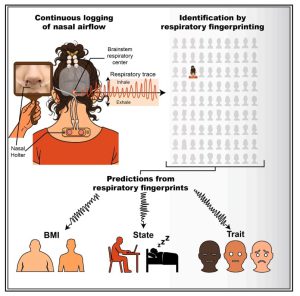
“I thought it would be difficult to identify anyone because everyone was doing something different – running, studying, resting,” Soroka marvels, noting that breathing doesn’t become chaotic just because someone is sweating. “But the breathing patterns were remarkably distinct.”
And indeed: The analysis tool BreathMetrics extracted 24 unique features from the daily nasal symphony – sniffing frequency, pause variability, and inhalation duration. The accuracy rate was 96.8%, even surpassing speech recognition under laboratory conditions.
The idea goes beyond unlocking your phone with a sneeze. The researchers envision a dual-use for this: part biometric scanner, part diagnostic tool. They found correlations between breathing, psychic state, BMI, and even circadian rhythm.
So if you’re feeling a little off track, your breathing profile may already know it. Sobel muses: “We intuitively assume that depression or anxiety alters breathing.”
But every biometric raises the question: What occurs to the data? A thumbprint is one aspect; this is about one’s internal physiological state, anxiety level, sleep quality – perhaps even subconscious.
The researchers assert that data protection and consent are important. But we know the ending of such films: Ask anyone who thought their smart speaker was turned off.
And then there’s your walk.
Gait detection, an AI process that identifies people by their gait, is already more advanced than heart or breathing detection. Whether you’re turning around, it’ll detect you from a distance, in motion, with your head down and your hood up.
The Chinese company Watrix – cheerful name, little restraint – claims that its platform achieves 94% accuracy based on CCTV footage.
It tracks limb movements, posture, and rhythm with machine-learned precision. Your footsteps become identifiers in video archives that are cross-linked in real time or retrospectively.
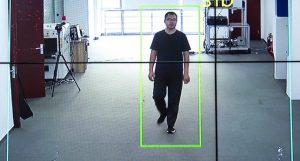
The United Kingdom is also conducting research: The Centre for Vision, Speech and Signal Processing has developed systems that recognize gait patterns from different angles and environments – no direct camera view required. Such devices are ending up in traffic hubs and major cities.
Surveillance agencies are already using gait recognition in airports and train stations – officially for passenger processing and suspect identification. Does someone escape the facial scan? No problem. The footage is filtered for movement patterns anyway, and people can be tracked across zones and compared with archived videos.

Airports in Asia are testing the system for passenger screening. Law enforcement officials are using it to filter out suspects from archived footage. Even when faces are turned away, the comparison remains.
People aren’t informed that they are being compared. Most aren’t even aware of the technology’s existence. Gait data is unprotected in most countries – and regulatory instruments are weak or non-existent.
yogaesoteric
July 28, 2025