
BBC Analysis: Putin and Kim joined Xi in show of strength as China unveiled new weapons at huge military parade
A united front at Beijing’s massive military parade as Xi, Putin and Kim met for first time
The watching world saw a significant display of diplomatic unity in Beijing on September 3rd, as China’s Xi Jinping, Russia’s Vladimir Putin, and North Korea’s Kim Jong Un met in public for the first time.
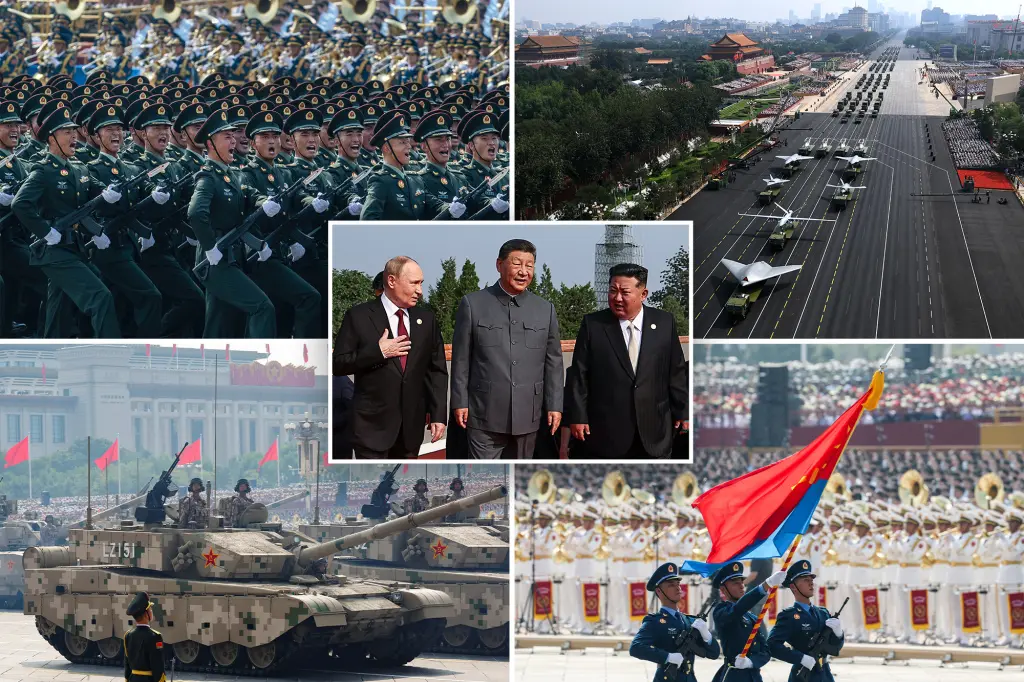
Alongside a vast military parade marking 80 years since the country’s victory over Japan in World War Two, the meeting formed part of a day of statements for Chinese President Xi Jinping.
Crowds of over 50,000 in Tiananmen Square witnessed laser weapons, nuclear ballistic missiles, and even robotic wolves – a display that is to be heavily scrutinised by Western defence officials.
All but two Western leaders chose not to attend the parade, while 26 heads of state joined. Xi inspected the waiting ranks of thousands of troops from the roof of his state vehicle, before warning the world needs to “never return to the law of the jungle, where the strong prey on the weak” in a speech.
After the parade, diplomacy continued with handshakes and hugs marking the end of Putin and Kim’s two-and-a-half hour meeting.
Putin invited Kim to Russia after the pair discussed North Korea’s contribution to Russia’s war effort in Ukraine.
China’s Xi Jinping said the country fears no-one
On a day when China was showing off its latest military hardware, the country’s leader seemed to have a message that peace is achieved through strength.
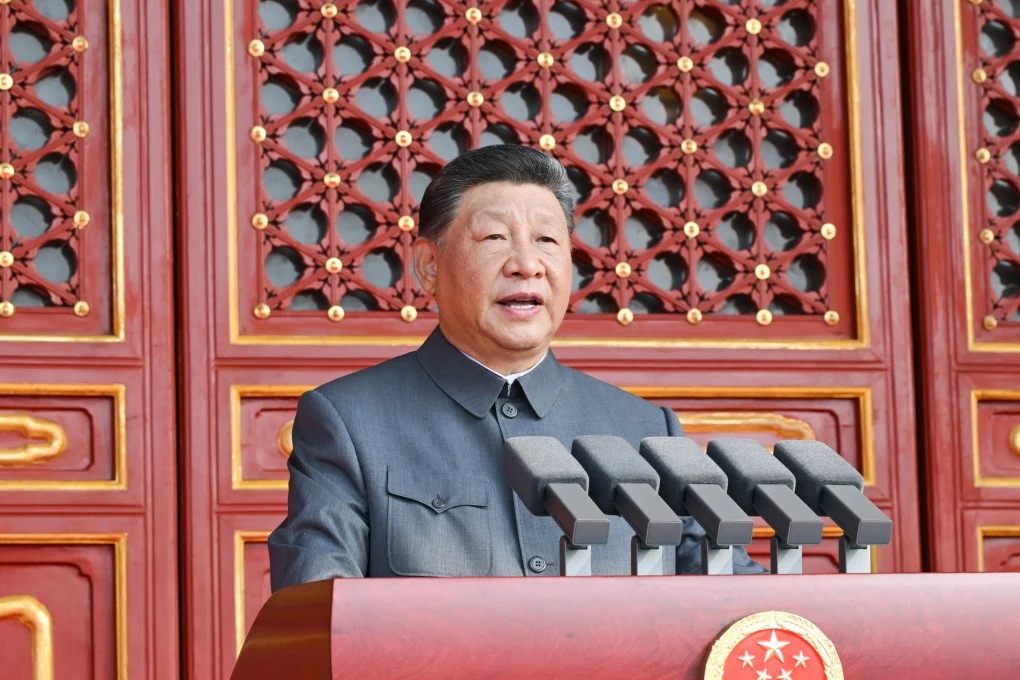
Standing on top of Tiananmen Gate – and without explaining what he meant – Xi Jinping said the world today faced “a stark choice between peace and war, dialogue and confrontation”.
He also said that his great nation now feared no-one.
Then a vast military parade to mark the end of the World War Two in Asia revealed China’s newest submarine drones, laser weapons and intercontinental ballistic missiles.
The presence of North Korea’s Kim Jong-un, Russia’s Vladimir Putin and other heads of government is being seen as a challenge to the West.
But some say Beijing is just trying to give a veneer of respectability for authoritarians.
U.S. President Donald Trump reacted with a tweet:
"The big question to be answered is whether or not President Xi of China will mention the massive amount of support and 'blood' that The United States of America gave to China in order to help it to secure its FREEDOM from a very unfriendly foreign invader…" – President Trump pic.twitter.com/YgSZs52A5N
— The White House (@WhiteHouse) September 3, 2025
Beijing’s military is impressive but untested in combat
China’s parade of 21st century weaponry has given Western defence analysts much to take away and think about.
Today’s People’s Liberation Army (PLA) and its equipment is unrecognisable compared to the outdated force of 20 years ago, which lagged far behind the West.
Beijing’s strength is not just in its numbers, backed by its huge economy, but by increasing innovation and self-reliance.
Its hypersonic glide and cruise missiles, for example – weapons that travel at above Mach 5 – are largely unmatched by anything the US or its allies have in their arsenal.
Its J20 ‘Mighty Dragon’ fighter jet employs 5th generation stealth technology while its navy is expanding at breakneck pace, due to China’s huge capacity for shipbuilding.
But aside from a few minor border skirmishes with India, China’s military has not fought a war since its ill-fated invasion of Vietnam in 1979, where it had to withdraw with significant losses.
A major question mark remains over whether the PLA, with its rigid hierarchy and doctrine, is capable of effectively coordinating all these formidable assets to fight an all-arms campaign: on land, at sea, in the air, space and cyberspace.
China’s new weapons on show at military parade
Beijing’s military parade wasn’t just a show of strength, but a giant sales pitch of Chinese arms to potential buyers, according to BBC analysts. Here are some examples of what was on display:
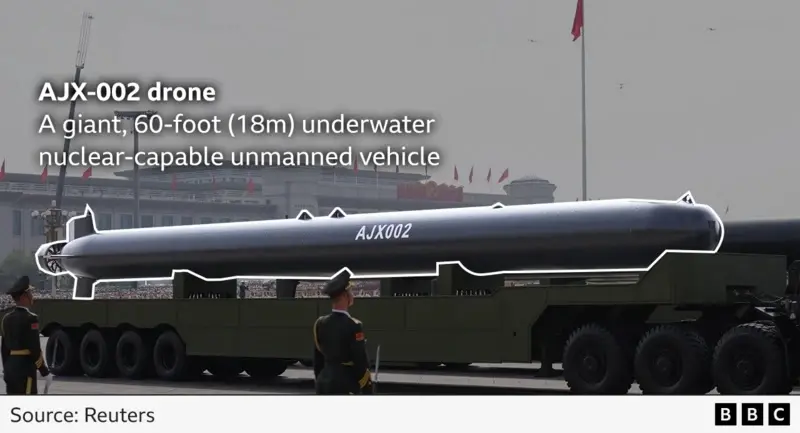
Giant underwater drones: AJX002 extra large uncrewed underwater vehicles were rolled out: they’re massive submarine-like drones can go up to 20m underwater.
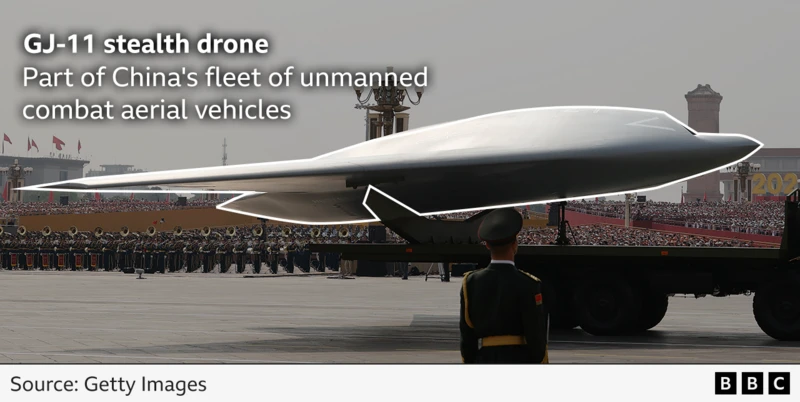
AI-powered drones: China also showed off AI-powered stealth attack drones capable of flying alongside a manned fighter jet.
Dongfeng-5 missiles: Intercontinental strategic nuclear missiles designed to be launched from China’s northern silo fields, which could be used to target continental US.
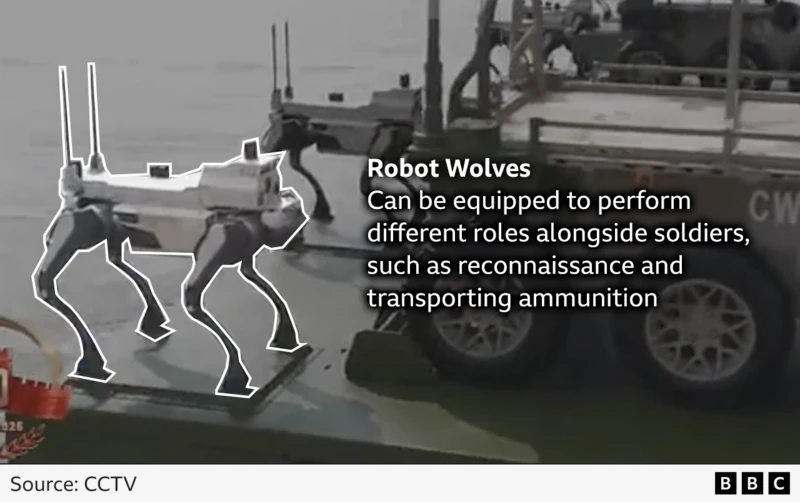
Robot wolves: A contingent of four-legged robots capable of frontline reconnaissance, delivering supplies and even launching precision strikes against targets, according to Chinese state media.
Laser weapons: The LY-1 laser weapon, mounted on top of an eight-wheeler HZ-155 armoured truck. It could disable or burn out electronics, said Pacific Forum defence analyst Alexander Neill.
China ‘going all the way’ with using AI and drones in warfare
BBC analysts say: “We saw a lot of drones – some of them AI-powered – at the parade in various forms. The one that grabbed eyeballs the most was the AJX-002 giant submarine drone that measures up to 20m in length.”
But China also showed off its stealth attack drones, dubbed the “loyal wingman”, as they are capable of flying alongside a manned fighter jet and aid it in its attacks.
The worldwide viewers also saw the “robotic wolves” which experts say could be used in a large range of tasks from reconnaissance and sweeping for mines, to hunting down enemy soldiers.
Their display shows a clear direction that China wants to take with its military strategy, where it “not only wants to augment, but replace traditional structures”. It has clearly taken lessons from the Ukraine war, where one can just “throw drones at the enemy” to wear down their defences, notes defence analyst Michael Raska.
“Alacrity in the kill chain matters,” adds military expert Alexander Neill, pointing out that in a fast-moving battle, decisions have to be made in “nanoseconds” in order to kill the enemy and gain the upper hand – which is what AI can do.
Many countries are still concerned about deploying AI in their military systems and asking “how comfortable are we in putting AI in the kill chain”, he adds.
But China is very comfortable with that, says Raska. “They believe they can control AI. They are going all the way to integrate it into their systems.”
Parade was a weapons sales pitch – and a chance to show the US a united front
With the leaders of more than two dozen countries invited to the event, the parade of weapons and tanks was essentially a giant sales pitch of Chinese arms to potential buyers, points out defence analyst Alexander Neill.
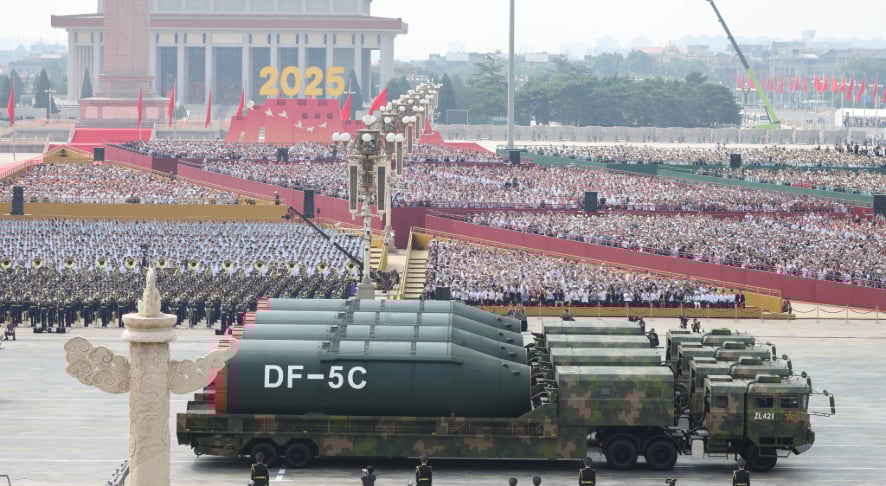
Some of the countries in attendance such as Myanmar are already known to be buying huge quantities of Chinese weapons. But the chance to sell to new customers or increase orders is a way of the Chinese government to extend its influence globally, notes military expert Michael Raska.
Among the key clients were those standing front and centre with Xi – Vladimir Putin and Kim Jong Un.
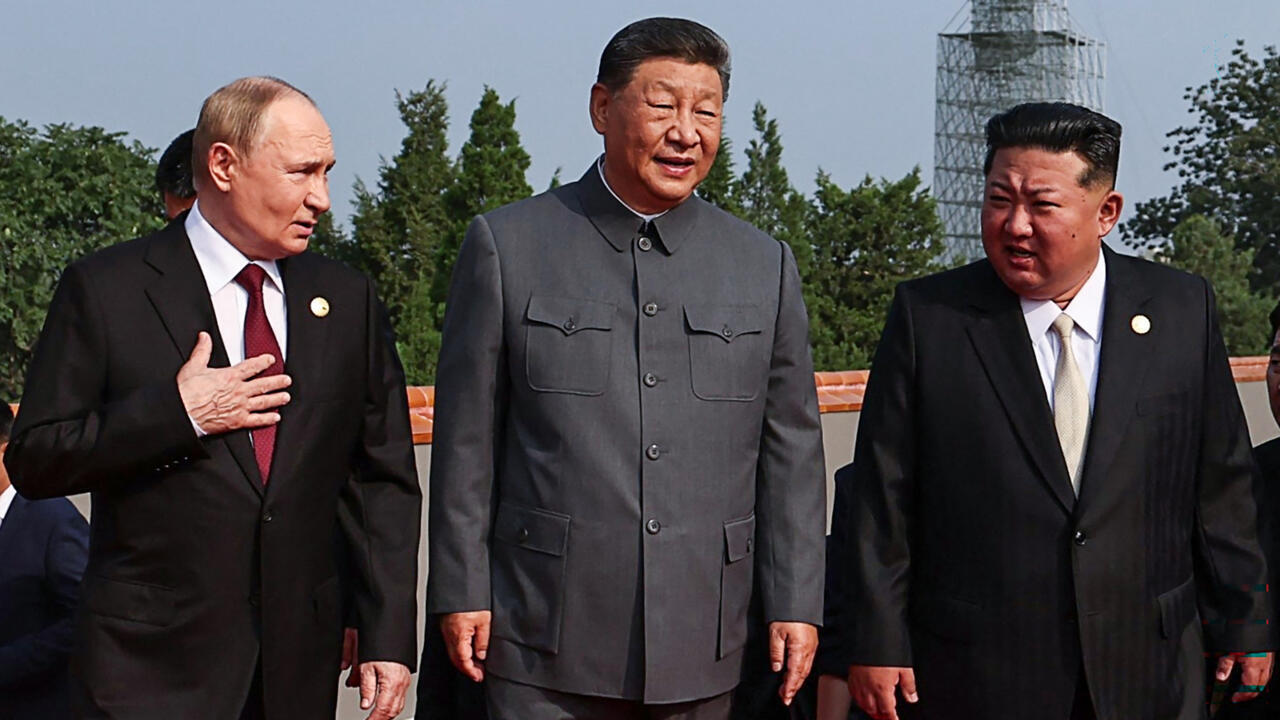
The three presented a united front as they walked to the parade together and mounted the stage.
It sent a message to the US, says Neill, that if America wanted to really challenge them it would mean “fighting them on several potential theatres at the same time – the Korean peninsula, Taiwan Straits, and Ukraine”.
“And if you consider it, putting pressure on the US on all three domains, it may fail in one of those theatres.”
China has the technology, but US has the operational edge
The parade clearly shows that China is fast catching up with the US in its military technology, and has the resources to build up a huge arsenal of weapons – but the US still maintains an edge in terms of operations, experts say.
In the US military there is a culture that gives more leeway for units on the ground to take decisions and innovate, “whereas China is top down”, explains Michael Raska, assistant professor in the military transformations programme at the Nanyang Technological University of Singapore.
“You can have flashy platforms and systems but they will not move a finger until they receive an order from the top.”
“The US military excels because there’s a bottom-up mission type of culture, where units can make decisions as the situation evolves,” he says, pointing out that this makes them more agile and innovative in any battle.
For the Chinese “at the operational level, there have been instances which show they may not be as good as they say they are”, continued Raska, pointing to recent encounters such as last month’s collision between two Chinese vessels as they confronted the Philippine coastguard.
America’s complex relationship with China
US President Donald Trump, who was not at the parade in Beijing, posted on Truth Social accusing Xi of conspiring against America with the others. The post was later deleted. The Russian officials reacted saying that Trump was probably talking “figuratively” and was not accusing anyone seriously.
Since returning to the White House, Trump has had a complex relationship with China marked by both competition and a grudging respect.
On one hand, Trump has repeatedly touted his relationship with President Xi, whom he has described as a “very smart leader” and “very good”.
On the other hand, the US administration has seen heated back-and-forth with China over a number of issues – namely trade, with Trump referring to it as the “chief ripper-offer” as he announced an extremely steep 145% tariff on Chinese goods.
But he’s been willing to negotiate, and in August, US and Chinese delegations again agreed to extend a truce on tariffs, and tit-for-tat retaliations in the past have made many of Trump’s moves against China short-lived.
But that adversarial relationship continues, and recently Trump threatened to slap China with 200% tariffs if Chinese exports of rare-earth minerals are dialled back.
On the geopolitical front, China has so far managed to dodge additional secondary sanctions over trade with Russia – a fate which has already befallen India.
Trump, some observers have pondered, may be attempting to avoid pushing China further.
How has North Korea aided the Russian war effort in Ukraine?
Putin invited Kim to Russia after a two-and-a-half hour meeting on the sidelines of the parade in Beijing, where the Russian president praised North Korean soldiers fighting alongside Russian forces in Ukraine. Kim said a new meeting would take place soon.
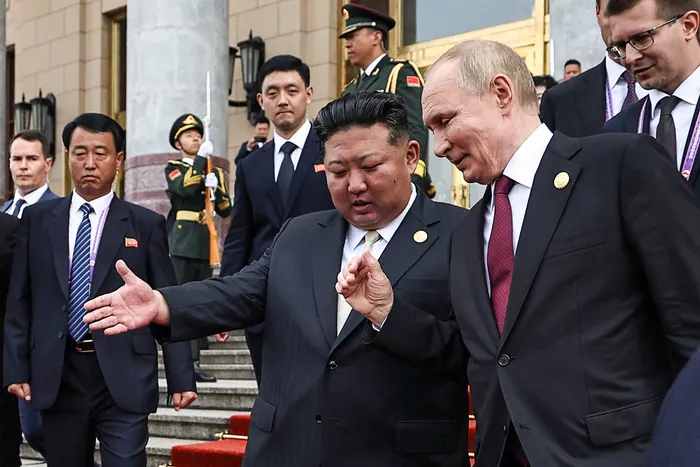
But how exactly has North Korea contributed?
According to South Korea, the North has sent some 15,000 troops to aid Russia in its Special Operation, along with missiles and long-range weapons. In return, it is believed North Korea received food, money and technical help.
These soldiers have been involved in Moscow’s efforts to recapture parts of western Kursk – where Ukrainians are defending a small area of territory captured during a surprise incursion in August – and are thought to have sustained heavy losses.
Western officials said in January that at least 1,000 had died in just three months. Two months later, Seoul lawmakers said they believed there were about 4,700 North Korean casualties, including 600 deaths, out of a total deployment of 15,000.
What Kim’s delegation tells us about North Korea
It appeared that Kim Jong Un did not bring any senior military officials to attend China’s military parade – a different arrangement from his visit to Russia in 2023.
The delegation list has not been disclosed, but no military or defence officials are visible from the photos of Kim’s arrival in Beijing released by North Korea’s state news agency.
Apart from his daughter Ju Ae and sister Yo Jong, Jo Yong Won, the party secretary for organisational affairs also stood out. Widely considered a close aide to Kim, he appeared to be the only UN-sanctioned member of the delegation.
Kim has become the first North Korean leader to attend a Chinese military parade in more than six decades, but it does not mean China would commit to any military partnership with North Korea.
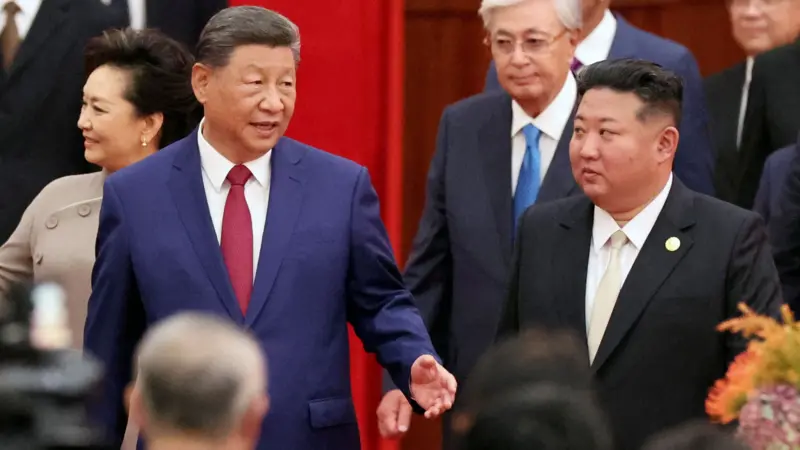
“Russia, being at war, openly cooperates militarily with North Korea. China, however, needs to avoid such arrangements. That’s why Beijing allows political and diplomatic alignment but steers clear of any military partnership,” says Prof Lim Eul-chul of Kyungnam University’s Far East Institute.
“China wants to show it is not part of a new Cold War’s military axis. Even if symbolic military figures were included in the delegation, they would have no counterparts to meet, so their presence would serve little purpose,” he adds.
Kim family dynasty shows no sign of ceding power, expert says
Speaking to the BBC’s Today programme, Professor Hazel Smith, a Korean studies expert at the School of Oriental and African Studies, suggests that daughter Kim Ju Ae’s presence shouldn’t be overstated.
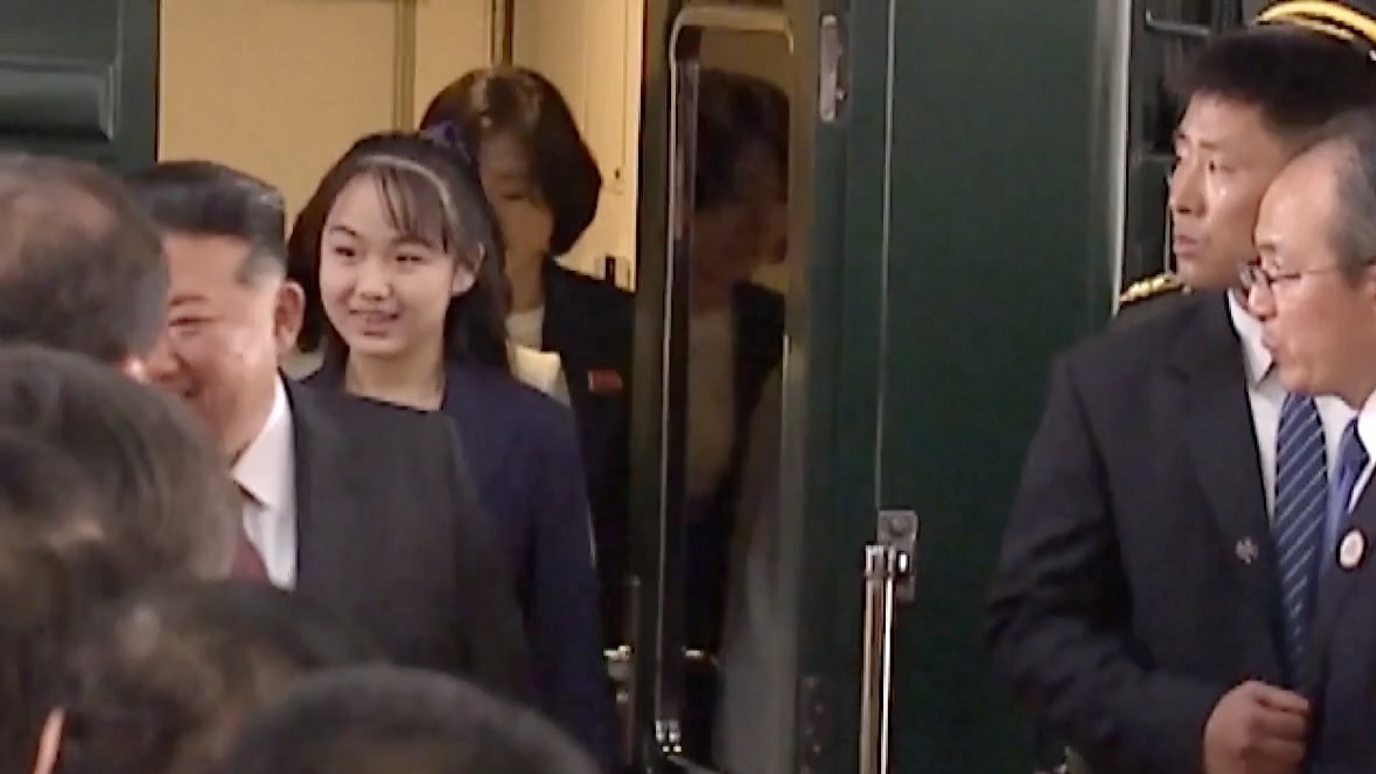
“It’s not a sign that this young person will definitely be the next leader of North Korea,” she says, adding that the country’s current leader also has a son who rarely joins him on public visits.
Instead, she says, “this indicates both at home and abroad, that this is a Kim family dynasty that isn’t intending to make way to any form of alternative type of government”.
North and South Korea switch roles
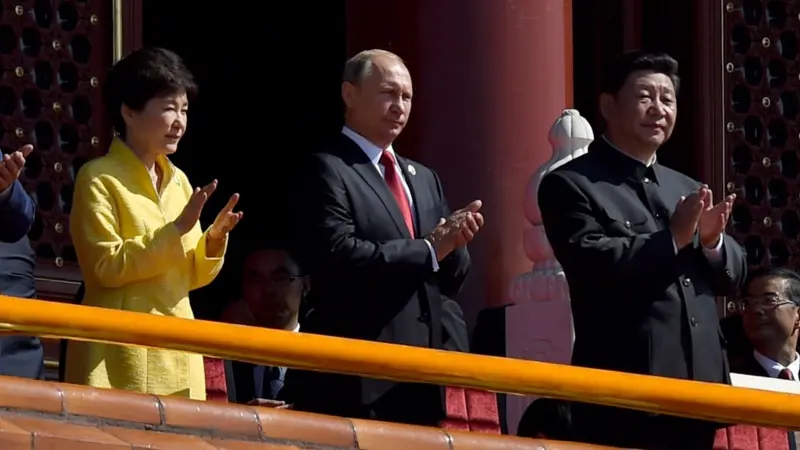
What a difference a decade makes. If you want a visual cue for how much the world has modified, look at a photo from the same parade in Beijing in 2015, to mark 70 years since the end of World War II.
There it was South Korea’s then President Park Geun-hye who stood shoulder to shoulder with President Xi and President Putin. Kim Jong Un was absent. North Korea sent a party official in his place.
But today Kim has stolen the show, and South Korea’s president is missing. President Lee Jae Myung did get an invitation, but he turned it down. Instead, Seoul has sent the speaker of its parliament.
South Korea still considers China an important partner, but more important is its relationship with the United States and Japan. The three countries have been working more closely together to combat the threats posed by China and North Korea – and President Lee, who was only elected in June, has been keen to prove to President Trump how much he values this partnership.
Today, Xi, Putin and Kim represent a counter-trio to Washington, Seoul, and Tokyo.
All but two Western leaders shy away from Xi’s parade
Most Western leaders have chosen not to attend China’s “Victory Day” parade.
The two who have gone, Slovakia’s Robert Fico and Aleksandar Vucic of Serbia, are no strangers to controversy but they have very different reasons for being there.
Both attended Russia’s Victory Day parade last May, and both have met Russia’s Vladimir Putin in Beijing, just as they did in Moscow.
But Vucic’s Serbia, although a candidate to join the EU, has cultivated close economic ties with China and he has sought to steer a neutral course with Russia, despite condemning its war in Ukraine.
Fico is in a very different position.
His country is a member of both the EU and Nato, and yet he has called for relations with Russia to be normalised.
While the EU wants a halt to Russian oil and gas imports by the end of 2027, Fico wants his Russian energy supply increased and Ukraine has sought to disrupt the pipeline providing it.
Putin may compliment the Slovak leader on his “independent foreign policy”, but Slovakia’s European allies don’t see it quite that way.
Asked whether Fico was representing the EU in Beijing, a European Commission spokeswoman gave a terse “No”, pointing out that China was a “key enabler” of Russia’s full-scale war in Ukraine.
His opponents at home accuse him of serving Russian propaganda and betraying his country.
Fico argued he was in Beijing “as a new world order is being formed” and said that after talks with Putin he has come to several conclusions and has a “serious message” for Zelensky.
Why was Modi not at China’s grand parade?
Indian Prime Minister Narendra Modi was not present at President Xi’s mega show, despite sharing the stage with China’s leader Xi Jinping and Russian President Vladimir Putin just two days before. Their warm exchanges went viral on virtual communication networks in what some saw as the start of a new world order that doesn’t rely on Washington.
So, it was natural for many to expect to see Modi once again sharing the stage with Xi and Putin. But the reality is far more complicated.
Trump’s 50% tariffs on India – which include a 25% penalty for Delhi’s refusal to stop buying oil from Russia – necessitated and even turbocharged ongoing peace talks between Beijing and Delhi. But the two Asian giants still have many underlying issues to resolve.
They still have high tariffs against each other in many sectors. India is also cautious about the $99bn trade deficit it is running with China.
More importantly, public sentiment against China worsened drastically in India after 2020 clashes between their troops in the Galwan valley. It’s too soon for India and China to start appreciating each other’s military might.
India is also nursing fresher wounds – Delhi has expressed concerns that the weaponry used by Pakistan in this summer’s clashes mostly came from Beijing.
After the stunning snub from “trusted friend” Trump, many Indians, led by commentary in the domestic media, are warming up to the idea of closer ties with Beijing.
However, attending a military parade in China would be as a self-goal for Modi.
‘A clear message to the US’: BBC correspondents conclude
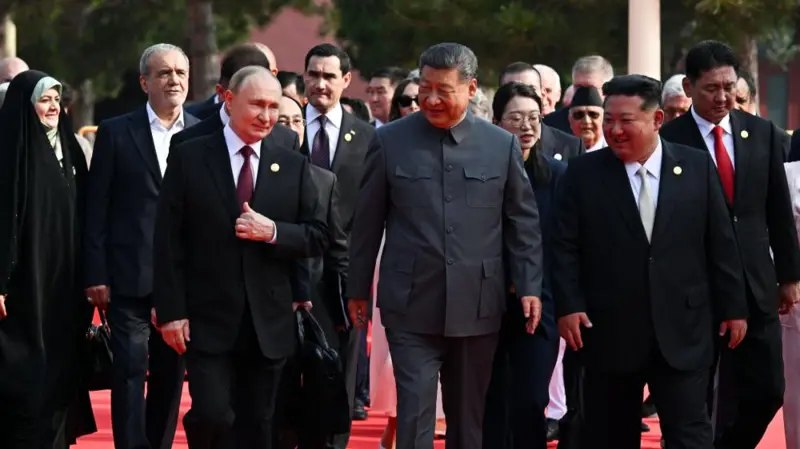 Donald Trump has not been invited to join the festivities in Beijing, and journalist Steve Rosenberg says this sends a clear message to the West by offering an alternative to the US-led world order.
This, BBC correspondent James Landale writes, will “send shivers down Western diplomatic spines” as China fills the vacuum left by America’s withdrawal from international norms.
Also of concern to military and security experts in the West will have been China’s display of weaponry – including missiles that travel at more than five times the speed of sound, analyst Frank Gardner writes.
There’s no doubt of the diversity of China’s arsenal, journalist Tessa Wong explains, but questions remain over how China’s military can integrate these weapons systems into its defences.
BBC correspondent Laura Bicker described witnessing a highly-choreographed spectacle of precision, power and patriotism.
Xi and Putin discussed organ transplants and living ‘indefinitely’
China’s President Xi Jinping and Russian President Vladimir Putin have been overheard talking about organ transplants potentially helping humans live to 150-years-old or even “indefinitely”.
The two leaders were being filmed walking with North Korean leader Kim Jong Un ahead of Beijing’s military parade.
The exchange took place in Mandarin and Russian, which was relayed to each leader by a translator who was with them.
The conversation has been translated into English by the BBC.
yogaesoteric
September 12, 2025