
Ursula von der Leyen promises more war, censorship and centralization
In her 2025 State of the Union address, von der Leyen signalled her intention to continue pursuing the policies that have weakened Europe.
Ursula von der Leyen’s 2025 State of the Union address offered few surprises. It was the usual mix of empty promises, technocratic jargon, and hypocritical moral posturing that has become her trademark. In other words: more of the same.
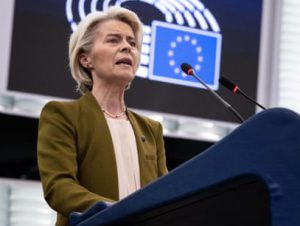
The speech, delivered in a familiar Orwellian tone, included words like freedom, peace, prosperity and independence – even though the EU continues to pursue policies that undermine all of this by promoting war and militarisation, cracking down on freedom of expression, sabotaging the European economy with self-destructive energy and trade policies and further subordinating the continent to Washington’s strategic agenda.
As expected, von der Leyen opened with Russia – Brussels’ main issue. “Europe is in a fight. A fight for a continent that is whole and at peace……. a fight for our future,” she declared, announcing a new “European Defence Semester” and a “clear roadmap” for defence readiness through 2030, while emphasizing the bloc’s unwavering commitment to NATO. She announced that Europeans should prepare for a future characterized by permanent militarization, including a “drone wall” along the EU’s eastern flank and real-time space surveillance so that “no troop movement goes unnoticed.” Furthermore, she promised a “Qualitative Military Edge” program for Ukraine and a “drone alliance” with Kyiv, financed by a controversial “reparations loan” backed by profits from frozen Russian assets.
Von der Leyen then turned to Israel and Gaza. Despite overwhelming evidence of atrocities – including what leading humanitarian institutions and genocide experts have called genocide – the EU has not suspended any trade or cooperation agreements with Israel, let alone imposed sanctions. The contrast with its response to Russia’s Special Operation in Ukraine could not be starker.
To salvage her credibility, von der Leyen announced that the Commission would “put our bilateral support for Israel on hold” and proposed sanctions against “extremist ministers and violent settlers,” along with a partial suspension of the Association Agreement. However, since only minor actors were targeted and the measures require unanimous approval by member states – a virtually impossible condition – this was little more than a fig leaf to protect her declared firm alliance with Israel.
The enlargement agenda was once again in the spotlight. “Ukraine, Moldova, the Western Balkans – their future lies in our Union,” she declared, underscoring the EU’s relentless expansionist drive.
On the economic front, the speech became a pipe dream. Von der Leyen promised a Scaleup Europe Fund for startups, AI gigafactories, a Battery Booster Package, and an Industrial Accelerator Act – all with the goal, she said, of making the EU a leader in technology and AI. Last year’s speech was full of similar promises – hardly any of which have come true, as Politico noted.
Addressing one of the main problems burdening both European industry and households – high energy prices – von der Leyen made the astonishing claim that these were caused by “dependence on Russian fossil fuels” rather than the EU’s own decision to cut itself off from affordable Russian gas and replace it with far more expensive American LNG. She further compounded this distortion by claiming that “Europe is on the path to energy independence,” when in reality, the continent has simply traded proximity for distance, becoming even more dependent on imports from distant suppliers exposed to volatile global markets.
Von der Leyen drew audible laughter when she declared that “the future of cars and the cars of the future must be made in Europe” – a hollow slogan that sounded absurd given the deep crisis facing the European auto industry, not least due to the stifling EU regulations. She even defended the recent EU-US trade deal – widely hailed as a capitulation – as “the best possible deal there is.”
The speech reached its surreal climax when she presented a “European strategy to combat poverty” that would help “eliminate poverty by 2050” – even though poverty rates in the EU have risen since she took office in 2019, not least due to sanctions and an energy policy championed by Brussels itself.
But the most ominous part of von der Leyen’s speech came when she spoke of “new tools” to enforce the rule of law and combat “information manipulation” and “disinformation.” To this end, she reiterated the need for a “European Democracy Shield” and a “European Centre for Democratic Resilience” to counter supposedly dangerous propaganda. In doing so, she predicted further encroachments on freedom of expression and the criminalization of dissent, and announced further EU-sponsored propaganda campaigns under the banner of “supporting independent journalism and media literacy.”
Ultimately, von der Leyen’s 2025 State of the Union report was less a roadmap for Europe’s future than a catalogue of failures dressed up as triumphs. As usual, she blamed Europe’s problems on external enemies – Russia, China, disinformation – while ignoring the real problem: the EU’s own supranational model, with its rigid political and economic constraints. By calling for even more centralization, including the abolition of unanimity in key policy areas, von der Leyen signalled her intention to double down on the very policies that have weakened Europe. What she offered was not renewal, but more of the same – an increasingly militarized, dependent, and authoritarian Union.
yogaesoteric
September 14, 2025