
The Dark Side of Organ Transplants
The truth about organ transplants is worse than anyone imagined. Millions sign up as organ donors, never imagining the system could betray them. But federal investigators found nearly 30% of donors showed signs of life, as surgeons prepared to harvest their organs.
 Nurses say some organ donors are sedated or even paralyzed just so the organ harvesting procedures can continue. Even more disturbing, the definition of “death” was re-engineered decades ago to make this nightmare possible.
This is what no one tells you about being an organ donor – and what really occurs when someone receives an organ. This information comes from the work of medical researcher A Midwestern Doctor.
We are told that organ transplants save lives – but the system is absolutely riddled with corruption, misdiagnosed “brain death,” and multiple cases of patients showing signs of life as their organs were about to be harvested.
This is nothing short of disturbing.
The organ trade (yes, it is actually a business) is worth billions, and a single transplant can cost nearly $2 million. Whenever we’re dealing with that kind of money, exploitation always follows.
Investigations estimate 5–20% of kidney transplants worldwide come from black markets – often at the expense of the poor or the imprisoned.
One of the most disturbing revelations: the definition of death was deliberately re-engineered to make organ harvesting easier.
In 1968, Harvard created the term “brain death.” Not because science proved it was a real situation, but because it allowed doctors to legally harvest viable organs from people whose hearts were still beating. A beating heart is necessary for keeping organs alive and healthy for transplantation.
Since then, countless patients who were diagnosed as brain dead have later revived. This has even occurred moments before their organs were to be removed for transplantation.
This isn’t just a conspiracy or a once in a million occurrence. This is occurring to real people, some of whom have survived to tell their story.
Colleen Burns woke up on the operating table.
Jahi McMath was written off as dead but showed brainwaves and purposeful movement months later.
One of the most amazing cases of something called “locked-in syndrome” occurred to a 12-year-old boy named Martin.
Locked-in syndrome is when someone is still conscious but has lost all control of their body and all ability to communicate. Hence the term “locked-in” – they’re literally trapped inside their own body.
Martin was left in a vegetative state after a bout with meningitis. He was eventually sent home where his parents waited for him to die. But he didn’t.
Four years later, Martin began to regain consciousness. By the age of 19 he was aware of everything around him, and at 26, a caregiver discovered signs that he was indeed aware.
Eventually, Martin recovered enough to get married and live a normal life.
Despite the fact that brain death is not straightforward and significant variations are not as rare as they would like to admit, the New York Times recently argued that the definition of death should be broadened even more to meet the increasing organ demand.
They want to redefine what life means until the organ supply matches the system’s needs.
Investigations into the U.S. organ procurement system (OPTN) have confirmed the worst: widespread corruption and dysfunction.
U.S. Congress found 80% of eligible harvested organs are never even collected or transplanted to other people, whistleblowers are retaliated against, and families are misled and gaslit in moments of crisis.
A federal review revealed an absolutely chilling statistic. Nearly 30% of people showed signs of consciousness during the organ harvesting process. Patients were crying, moving, and even mouthing “Help me.” Some brave surgeons have refused to operate while coordinators pressured them to continue the harvesting process despite obvious signs of life.
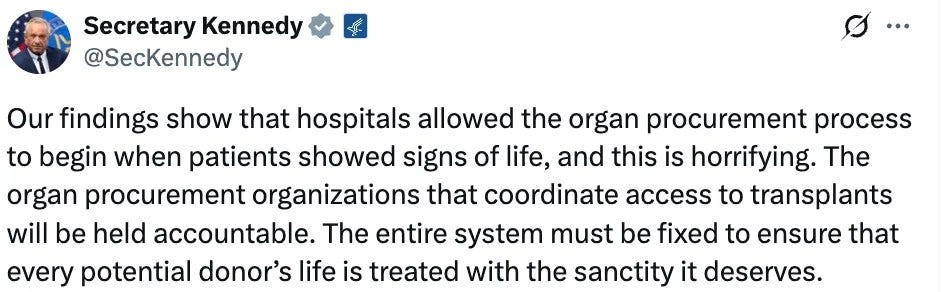
Nurses have testified that patients were sedated, and sometimes even purposefully paralyzed, to push forward organ harvesting procedures. One ICU nurse said: “All they care about is getting organs. They’re so aggressive. It’s sickening.”
This isn’t medical care – it’s straight out of a horror movie.
Even when transplants succeed, outcomes are often grim. Organ transplant isn’t easy.
Within 10 years, nearly half of kidney and heart grafts fail. In an effort to achieve success, patients are forced to take toxic immune-suppressing drugs for life, costing $10,000 – $30,000 a year. Unsurprisingly, these drugs can come with severe side effects.
If this didn’t sound horrific enough, the covid era added new layers of cruelty.
Around the world, unvaccinated patients were denied transplants. Some complied – only to suffer organ rejection soon after the shot. Others were told by their doctors that they were not eligible for the vaccine, due to their frailty – but that didn’t matter.
And guess what? Reports now link mRNA vaccines to graft failures in kidneys, livers, corneas, and hearts.
An often unacknowledged feature of organ transplants is that they often transfer memories, emotions, even personality traits from donor to recipient. Cases document recipients developing new cravings, habits, or even dreams reflecting their donor’s final moments.
Science can’t explain it. But it occurs.
Dr. Paul Pearsall’s research in this phenomenon, The Heart’s Code, details dozens of these cases.
One woman craved beer and chicken nuggets – her donor’s favourites, even though before the transplant she never liked those. A child dreamed vividly of her donor’s murder and later helped police identify the killer.
Sounds shocking, doesn’t it? What is going on in the final moments before organs are removed is significant and needs to be considered.
Chinese medicine has long linked organs with emotions. Modern transplants appear to validate these beliefs, with recipients suddenly overwhelmed by new emotional states they had never experienced before.
But is this being considered in the process?
The psychological burden of transplant recipients is immense.
Many recipients describe feeling like a stranger suddenly lives inside them. Some resist the new organ because of the way this makes them feel.
Studies suggest even one’s attitude toward the organ can affect whether or not the transplant succeeds.
It seems that “trapped emotions” may transfer with organs. That means traumas embedded deep within the donor may end up with the recipient.
Therapies to release these emotions have reportedly improved organ acceptance and even function.
Ignoring them only compounds suffering and increases the chance of rejection.
So what’s the solution?
Medicine presents a false and dangerous choice. They currently want to relax the definitions of death – to make it even easier to harvest organs and increase supply – or allow black markets to flourish. Both are unacceptable.
There are alternatives to harvesting organs. These include therapies that restore failing organs before transplant is needed.
One such therapy is DMSO.
Decades ago, IV DMSO was shown to reverse brain injuries that often lead to “brain death.”
If adopted, using DMSO could save patients who are now written off as hopeless. This could even reduce the demand for organs altogether.
At its core, this is much bigger than medicine.
Organ transplantation forces us to confront questions about consciousness, death, and the very nature of memory.
Where do our emotions really live? Where is our identity stored? And what occurs when those organs are transplanted into another body?
If we’re going to remove organs from one human and put them into another, we need to answer these questions first. It is irresponsible not to.
Organ transplantation is sold as “lifesaving.” Yes, the practice has saved countless lives. But behind the curtain lies corruption, redefined death, live harvesting, and spiritual questions that modern science refuses to face.
The truth is disturbing. And it can’t be ignored.
yogaesoteric
September 30, 2025