
Europe stumbles into war – two former secret service employees warn
The video presented in this article is an interview by Larry Johnson with Alastair Crooke on the program Countercurrence, recorded on September 28, 2025. Alastair Crooke is a former British diplomat and intelligence officer who has earned a reputation for his in-depth analysis of geopolitical issues. As the founder of the Conflicts Forum, he offers insightful insights into political and military developments, particularly in West Asia, including Gaza and Iran, and Ukraine. His expertise extends to the historical roots of current conflicts and the complex dynamics of global power shifts. In this conversation, Crooke sheds light on the escalating war rhetoric in Europe, the geopolitical tensions, and the deep-rooted historical resentments that shape today’s politics.
Europe’s war rhetoric and the danger of false flag operations
A central theme of the interview is the growing war rhetoric in Europe, which Crooke describes as worrying. European politicians, particularly in the Baltic states and Germany, are increasingly talking about the inevitability of war. This rhetoric is no longer abstract but is presented as a given, without questioning Europe’s actual military capabilities. Crooke emphasizes that Europe has neither sufficient troops nor fully stocked weapons arsenals. Even the US is unwilling to supply Europe with weapons because its own stocks are limited. Nevertheless, European elites appear to be driven by a “psychological dynamic” that leads them to provoke conflicts with Russia.
A particularly alarming point is the proliferation of incidents that Crooke classifies as false flag operations. He cites, for example, drones assembled from Russian drone parts and deployed in Poland or Denmark to create the impression that Russia was the aggressor. Such actions are aimed at putting pressure on the US, particularly President Donald Trump, to increase support for Ukraine and impose tougher sanctions against Russia. Crooke warns that these provocations are dangerous because they could trigger unforeseen escalations, such as an incident involving a Russian ship or aircraft.
Russian strength and Western self-deception
Another central theme is the Western misperception of Russian strength. Crooke criticizes the Western narrative that portrays Russia as weak and incompetent. This view, which he calls the “end of the Cold War syndrome,” is rooted in the misinterpretation of the collapse of the Soviet Union as a Western victory. Instead of understanding the internal dynamics of the Soviet collapse, Western elites have developed an exaggerated self-image that sees them as economically, militarily, and culturally superior. This self-deception leads to Russia being dismissed as a “gas station in the middle of nowhere,” despite its immense resources and strategic depth.
According to Crooke, the Russian leadership, on the other hand, demonstrates a sober assessment of Western weaknesses. Russia considers the European elites incompetent and despises their strategic shortsightedness. Nevertheless, Russia remains cautious, recognizing Europe’s military and economic weakness. However, Crooke warns that minor incidents could escalate quickly, as European provocations could provoke unpredictable reactions.
Roots of Russophobia: Historical Resentments
Crooke analyses the deep-rooted historical causes of Western, particularly British, Russophobia. This Russophobia dates back to imperial times, when Great Britain sought to prevent an alliance between Germany and Russia in order to secure its own maritime supremacy. The geopolitics of Halford Mackinder, who viewed control of the “Heartland” (the Eurasian landmass) as the key to global dominance, continues to shape Western thought. The fear that Russia could control the Heartland led to a persistent geopolitical strategy against Russia.
In addition, historical resentments play a role, such as disappointment over the failure of the Bolshevik Revolution, which was supported by Western intellectuals, as well as personal feuds dating back to the times of the tsars and the British monarchy. These resentments were exacerbated by the postwar period, particularly by the integration of Western Ukrainian elements into Western intelligence structures such as the Gladio organization, which promoted anti-Russian operations.
Europe’s internal tensions: elites versus the people
Another focus of the discussion is the growing gap between European elites and the population. Crooke describes a deep contempt among the elites for “ordinary” Europeans, whom they view as uneducated and incompetent. These elites, especially in Brussels, are unelected and therefore untouchable, which increases citizens’ frustration. Protests, such as those in France or Serbia, are being suppressed with increasing brutality, including the use of water cannons, chemical weapons, and noise machines. Crooke sees this as a deliberate strategy to suppress any form of dissent and destroy political bridges to alternative solutions.

The economic situation is exacerbating these tensions. Crooke cites a massive outflow of capital from Europe to the US as wealthy Europeans seek safe havens. This reflects fears of an impending economic crisis, exacerbated by Europe’s high levels of debt and deindustrialization. According to Crooke, the elites are preparing for internal conflicts by taking administrative measures aimed more at suppressing protests than at war with Russia.
The rise of the BRICS and Western fear
A significant aspect of the interview is the discussion of the rise of the BRICS countries and the associated fears in the West. Crooke emphasizes that Western elites are increasingly recognizing the importance of the new economic order led by China and Russia. In particular, the development of an alternative financial system, such as the Chinese Mbridge platform and the linking of currencies to gold, threatens the dominance of the US dollar. Crooke points to a 15% decline in SWIFT transactions in 2025, while the Chinese payment system CIPS is gaining importance.
The Western reaction to this is ambivalent: Publicly, the BRICS development is downplayed, but internally, concern is growing. Crooke emphasizes that China is deliberately pursuing a “quiet” strategy to gradually replace the Western financial system rather than abruptly destabilize it. This development is being accelerated by Western sanctions against Russia and China, which have forced the BRICS countries to build alternative trade and financial systems.
Oil and geopolitics: Trump’s dominance strategy
Crooke also comments on the theory that the US is trying to secure geopolitical dominance through control of oil resources. However, he casts doubt on the notion that Trump is deliberately trying to manipulate oil prices through sanctions against Russia, China, and Venezuela. Instead, he sees Trump’s strategy as part of a larger goal to secure US “energy dominance” in order to exert geopolitical pressure and maintain the hegemony of the dollar. The attack on Iran, Crooke argues, could be aimed at denying China access to cheap Middle Eastern oil, which would weaken both China and Russia.
At the same time, Crooke points out that the US fracking industry is no longer playing the same role as it once did due to its rapid depletion. Even higher oil prices could not save the industry, as major oil companies are reluctant to invest in a declining industry. Instead, Crooke sees the focus on controlling the Middle East’s cheap oil reserves, which, with low extraction costs of around $9 per barrel, are strategically important.
Gaza and Israel: A New Era of Zionism
The conversation also turns to the situation in Gaza and Israel, where Crooke observes a radical shift in Israeli policy. He describes the development toward “extreme Zionism,” characterized by a policy of domination and oppression. The attack in Doha, in which Israel acted without apology and even threatened to carry out similar actions in Turkey, is a clear signal to the region: Israel ignores borders and relies on intimidation. This policy, which Crooke describes as a “the boss has gone mad” strategy, aims to spread fear and crush any resistance.
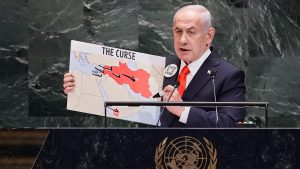
This development also has internal repercussions in Israel. Society is deeply divided, and even the families of hostages in Gaza are now being brutally treated. Crooke sees this as a departure from ethical principles toward a policy that openly legitimizes violence and hatred. This “brutalizing policy” is deepening societal wounds and leading to a polarization that could destabilize Israel.
A new age: The end of an era
Crooke and Johnson conclude the conversation by stating that the world is at a turning point. Western attempts to weaken Russia through the Ukraine conflict have revealed the West’s military weakness. The rise of the BRICS and the development of an alternative financial system mark the end of Western dominance. At the same time, the attack in Doha has shaken the Gulf states’ trust in the United States, further modifying the geopolitical landscape.
Crooke emphasizes that these modifications herald the beginning of a new era, which historians might consider the “fourth turning,” or the end of a historical cycle. Western elites face the challenge of maintaining their power in a transforming world while the population increasingly rebels against their policies. The risk of a major conflict, whether with Russia or in the Middle East, remains high, as Western elites underestimate their own weakness and opt for confrontation.
Conclusion
Alastair Crooke’s analysis offers deep insight into the complex geopolitical dynamics shaping the conflicts in Gaza, Iran, and Ukraine. His warnings about Europe’s war rhetoric, false flag operations, and deep-rooted Russophobia underscore the urgency of challenging Western policies. At the same time, he highlights the significance of the rise of the BRICS and the weaknesses of the Western system.
yogaesoteric
October 11, 2025