
How Western media use drone incidents to cement enemy images and justify measures
Drone alarm in focus: Media as amplifiers in a geopolitical staging?
In communication studies, this is called “securitization” (Copenhagen School): An issue is framed in such a way that it is perceived as an existential threat. This allows governments to legitimize extraordinary measures (e.g., new defence systems, increased military spending, restrictions on freedoms). Drones are ideally suited as a “hybrid threat”: They are small, difficult to identify, potentially usable by states or “terrorists,” have a media impact, and are prominent in conflicts (Ukraine, Syria).
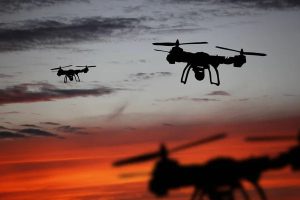
In recent months, reports of drone overflights, alleged spy flights, and airport closures have been making waves in the media. In Germany and Switzerland, the topic is being rehashed almost daily, as if a flood of drones were sweeping across Europe. At the same time, there are growing voices suspecting strategic intentions behind this media stunt – for example, an attempt to demonize Russia as a threat or to mobilize security fears.
But we should not forget: drone sightings and incidents have occurred before – long before they became a media ‘hype.’
Historical roots: Drones even before the current hype
Germany: Drone technology & incidents
- The German Armed Forces (Bundeswehr) have been using military drones for reconnaissance for many years. The LUNA reconnaissance drone program, for example, has existed since around 2000.
- Civilian drone technology was already on the rise in the 2010s, particularly in model aircraft, media use, photography, surveillance, etc.
- Recently, the media have reported many sightings over chemical plants, military sites and near airports – for example, over Ludwigshafen (BASF) or over Ramstein.
These examples prove that drone overflights are not a new phenomenon. Their use and sightings have been documented for some time.
Switzerland: Military, Legislation & Civil Use
- Switzerland has a drone squadron 7, which has existed since the 1990s (originally with ADS 95, later upgraded to ADS 15) – an institutionalized military drone structure.
- Several incidents involving drones in urban areas or at events have already been documented in Switzerland, for example, in Zurich, where legal regulations were tightened to restrict overflights over crowds.
- An official document acknowledges that frequent drone incidents in everyday life are due to negligence – not necessarily malicious actions.
These historical and institutional anchors demonstrate that Switzerland is not new to drones. The phenomenon is already firmly established.
The media narrative: sighting becomes alarm, drone becomes threat
Observation: More reports, sharper framing
The media today produces much more intense narratives:
- Drone sightings are often directly linked to official events or closures – “airport closed,” “operations suspended,” “secret drone alert.” This occurred, for example, in Munich, where flight operations were halted due to drone reports.
- In Germany, speculation that Russia may be behind some of the drones is openly reported. Such hints are often made in subordinate clauses or insinuations, but they have the effect of suggestion.
- The focus is often on military installations, critical infrastructures or airports – places with high symbolic significance.
- Media reports usually emphasize the urgency, call for faster legislative action, stronger action against drones, and suggest a failure of the authorities.
Why this narrative?
- Raising awareness: Technology has evolved rapidly. Drones are no longer marginal toys, but powerful devices with range, sensors, and autonomy.
- Combination with geopolitical narratives: In times of NATO-Russia confrontations, drone technology can be easily embedded as a tool of hybrid warfare.
- Interests of the security industry: Every perceived risk creates a market for defence systems, radar, detection, AI solutions, etc.
- Mass mediation & attention: Security and alarm scenarios attract audiences. “Fear sells” is an old media theory insight.
- Political legitimacy: The demand for new powers for defence, drone defence, shooting rights, etc. can be more easily enforced through media threat rhetoric.

The framing network: Between security, fear and blame
Framing mechanisms we observe
- Causality reduction: One drone flight → immediate drone threat → “Russia behind it” (without reliable evidence)
- Symbolic places: airports, military bases, nuclear or energy facilities are systematically highlighted
- Shifting responsibility: Authorities do not act as defenders, but as victims who react too late
- Narrative amplification: Repeated reporting multiplies perception – one incident becomes a series
- Vague speculation: Terms such as “possibly”, “suspected”, “not excluded” act as a rhetorical bridge to blame
Hypothesis: Why Russia?
- In the current security situation, Russia is often portrayed in Western narratives as an aggressor or disruptive factor – this is part of the political framework
- Drones as a symbol of modern warfare fit well into narratives of hybrid warfare in which Russia is seen as an aggressive actor
- Media, think tanks and security institutions in the transatlantic environment have an interest in making strategic threats visible
Risks & dangers of this media dynamic
- Overreaction & panic: Society and politics react with fear, surveillance and restrictions
- Misallocation of resources: Instead of addressing real problems, one can overreact and put resources into questionable defence projects
- Legitimation of authoritarian measures: Emergency rhetoric can be used to push through restrictions on freedom and special rights
- Polarization & enemy image creation: Russia continues to be demonized in the media, enemy image creation exacerbates lines of conflict
Conclusion & demands
- Critical reading instead of shock headlines: Every drone is not a war. Media consumers should critically examine: When is speculation, when is evidence?
- Publication of primary data & transparency: Authorities should publish complete, comprehensible incident data.
- Independent media analysis: Media studies should analyse framing, source origins, and the political environment to uncover manipulation.
- Binding standards for drone defence & clear rules: Instead of hectic laws, we need well-thought-out legal frameworks that avoid excess and ensure accountability.
- Vigilance against geopolitical staging: Propaganda is always possible in security matters. The media, institutions, and civil society need to counter this.
yogaesoteric
October 13, 2025