
How does colonialism work? It still exists and functions today
If you want to understand how the world works, you have to understand how colonialism works. Because colonialism exists and still functions today. Remember: colonialism is always closely linked to financial institutions. Very powerful financial institutions. Powerful because they have been secretly conducting their business for hundreds of years. Powerful also because they completely control politicians.
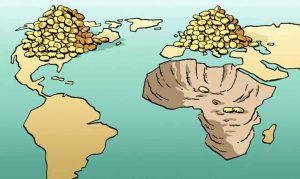
The golden rule of all power structures in our time is that a concrete element should be changed into an abstraction. The abstraction then takes on a life of its own: from goods to money, from a problem to an ideology, from balanced human beings to fanatics, from justice to laws.
The money supply on Earth (money and monetary derivatives), for example, an abstract concept, is much larger than the supply of goods. It could be that you need no more than 10% of the money supply to buy the entire world, and everything in it.
It could also be 20% or 30%. We don’t know. You won’t be able to find out the total amount of money in the world right now. You also won’t be able to find out who the richest people in the world are. You won’t even be able to find out who owns New Zealand. They’ll have their reasons for keeping all of that secret.
The Maori, the indigenous people of New Zealand, supposedly own no more than 6% of the land today, which they once owned entirely. Not even 28% of Maori own their own homes. Were they robbed and cheated? My God, be careful, neither you nor I can say that. Because everything occurred perfectly legally, of course. After all, there were and are laws.
They simply changed a concrete element into an abstract one. And then what? And then they fooled the Maori. Yes, totally fooled. But legally fooled, of course.
Wellington, New Zealand, 1880
In 1840, the Māori and the British agreed to a peaceful coexistence in the Treaty of Waitangi. Since then, they have been arguing about the treaty’s actual content and who truly owns the land.
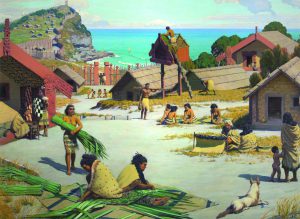
Naturally, the British also established their famous democratic structures in New Zealand. As recently as 1880, four Māori were even allowed to represent their people in parliament. At that time, Māori made up about 90% of New Zealand’s population. The British had 84 members of parliament. That’s how democracy works.
You probably don’t know which country in the world first introduced a dog tax. It occurred in New Zealand. In 1880. Why?
Well, the Maori had many dogs. Dogs were used for hunting, but they were also an important part of the Maori household. There was a deep spiritual connection between the Maori and dogs.
Maori MP Ihaka Te Tai Hakuena explained all this in parliament when he spoke out against the introduction of a dog tax. Maori people value dogs as much as they value people, he said. When he then mentioned that one of his ancestors was even a dog, loud laughter erupted in parliament.
The dog tax is a good example to illustrate how, by 1880, it had become all too obvious that two cultures with completely different worldviews had clashed. The British were unwilling to engage with or even respect Maori culture. However, they knew how to use Maori culture against the Maori themselves: to change an important, concrete issue into an abstract one.
Ultimately, despite the resistance, the law introducing a dog tax was passed. The Maori now had to register their dogs and pay the corresponding fee. They needed money. Where would they get it from? The Maori, of course, had no money.
How to legalize theft
In the Maori world, you cannot own land. For them, that’s a completely absurd idea. The land doesn’t belong to the people. The people belong to the land. I repeat: The people belong to the land. I, too, know perfectly well which country I belong to and which country I don’t. And of course, you know exactly which country you belong to. But if you were to say that out loud in Europe today, you might get into trouble.
Well, according to European understanding, the land belonged to the Maori. The British wanted the land. They wanted to buy it. They couldn’t. But they did it anyway. They offered the Maori goods they wanted and could only buy from the British. For money they didn’t have. So, as was inevitable, weapons, alcohol, tobacco, and many other products were imported. The temptation was great. The trade was irresistible, because if the neighbouring tribe had guns and we didn’t, then we were in serious trouble. The Maori began selling their land for money. They learned quickly.
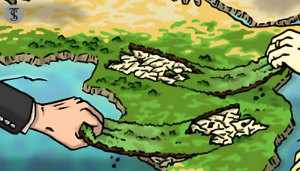
The government soon secured the exclusive right to acquire land from the Maori. It needs to be said: to buy it cheaply in order to sell it for ten times the price. This is how they financed the costs of the administration and the army. And this is how they financed the repayment of their enormous debts.
Unfortunately, it wasn’t people who had the right to dispose of the land, but the tribe as a whole. The British stipulated that no more than ten people could be accepted as owners. After this painstakingly settled matter, the land naturally had to be surveyed. By the British. This cost money. The Maori had to pay for the survey. With money they didn’t have. This is called credit. Debt. The Maori debt grew and grew and grew. The British did everything they could to make this debt increase even further.
In the many land disputes, the Maori had no choice but to go to court. The law is the law. They had to hire a lawyer and an interpreter, whom they had to pay for themselves, as well as the court costs. These proceedings often dragged on for months, deliberately. To put it simply: the British made a genuine effort, through legal means, to deprive the Maori of their land. There were cases where, by the end of the legal proceedings, the Maori had spent so much money that virtually nothing remained after the land was sold.
The New Zealand Company
The chain of events began in 18th-century England. During this century, the appropriation of common land by large landowners accelerated due to new laws. The commons, or public property, had secured a livelihood for farmers in the countryside for centuries. Without the commons, they could not survive in the villages and therefore migrated to the cities, where industrialization had spread. There, they languished in the slums. As slaves.
Furthermore, the population had doubled between 1780 and 1840. Where would all these people go?
The Briton Edward Gibbon Wakefield had the idea of offering an attractive investment opportunity in New Zealand for the abundant capital available. He founded the New Zealand Company and began selling land in New Zealand that he didn’t yet own. His company nevertheless quickly raised enough money to send a ship on its way.
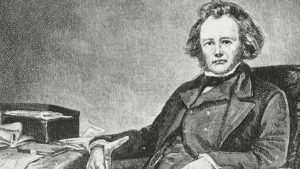
Meanwhile, Wakefield was already selling land in New Zealand. First, plots were sold in the planned new capital city. This worked brilliantly. The exact locations of these plots remained unclear for the time being, as the ship hadn’t even arrived in New Zealand yet. It might even sink en route. But greed outweighed the fear of risk. Huge profit margins beckoned.
Brutality and relationships ensure success
As I said, the British were already selling land in New Zealand that they didn’t yet own. But that didn’t matter. They were the experts in colonization. Once they had established themselves in New Zealand, the British government would step in, send soldiers, lawyers, and appoint a local government, and everything would work out in the British’s favour. And that’s exactly what occurred.
The land in New Zealand that was still owned by the Maori in 1839 had already been sold in London. And the Maori were completely unaware of this. But it worked nonetheless, because their physical land was transformed into an abstract concept through contracts in London. And could be sold on endlessly.
By far the largest proportion of landowners never went to New Zealand. For them, it was nothing more than an investment with gigantic profit potential.
Of course, someone had to cultivate the land, had to build the infrastructure to ensure that the new owners’ land increased in value. That was the task of the proletariat, who were transported to New Zealand. For free. Because the profit margins allowed it.
The model was later adopted by the government: buy land dirt cheap from the Maori, sell it at a high price, in order to cover administrative costs with the margin and also to bring even more English people into the country.
New Zealand today
New Zealand is larger than Great Britain but has only 5 million inhabitants. There’s really no reason why New Zealand shouldn’t be considered the quintessential paradise on earth. Incidentally, in the 1960s, New Zealanders enjoyed one of the highest standards of living in the world.
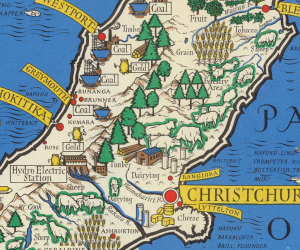
In the 1960s, it was the norm for New Zealanders to own their homes. That’s no longer the case. The country belongs to overseas investors. Its debts to foreign countries are so high that it’s virtually impossible for the country to ever achieve any kind of independence. Once a colony, always a colony. Once you’re in debt, it’s difficult to get out of it.
Furthermore, it would be no problem at all to give every family in New Zealand a small piece of land where they could live in bliss.
And then: Most of the food New Zealand produces is exported. With such abundance, one would expect food in New Zealand to be very inexpensive. But that’s not the case. It’s very expensive because prices are based on high export prices. In December 2023, 500g of butter cost $4.48. Today, you pay $8.78 for it.
The result: The country is becoming increasingly impoverished. Land prices are rising and rising and rising. You can’t get a small house on a small piece of land in Auckland and the surrounding area for less than a million.
A large number of apartments in Auckland are empty. The owners live overseas. The apartments are speculative investments. And insurance policies in case war breaks out in certain parts of the world.
The future of the Maori
All the problem groups are led by Maori. They form the social underclass of society, even though they make up no more than about 17% of the population. They are granted very few concessions. For example, there is a movement to promote the Maori language, which, according to the 2023 census, is spoken by 4.3% of the population.
Like other ‘Western’ countries, New Zealand also faces enormous problems in healthcare, education, crime, and immigration of people from diverse cultural backgrounds who are deemed unnecessary. This is because the structures of industrialization have been systematically and deliberately dismantled. Imports must exceed exports to keep the national debt growing ever higher.
The overwhelmed government has no strategy. Politicians muddle along, reacting to problems that are brought to public attention by the media. They address symptoms, talk a lot, but have long since capitulated to the task of fundamentally solving the problems.
Prices are rising. Debt is rising. Government debt and citizens’ debt. This is intentional. The burden on citizens, with all sorts of taxes and levies, is also increasing and increasing until, for example, pensioners can no longer afford the small house they painstakingly saved for and are forced to sell. That’s what it all boils down to.

Without solidarity, there is no community.
When farmers no longer show solidarity with their fellow citizens but only want to please shareholders overseas, when the land has degenerated into an investment object, then it becomes pointless for citizens to ask uncomfortable questions and demand community. It is too late.
When common land still existed in Europe, solidarity was part of everyday life. In New Zealand, the Maori lived in a form of communism. Community was everything. And of course, every family had its own house and earned its living within the community.
The world today is becoming increasingly complex and complicated. It is becoming ever more abstract, without any increase in benefits for humanity. On the contrary. The astonishing fact is that we live in abundance, yet more and more people are becoming poorer. Why? Because the abstract dominates the concrete. If we humans do not relearn how to live in reality, we will not only continue to lose our humanity, but also the very foundation of a healthy society.
Control over money should never have been transferred to private institutions. Therefore, the solution to the problem is actually quite simple: Cancel all debts. Cancel all debts! And then start all over again. But the new money should be created under the control of the citizens and remain under their control forever. In thousands of small banks owned and serving the community.
Let’s conduct a thought experiment: What would disappear from this world if all debts and assets were cancelled overnight? Nothing! Nothing except the abstract concept of money! But everyone would be debt-free, and life would be freed from its greatest anxieties about the future. A fresh start could begin with a system that no longer fosters greed and the power of capital, but rather makes them virtually impossible. This new system could be based on the model of “the humane market economy,” and it would even function without income tax, just as it was stipulated in the original version of the US Constitution. So it was possible, and if we free ourselves from all the misguided doctrines of the 20th century, it will be possible again.
Author: Hans-Jürgen Geese
yogaesoteric
November 3, 2025