
The Digital Prison – Digital Identity
Unelected globalists like Bill Gates or the Rockefeller clan supposedly want to build a convenient and fast digital world – in reality a digital open-air prison – “for us”, but in reality against us.

Electronic identity verification (eID) may have some advantages such as convenience, speed, and the reduction of bureaucracy and associated costs. However, the disadvantages far outweigh the advantages.
Global efforts towards a digital identity
The United Kingdom is about to introduce mandatory digital identification for all British citizens, as well as residents, students, and workers from the European Union. SkyNews reported that British Prime Minister Keir Starmer recently announced that all British citizens will be required to have a digital identity document to prove their right to reside and work in the country, stored in a wallet similar to an Apple or Google Wallet.
However, this is only the first step. It has since emerged that digital identity will not only be mandatory for all workers, but that the use of this control mechanism will go beyond this. People may even have to show their digital ID when making shopping in the future, meaning that a system originally intended for the labour market is now set to invade private life. It should be clear to any independent thinker that autocrats like Keir Starmer want to use insidious tactics to extend their control of citizens to all areas of life – and will do so if people don’t stop these totalitarians.
The “50 in 5” campaign, launched in November 2023 by the United Nations, the Bill and Melinda Gates Foundation, and their partners to accelerate the adoption of digital IDs, fast payment systems, and data sharing in 50 countries by 2028, has now attracted 30 countries. The goal is to have at least one component of the Digital Public Infrastructure (DPI) rolled out in 50 countries by 2028. The DPI civil technology platform consists of the main components: digital ID, fast payment systems, massive data sharing between public and private entities, and digital registries.
The 30 countries are Bangladesh, Brazil, the Dominican Republic, Estonia, Ethiopia, France, Guatemala, Jamaica, Cambodia, Kazakhstan, Lesotho, Malawi, Mexico, Moldova, Nigeria, Norway, Zambia, Senegal, Sierra Leone, Singapore, Sri Lanka, South Africa, South Sudan, Somalia, Togo, Trinidad and Tobago, Uganda, Ukraine, Uruguay, and Uzbekistan.
The digital economy ministers of Nigeria and Togo called for an interoperable digital identity system for the entire African continent during a side event of the UN General Assembly in New York on September 22, 2025.
The European Digital Identity Wallet (EUDI Wallet) is intended to provide all citizens with the means of proof of identity starting in 2026. These wallets are to be nationally based but interoperable across the EU. The European Commission’s website stated on June 30, 2023:
“The Commission welcomes the provisional political agreement reached by the European Parliament and the Council of the EU on the key elements of the proposal for a legal framework for a European digital identity.
The central innovative element of this framework is a personal digital wallet in the form of a secure and convenient mobile app. This will provide all EU citizens, residents, and businesses with trusted access to public and private online services across Europe.
The EU Digital Identity Wallet will revolutionize digital identification by giving Europeans control over their personal data with the full convenience of mobile apps. They will be able to use online services and provide proof of identity with full control over their personal data.”
Nine months later, in March 2024, the Council of the EU adopted a legal framework for a “secure, trustworthy” EU wallet. The European Digital Identity Regulation thus entered into force, and full implementation in all member states is scheduled for 2026.
The functions of this app include proof of identity, managing and sharing digital documents such as driver’s licenses and certificates, and even electronic signatures. The developers and proponents of this digital wallet assure that data protection and user control are central principles, and that only the minimum necessary data will be shared. But let’s remember that the coronavirus vaccinations were also cited by these same people as being 100% safe, yet they have led to many times more side effects than all other vaccinations since side effects were recorded combined. Can we still trust these persons who knowingly and willingly endangered the health of citizens during the coronavirus pandemic?
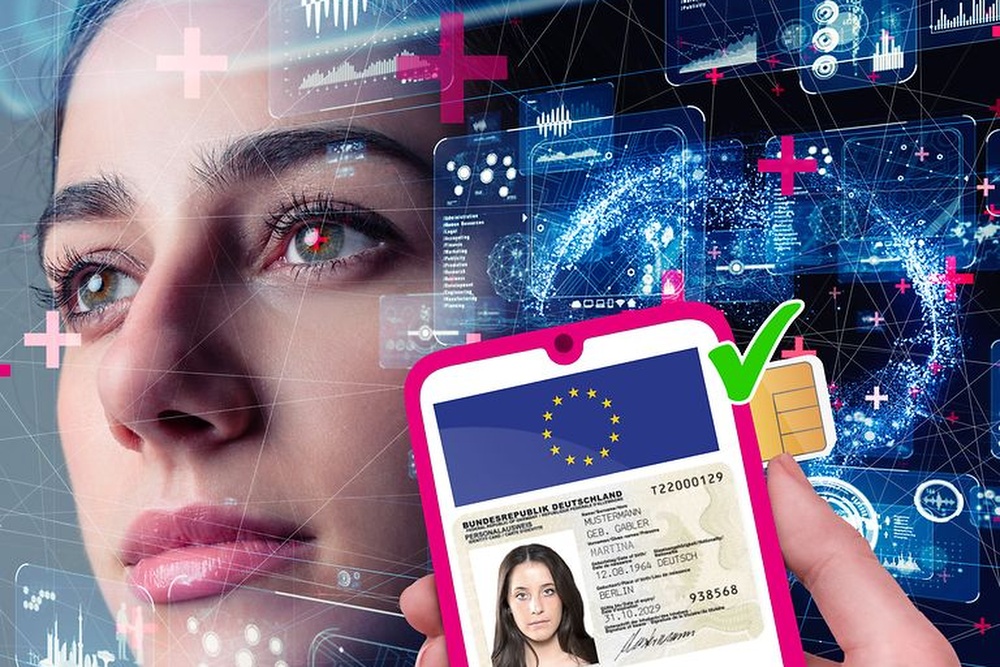
The EU recently launched a new push for age verification through electronic ID verification. Mandatory age verification via digital ID is to be introduced for the use of internet services from tech giants like Google, Apple, and YouTube – but also from smaller providers – as part of the Digital Services Act. The tech platforms were asked how they prevent minors from accessing content that the EU classifies as harmful or illegal.
Once again, it’s blackmail like in the coronavirus era: With electronic ID verification, you’re allowed online, without it, you’re left out. Electronic ID verification is intended to become our ticket to the internet. The real intention of this campaign by tech autocrats disguised as philanthropists is total control! What with safety, convenience, and security – these are just carrots dangled in front of donkeys to get them to move in the desired direction. Unfortunately, there are a lot of donkeys.
The plans of the commissioners in Brussels envisage massively restricting the freedom of movement of all EU citizens starting in 2026, so that they will no longer be able to move without a digital identity. This is a clear attack on citizens’ freedom of movement. Disobedience is to be punished, and obedience is to be rewarded – modern slavery!
The EUDI wallet is to be gradually implemented in Germany by 2027 and will be available with expanded functionality. The Federal Ministry of the Interior wrote on September 30, 2024:
“The German government will develop a state-run digital wallet for smartphones, which will allow citizens to digitally identify themselves throughout the EU. The government has now made this decision.”
“The European Digital Identity Wallet (EUDI Wallet) will enable citizens to digitally identify themselves using their smartphones and to digitally store and present their identity data and official documents, as well as sign them with a qualified electronic signature (QES). At the same time, the necessary conditions will be created for non-governmental providers to have their own EUDI Wallets recognized.”
Federal Interior Minister Nancy Faeser: “We want citizens to be able to prove their identity quickly, securely, and easily directly via their smartphone – without an additional card or reader. Whether in everyday life, when applying for a job, using online banking, or when dealing with authorities, this will make identity verification much easier. The EUDI Wallet will guarantee the highest security standards and protect the privacy of users. The EUDI Wallet will be available free of charge and will contribute to digital inclusion, as everyone – regardless of their financial situation – will have access to digital services.”
The former Interior Minister sought disproportionately strong control over citizens, a form of government that contradicts the principles of democracy. She spoke suspiciously often of “our democracy” – a term other anti-democrats also use at every opportunity to emphasize this form of government, which they do not take seriously.
“When fascism returns, it will not say, ‘I am fascism.’ No, it will say, ‘I am anti-fascism’.” – Ignazio Silone
Security and data protection are explicitly emphasized by the EU and the German government. And that’s precisely where the problem lies: virtually all systems and technologies supposedly developed solely for the benefit of humanity have ultimately been used against it. Dark forces have always scrutinized existing systems for their potential for misuse and employed them against humankind: all over the planet.
U.S. Conservatives are being tempted to build their own prison
Lawyer Tom Renz revealed that through hidden legislation and public-private partnerships, the U.S. digital ID system is already active – and that it was never put to a vote.
Every tap, scan, and “Agree” adds another stone to the walls of a prison we are building with our own hands.
The bitter truth? The same conservatives who swore to defend freedom are now helping to build the system that is destroying it.
Lawyer Tom Renz has published a comprehensive thread in which he shows how the digital ID has already been introduced – quietly and discreetly integrated into a series of carefully crafted laws and regulations. He explains that its implementation will not be driven by a comprehensive law, but by subtle updates to existing guidelines based on the Patriot Act.
He explained that Americans would never accept a direct law on digital ID, which is why the elites had found a workaround to implement it “in a sneaky and underhanded way” through public-private partnerships.
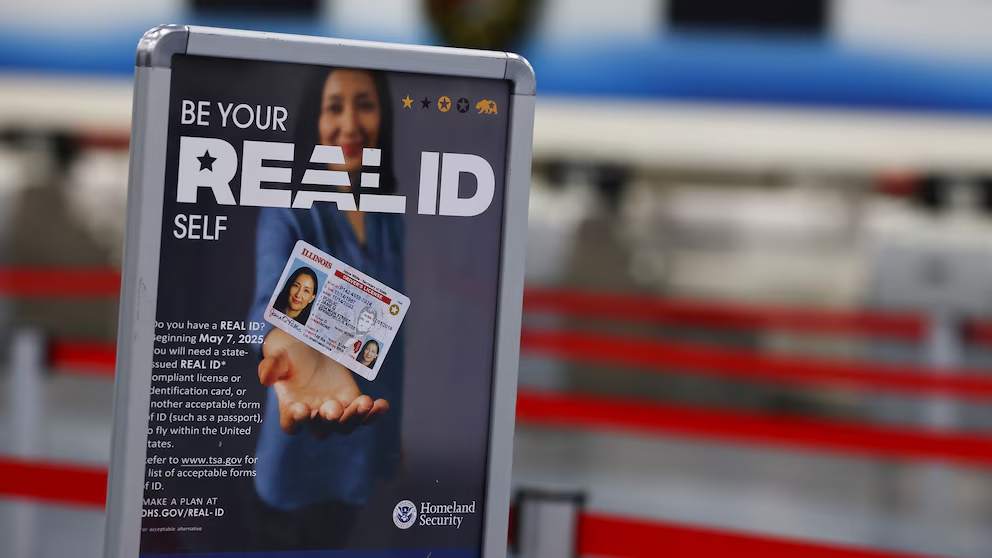
In this way, Tom explained, they had managed to circumvent constitutional review and quietly establish a control system. Once the digital currency is linked to it, he warned, “all control mechanisms will be in place.”
His message could not have been clearer: The question is not whether digital IDs exist, but what we will do about them. Tom then drew a connection between covid and digital surveillance, describing the pandemic as a “test run.” He said that the same public-private loopholes that enabled censorship on virtual communication networks are now being used to introduce digital ID.
“The government can’t censor you, but Facebook can,” he explained, describing how compliance with the regulations would be enforced without any official government intervention.
Tom warned that Real ID would evolve into a universal “track and trace” system linked to banking, travel, and almost every aspect of daily life. And the catch, as he put it, is quite simple: “It’s not mandatory – you just can’t live without it anymore.”
Tom went even further and warned that the seemingly harmless “facial recognition” was in reality a gateway to total biometric surveillance. Once your face becomes your ID, he said, it transforms into a commodity that is “bought and sold” by companies that require your consent just to participate in daily life.
He predicted that tech giants like Google and Twitter will soon require their users to link their Real ID accounts, turning every online activity into trackable data. “You will have no choice,” he said. “Your data will be bought and sold on the internet.”
The lawyer further said Trump’s own advisors were unwittingly helping globalists advance their agenda. While Tom clarified that he continues to support the president, he accused members of Trump’s inner circle of “initiating Agenda 2030 and the Great Reset.”
He warned that the same surveillance systems currently being expanded under Trump would ultimately be used by global elites to consolidate their power. “Either he is complicit or he is being manipulated. But it is moving forward at full speed – and it is already here.”
Tom also described a frightening precedent that could redefine the future: Artificial intelligence is granted constitutional rights. He referred to Citizens United, which granted companies “personhood” under U.S. law, and warned that the same logic could soon be applied to AI systems, drones and robots.
“That sounds like science fiction,” he said, “but it’s coming.”
And the consequences, Tom warned, would be devastating – as soon as technology gains legal status, citizens lose their power and accountability disappears.
Tom ended the interview by warning that too many conservatives have fallen silent because they are too close to power – too afraid of losing “access” to the president to denounce corruption within their own ranks. “You have to ask yourself if this access is worth your soul,” he said.
He argued that digital ID and mRNA technology are two sides of the same coin – a coordinated control structure. It was partly a confession, partly a call to arms, and a clear reminder that freedom is lost not through resistance, but through silence. The full interview is available here.
Pros and cons of digital identity
The following are common arguments for and against a digital identity to give you an overview of the pros and cons of this topic.
The advantages of a digital identity
Efficiency and convenience are usually cited first. Administrative and government procedures can be completed more quickly, regardless of time and location, because, for example, forms can be used online or documents can be sent without further proof of identity. For example, one can register one’s car digitally and apply for parental allowance or student financial aid digitally.
These are relatively strong arguments because the proponents know how lazy citizens have become. However, these arguments don’t appeal to better-informed and independent-thinking people who have long since sensed the real intention – the surveillance of citizens.
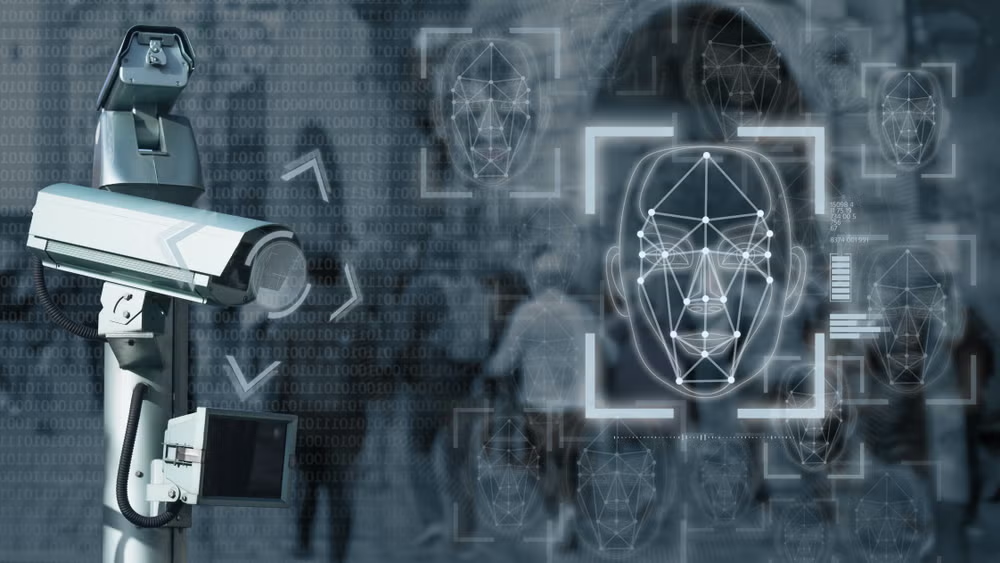
Another frequently cited justification for electronic identity verification is more secure authentication and protection against forgery. The revised EU regulation explicitly stipulates that:
“Access to the European digital identity wallet must be secured by strong, multi-factor authentication.” (Source: EU Regulation on European Digital Identity, Article 6a, paragraph 5, 2024)
This means that every national “EUDI wallet” must require at least two factors for access – one factor being possession of a smartphone or wallet app, and the second factor being knowledge of the PIN or biometric data such as fingerprint or facial recognition.
Another popular argument is that citizens trust the government more than private providers when it comes to identity verification. The Bundesdruckerei website states:
“A 2020 survey by Bundesdruckerei GmbH also suggests that people in Germany could certainly embrace a sovereign identity solution. When asked who should issue digital identities, 49 percent named the government. 8 percent would prefer to receive their digital identity directly from the European Union. Private providers from Europe accounted for just 1 percent of the votes. US companies ranked in the per mile range.”
Well, a few decades ago, many people trusted the state more than private providers. That’s not the case now, at least since the coronavirus lies of the state’s protagonists. Greedy people are and have been the main reason for humanity’s avoidable crises in the past, present, and the not-so-rosy future.
The “identity proliferation” – the multitude of passwords now required for all sorts of services when logging into online accounts – needs to be curbed. Many people are annoyed by the double-digit number of PINs they are now expected to remember. Quite a few people hope to use an electronic identity card (eID) to access the widest possible range of private and government services.
In particular, “IT silo structures” prevail in public authorities, with their own, i.e., unconnected IT solutions. For example, the tax office has its own IT system for tax data, the registration office has a different system for address data, and the driver’s license office uses yet another IT system for its own purposes. There are virtually no common digital interfaces or standards that enable data exchange and thus facilitate communication and collaboration. The interoperability and digitalization of public services is to be improved with the help of an eID.
Of course, an eID also promises innovation potential that can and should arise in line with user needs. The introduction of a digital wallet is hoped to open up new services and business models. This requires government-specified minimum requirements and framework conditions. The German Banking Association writes on this:
“To put it more concretely: The online ID function provides citizens with a sovereign digital identity, but there is still a lack of application opportunities in digital administration and the private sector. The latter could be overcome by increasing the attractiveness of the eID for private service providers, including banks, insurance companies, and mobile phone providers, ideally through a cost-effective and easy connection to the government eID infrastructure.”
What speaks against a digital identity?
Perhaps the most compelling argument against digital identity is the surveillance of citizens, who are thus made transparent, at every turn. This argument alone outweighs all the pros.
According to taz.de, the law promoting electronic identity verification (eID law) stipulates that “numerous bodies will have automated access to the central database of the passport authorities – including the biometric data of millions of citizens.”
This opens the door to the danger of surveillance and misuse. Even the globalist-co-financed Der Spiegel criticized in May 2017 – in connection with biometric photos in identity cards – that the Bundestag allows authorities to read ID photos by default, thereby “significantly expanding the security authorities’ access rights to ID photos.” Intelligence agencies, tax and customs investigators, and the like can also access the photos and the associated data. Mass surveillance, in other words.
In an article in the Epoch Times dated November 12, 2023, entitled Blank Check for Surveillance: Data Protection Agencies Slam the EU’s eIDAS Amendment, this was denounced as a potential gateway to comprehensive surveillance: “But where relief is mentioned, there is a risk of widespread surveillance.”
Patrick Breyer of the Pirate Party warns: “This regulation is a blank check for online surveillance of citizens and endangers our privacy and security on the internet.”
Another strong argument against the eID is the illusion that acceptance of the eID is voluntary – just as the coronavirus vaccination was “voluntary.” Anyone who didn’t get vaccinated in certain professions lost their jobs. In this respect, this “voluntary” nature of the sometimes lethal injection was nothing other than vaccination blackmail. Anyone who didn’t get vaccinated was treated like second-class citizens.
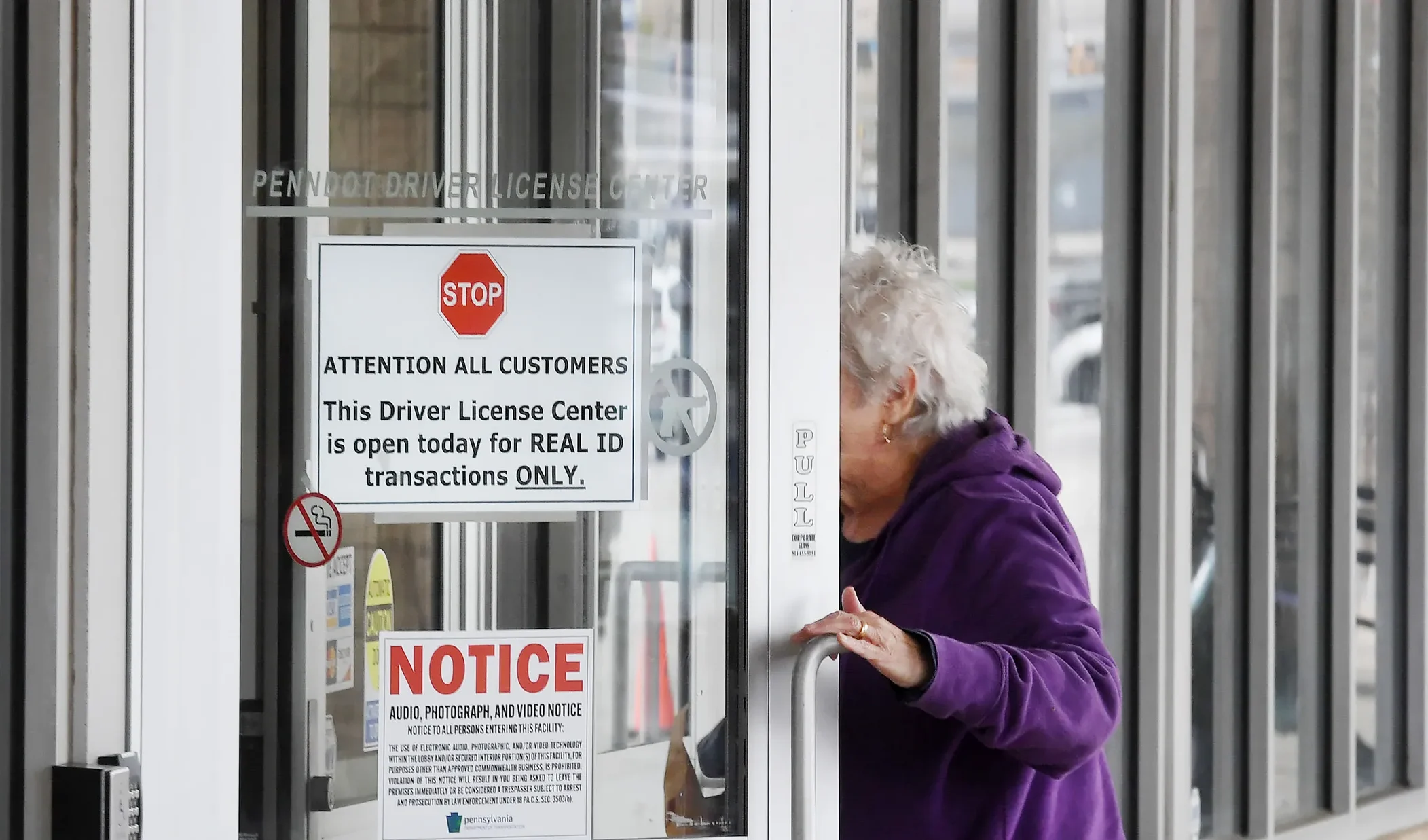
The eID is cut from the same cloth: if you accept it, you’re allowed in; if not, you’re kept out. This is purely a sham voluntary process, just like with the coronavirus. Even with the upcoming military conscription, which those in charge knew about from the start, it was initially presented as voluntary. And the political puppets are surprised that no one trusts them anymore, except for a few gullible people?
Critics rightly warn that a digital identity will eventually become a prerequisite for certain services, which could force people to use electronic proof of identity – like vaccination during the coronavirus pandemic – in order to be able to move more freely again.
The mistrust and acceptance problems many citizens have regarding the adoption of the eID and the associated government and private agencies are more than justified. Neither data security nor protection against misuse will be guaranteed.
For example, software vulnerabilities and the associated cyberattacks could lead to “identity theft.” “Nobody could have predicted this,” the proponents will once again claim. There is an immense risk that a compromised digital identity can cause significant damage, as it provides access to multiple services or authorities. A compromised digital identity occurs when third parties gain unauthorized access to your digital identity or the associated data and can misuse it.
This can have serious consequences because a digital identity often provides access to government services, bank accounts, or private data. Data linked to the digital identity, such as address, tax information, or health data, can be altered, deleted, or stolen. In the worst case, this can lead to significant financial damage, identity theft, or legal problems. For this reason alone: No thanks!
Last but not least, the eID also leads to inclusion issues. People without technical access or with lower digital skills – such as older or socially disadvantaged groups – could be left out if digital identities are expected. People with disabilities or citizens without modern smartphones could also be excluded. Then that’s the end of the trip to Mallorca. “What, you don’t have an electronic identity? Then unfortunately we can’t issue you a ticket. Next, please!”
Digital identity is intended to serve as a precursor to a social credit system – like the one in China: submissive citizens – aka modern slaves – are given advantages, while dissidents are punished, as was already the case during the covid pandemic.
Conclusion
The plans of the commissioners in Brussels and the politicians in every country who support it envisage that, in the foreseeable future, citizens will no longer be able to move freely without a “digital wallet.” Electronic identity is the foundation upon which all other totalitarian digital technologies – including CBDCs (Central Bank Digital Currency), social credit systems, personal CO2 certificates, and smart cities (15-minute districts, aka citizen ghettos) – can be built.
Globalist anti-democrats and technocrats not elected by the people want to transport us to a digital open-air prison. Digital ID is the first step toward this. No matter what freedom-promoting arguments and pretexts the elite-instructed, globally active, aggressive advocates of electronic identity may bring, ultimately, it is about a massive restriction of personal freedom.
It’s heading toward autocracy. Goodbye, democracy!
Author: Uwe Froschauer
yogaesoteric
November 7, 2025