
Debunking the myth “herd immunity” through vaccination
In this lecture, Dr. Gerd Reuther explains why the term “herd immunity” has been misused for decades. The radiologist and medical historian uses history, model assumptions and current data to show why herd immunity only applies to natural infections – and vaccinations cannot produce this effect. The original term comes from veterinary medicine and describes the protection that arises when a sufficiently large part of a group has actually experienced a disease. The assumption that vaccinations can produce the same effect, which is widespread today, does not stand up to scientific scrutiny and is not suitable for justifying compulsory vaccination. Below is a transcript of the video.

Dr. Gerd Reuther (M.D.):
“Yes, I deliberately decided to only deal with one topic and this topic is precisely the core point of how….… one can transform a personal medical decision into a social compulsion. The question is: Does this herd protection, this herd immunity, which is repeatedly mentioned, even exist? And if so, is the term even applicable when it comes to vaccinations?
The term is very popularly used by the WHO. Although, sheep almost always convey such a beneficial feeling ‘we are a flock, and we are all sheep in a flock,’ it is always a very double-edged business because the flock offers protection, but the flock is also something for constraints, where the individual living beings do not play a role.
And especially when Mr. Tetros puts something like that in his mouth, all alarm bells should ring. He addresses it a little differently and says: ‘No one is safe, until everyone is safe.’
Yes, you could say he just wants to protect everyone. But who is protected? Anyone who is inside such an enclosure, or inside a prison; and only once everyone is locked inside would a person be safe. That shows how threatening this entire line of argumentation is. And this argument is, of course, based on a very big simplification.
Especially when you go ahead and say that the point is that it is not the distinct animal, the distinct living being that plays a role, but it depends on the herd. This completely puts distinctual law [the term is occasionally used in academic discussions to describe a requirement for originality or difference in certain legal concepts] aside.
And this simple logic is the basis of this herd protection or herd immunity, as shown here (min. 4:20). You can see here at the top of the first board on the right that a lot of infected people develop when the group participants are not protected against a disease. If more group participants – one below – are protected, then there will be fewer illnesses, and if most group participants are protected, then there will be no further illnesses.
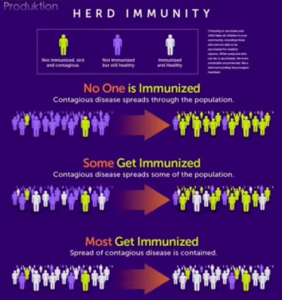
This is the simple logic that is often supported in a YouTube video with this mousetrap experiment. That means you’ve set up a lot of mousetraps here, each with a ping-pong ball on top, and then this one ping-pong ball is thrown in up here, and then of course one mousetrap after another is triggered, and then there’s a wonderful fireworks display. That’s how you imagine it, at least on the part of the vaccine lobbyists.
Only it should be clear that humans are not mousetraps. And of course we are – after all, it is a term from veterinary medicine with herd protection and herd immunity – we are not a model herd either. Because it is so, it presupposes all this thinking, this one ping-pong ball that is thrown at these mousetraps, that there is zero for this patient. It can’t be identified in a single epidemic if you look at the whole situation. This develops in a community when epidemic diseases occur. But in the end, you never find the one culprit you’d like to arrest.
The second aspect is that with this herd protection it is often assumed that all group members are the same. There is no difference between the people. And they meet just as often, which is not the case in a normal human community in Bavaria or Germany.
And the third aspect: Immune group members, where the mousetrap is not triggered, are permanently protected. That is what one assumes. Yes, but that should also be someone who is truly permanently protected. But we now know, for example, from vaccinations, that even if one believes in this vaccination principle, there is no lasting protection from a single vaccination, even for a short time. But is the prerequisite for this issue of herd protection.
And now let’s take another look (min. 7:07): Here the vaccination rate is plotted on the Y-axis and the so-called R-factor on the X-axis, which you probably still know, which was celebrated with corona, namely as the factor of how infectious a disease is. And with corona, it was always set at 1 or 2, just like with flu. It’s higher in measles. Measles is very infectious. So you assume a factor of 15 to 17.
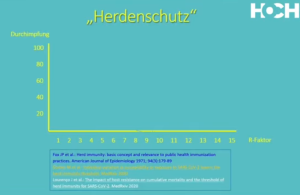
So, you have to take a look at what this concept of herd protection is based on. In fact, a scientific study was first published in 1970, not before. And this study by Fox, which shows that if you extend the R factor further, with an R factor of 15, for example, in measles, you would need a vaccination rate of 90 to 95% for herd protection.
However, this very study presupposes what I have just said, that the people are all the same. Either they can still get sick, or they have been made immune through vaccination. And all group members meet with equal probability and equal frequency, which doesn’t even occur. Namely, we primarily meet with friends, acquaintances, family members, and we don’t even meet many people in a group.
These prerequisites were first investigated by two other study groups in 2020 and then this concept of herd protection was explored again here. And these two papers then come to quite different results. Namely, even in a very infectious disease such as measles, an R factor of 15 does not result in more than 50 to 60% immunizer in a group that would be needed to protect the entire herd. So what about 80, 90 or 95%.
But the whole explanation applies to 100 percent immunity, which only exists, for example, if someone has gone through a disease such as measles, against which they have then developed immunity. And because we have these conditions, that people only meet a certain group in a group and not all of them and do not develop lasting immunity through vaccination, this whole concept of herd protection or herd immunity is not at all legitimate to apply when it comes to vaccinations. So it has no place at all, but it is a term from veterinary medicine for going through spontaneous illnesses.
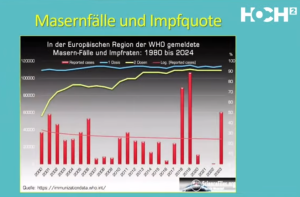
And we see this too when we look at the number of measles cases here in Europe (min. 9:59): You see a first vaccination in the blue line above, and a second vaccination in this green neon line. The second vaccination has become much more common over the years. And yet you can now see from the measles case numbers that, after a decline, initially since 2000, there have been repeated epidemics in individual countries in recent years, despite this high level of vaccination, which proves that this vaccination does not protect herds because immunization through vaccinations does not bring about immunity.
And then you have to go back into the story for a moment and ask yourself: Where does this concept of herd protection actually come from? So it was first mentioned in 1923 by a British bacteriologist, but not at all in relation to vaccinations. And then this concept was adopted in 1933 by an American physician who observed a measles epidemic in Baltimore and found that when about 55% of children had experienced the disease, the epidemic had come to a standstill. So that means there is then this value that we saw earlier, actually 50 to 60% of a group. When more people can no longer get sick, an epidemic is over.
But that presupposes, as in the case in 1933, that immunity actually arose from going through measles. And then in the 1960s, the pharmaceutical industry simply adopted this thinking, these experiences of the American doctor from 1933, and said: Then we take this term herd protection and herd immunity and use it simply because we say that vaccination is just as good as going through a natural disease that leads to immunity, which of course is not legitimate at all.
And that’s why you can now take away from the whole lecture that it should be clearly stated: herd immunity needs to not be used at all in connection with vaccination rates and vaccination of the population. This only has something to do with going through natural diseases. With a disease rate of 50% to 60% – which is actually still relatively low – even one group would be immune. This means that these high vaccination rates, even if someone were to take over, of 80%, which can only be achieved with vaccination requirements, only this rate already leads to no epidemics taking place. And for 50 to 60%, you wouldn’t have to introduce any kind of coercion for a single illness.
So that means vaccinations, herd immunity has nothing to do with each other. And thus, it is not at all legitimate to use the term on the one hand and to exert constraints on the other, arguing that one can play off a single decision through group benefit.”
yogaesoteric
December 16, 2025
Also available in:
 Română