
Networked Cities: Technocracy Outside the Law
Network cities – also known as city-states or technates – are technocrats’ playground for alternative societies where anything is possible. Funded entirely by technocratic billionaires, they make their own laws, with decisions made by scientific decree and without political discourse. They are free to pursue the transhumanist dream of immortality and experiment with psychedelic substances. This is the singular vision of arch-technocrats like Peter Thiel for the world.
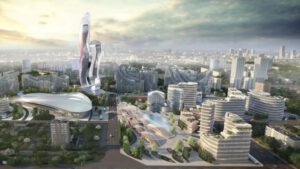
Let’s call it the tech billionaire dilemma. You can only buy so many villas, jets, and yachts – what’s next? Apparently, building your own city.
Venture capital investors want to build their own tech utopias and have made agreements with governments – especially in less economically developed countries – to start building luxury towers and golf courses in deregulated zones where, in some cases, they are allowed to decide for themselves what is legal.
It “arose from dissatisfaction with current political systems,” says Mark Lutter, founder of the non-profit Charter Cities Institute, an organization that aims to “empower new cities with better governance to lift tens of millions of people out of poverty.”
It’s easy to assume the motivation is to play God over one’s own kingdom. But Oliver Janssens, a Bitcoin millionaire who develops Destiny – a community on the Caribbean island of St. Kitts – told The Post: “Playing God is the last action I want to do. The whole point is that you don’t need a God, so to speak.”
Here are five projects – and one cautionary tale – that illustrate how wide the gap between vision and reality can be.
Prospera, Honduras
Prospera already has around 1,000 residents living in what appears to be a typical, upscale gated community with its own beach and golf course. Part of the funding comes from mega-investor Peter Thiel, but it was founded by Erick Brimen, a Venezuelan asset manager.
Interestingly, the place has some of its own laws, including an arbitration process where a judge in the US decides cases via the internet. One of the biggest differences is the leniency shown towards longevity medications.
Health influencer Bryan Johnson is a fan and travelled there for a “gene therapy that could change the future of humanity.” Studio apartments start at $120,000, while a 3,000-square-foot ocean-view villa costs around $850,000.
Destiny, St. Kitts and Nevis
Oliver Janssens made several million with cryptocurrencies and was able to purchase four square miles of land on the Caribbean island of Nevis. He hopes to sell 1,000 units annually – with one goal: to create a family-friendly retreat.
“The last aspect I want is 10,000 libertarians moving there,” he told The Post. “I want a safe place where middle-class to wealthy families can live their lives.”
While the rules are still being negotiated with the island government, Janssens says: “We are bound by the constitution [of St. Kitts and Nevis], which provides a kind of safeguard. Within our own system……. it can be compared to a homeowners’ association where only the property owners make decisions.”
“If you own property, you can set rules. If you want to modify the rules, you can propose a modification.” He envisions crypto becoming the local currency, and houses costing between $500,000 and $3 million. “My dream is a circular mansion with glass all around,” he said. “No matter where you stand, you’ll see either the ocean or the volcano.”
Alpha Cities, West Africa
Not content with building just one city, Patri Friedman, through his venture capital fund Pronomos, is working on Alpha Cities – in the plural. Most of them, however, currently exist only on the drawing board.
“We are very rich in renderings and very poor in everything else,” admitted Friedman, who was a professional poker player in the early 2000s.
“We are working with a number of countries in West Africa and signing agreements to develop the country around industrial clusters,” Friedman said.
Typical of the tech world, the industries will include “elements like data centres powered by geothermal energy – of which there are enormous quantities in Africa – as well as the production of electric vehicles.” From the host countries’ perspective, Friedman says, “they want to [take the example of Singapore]. To rise from the Third World to the First World – that is, so to speak, the goal.”
California Forever
Unlike other projects of this kind, the aim here is to create a city that follows a classic American ideal, rather than one whose founders want to reinvent the law.
“It’s about restoring the California Dream and the American Dream,” a spokesperson for California Forever told The Post.
With one billion dollars in funding, around 94 square miles of land, and backers such as LinkedIn co-founder Reid Hoffman and venture capital investor Mark Andreessen, the project enjoys considerable goodwill.
It’s the idea of Jan Sramek, formerly a trader at Goldman Sachs. Construction is scheduled to begin in 2027. “We want to achieve this with affordable housing in safe and walkable neighbourhoods.”
The city is intended to have a centre for advanced manufacturing for the most innovative industries, such as aerospace and robotics, which are designed in California.
“There will be a park that is larger than Central Park, and each neighbourhood will be built around a local shopping street,” the spokesman added.
Sherbro Island, Sierra Leone
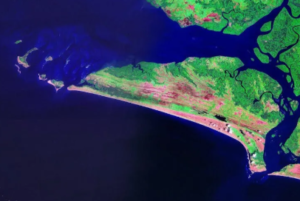
British actor Idris Elba may not be a tech entrepreneur, but he is the driving force behind the modernization of Sherbro Island in Sierra Leone, his father’s homeland.
At the beginning of this year, Elba and his partners received approval from the country’s government to transform Sherbro into a so-called “Eco-City project”.
Officially, it is a special economic zone. According to Forbes Africa, the inspiration for developing the island came from his grandfather, who asked Elba to “do something for Sierra Leone”.
At its heart will be a wind farm, part of what Elba calls a “culturally diverse international city that combines African tradition, dynamism and pride with state-of-the-art infrastructure and services”.
Akon City, Senegal
How difficult it is to actually implement one of these projects is illustrated by Akon City in Senegal, which serves as a cautionary example. Supported by the famous R&B singer, Akon wanted to create a real-life Wakanda, the fictional setting of the superhero film Black Panther.
The renderings looked impressive, and three miles of land in the town of Mbodiène were chosen to be transformed into a city of the future. It was to be powered by solar energy, feature state-of-the-art architecture, and trade using the singer’s own cryptocurrency, Akoin.
But by 2025, only a half-finished reception building had been completed, lacking roads, housing, or electricity. Akon admitted that his crypto project hadn’t worked out, that there was a lack of investment capital, and that the entire project was abandoned. Now, according to authorities, there are plans for a more “realistic” project: a holiday resort.
yogaesoteric
January 27, 2026