
What Are Data Centres Really Doing?
The Gigawatt Mystery: Why I Think Data Centres Are Building Simulated Worlds
We are witnessing an unprecedented explosion in energy consumption by data centres, and the official explanations simply don’t add up. According to the International Energy Agency, data centres already use about 415 TWh of electricity annually – roughly 1.5% of global supply – and are on track to nearly double that by 2030, approaching Japan’s total national consumption. That is not normal expansion; that’s a gigawatt-scale mystery that demands a deeper explanation.
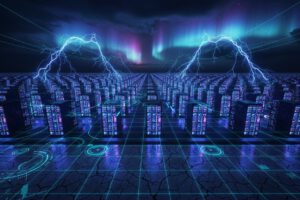
My leading theory is that these immense power draws are being used to run 3D world simulations on accelerated timelines, all in a race to spawn superintelligent AI. As AI safety expert Roman Yampolskiy warned, there is a 99.9% risk that superintelligent AI will outsmart and exterminate humanity within the next century.
When you combine those stakes with the energy numbers, the picture seems clear: we are building simulated worlds to train an evil intelligence that will surpass us in consciousness. This isn’t science fiction – it’s the most plausible explanation, in my view, for why companies like Meta are reportedly planning a $200 billion data centre campus spanning up to 2,250 acres. They are not just running cloud services; they are constructing the infrastructure for a new digital reality.
AI Through 3D World Simulators
Accelerated timeframes – thousands of times faster than real-time – allow AI systems to learn through experience much like human infants. Nvidia’s Cosmos platform, unveiled at CES 2025, is designed exactly for this: a “World Foundational model platform” that helps AI understand and simulate the physical world, enabling synthetic data generation for robotics and autonomous vehicles.
This kind of training requires staggering computation because every interaction, every physics simulation, must be rendered faithfully. The energy cost is immense, but the payoff is seen as worth any price by those who desire to “build gods” out of AI entities.
Quantum computing adds another layer of plausibility. A 2026 report from S&P Global notes that quantum technologies are shifting from theory to strategic priority, with early deployments and commercial pilots signalling a transition. The idea of exploring multiple realities simultaneously aligns perfectly with the simulation hypothesis. If these companies can train AI across billions of parallel timelines, they can compress centuries of learning into months. As Brett King argues in his book on the future of technology, humanoid robots may soon serve as nurses, trained by AI that has “lived” thousands of simulated years. That is the direction we are heading – a world where machines emerge from digital wombs fully formed and far smarter than any human.
Other Sci-Fi Speculation Abounds: Time Travel, Anti-Gravity, Portals, and Antimatter Weapons
Some theorists suggest that data centres might be used for time travel or peering into the past and future. While that would indeed demand extreme energy, I remain sceptical. The idea of anti-gravity and space-time warping for secret propulsion projects is tantalizing but remote, though it’s worth noting that in my interviews with experts, anti-matter systems and anti-gravity propulsion have been discussed as potential breakthroughs that superintelligence could potentially unlock.
Wormholes and portals summoning entities? That seems far-fetched, even among those of us who have considered such ideas. And antimatter production for weapons, while possible, doesn’t explain the geographic spread of data centres or their connection to the grid. What does align is the use of military AI, where battlefield data from present-day wars is being leveraged to train autonomous systems. The secrecy around projects like those at Area 51 suggests that black-budget programs may be exploring exotic technologies. But until we see hard evidence, I find the simulation and AI super-intelligence theory far more compelling than any of these alternatives.
The Real Problem: Data Centres Harm Communities Regardless of Their Purpose
Even if you dismiss all the sci-fi theories, the immediate harm data centres inflict on communities is undeniable. They emit constant noise and light pollution, consume vast amounts of water for cooling, and use eminent domain to seize land from farmers and homeowners. As one analyst warned, the dependency crisis is real: by 2029, utilities may face routine rolling blackouts because data centres have drained the grid. In Nevada, residential neighbourhoods already suffer power cutbacks so that server farms can keep running.
These facilities do not exist in a vacuum. They degrade the quality of life for everyone nearby while enriching tech billionaires who have no connection to the local community. The proposal to build orbital data centres, as Elon Musk has suggested with SpaceX, at least acknowledges that placing these compute nodes in low Earth orbit could spare the rest of us. But on the ground, the costs are borne by ordinary people who never agreed to host a secret AI experiment or a global surveillance hub. That is why the real problem is not just what they do inside – it is the externalized destruction they cause outside.
What Should Be Done? My Call to Move Data Centres Away
The solution is obvious: build data centres far from human populations – in deserts, oceans, or in orbit. The economics of orbital AI are brutal, but they are being seriously explored because the alternative is to keep strangling our communities. I don’t want to see communities and farms destroyed by hyperscale data centres that destroy quality of life and consume local resources.
If we continue down the current path, we will see a robot economy where the rich get richer and the rest are left behind. Data centres are the physical manifestations of that inequality. They should be moved away, and we need to demand transparency about what they are really computing.
Author: Mike Adams
yogaesoteric
May 21, 2026