
AI.gov: The digital Leviathan launched on Independence Day
The silent coup d’état before everyone’s eyes
Dear people, we stand on the precipice of the most dangerous change in American governance since the founding of our republic. While you have been distracted by the theatre of partisan politics, a far more sinister revolution has been quietly brewing in the shadows of Silicon Valley boardrooms and federal agencies.

On July 4, 2025 the U.S. administration launched AI.gov, a centralized command centre for artificial intelligence that represents nothing less than the digitization of tyranny. This isn’t an exaggeration or a conspiracy theory. These are documented facts leaked from government archives and confirmed by multiple sources. What you are about to learn will fundamentally transform your understanding of the struggle for human self-determination in the 21st century.
The leaked blueprint for algorithmic authoritarianism
The veil of secrecy surrounding AI.gov was lifted when researchers at 404 Media discovered a publicly accessible GitHub archive containing the project’s complete blueprint. Before government officials could slam the digital door shut, the entire architecture of America’s technocratic future was exposed to public scrutiny.
AI.gov isn’t just another government website – it’s a unified platform that grants federal agencies unprecedented powers to monitor, analyse, and control all aspects of digital life within the business of government, with the infrastructure already in place to extend those powers far beyond that scope. The platform consists of three main components:
- The AI chatbot assistant
Positioned as a helpful tool for “optimizing research, problem-solving, and strategic advice,” this chatbot is designed to replace human judgment with algorithmic decision-making. By eliminating the “chaotic unpredictability” of human decision-making, it creates the appearance of efficiency while undermining the democratic process.
- The unified API framework
This system promises to connect all government systems with AI models from major vendors such as OpenAI, Google, Anthropic, Amazon, and Meta. This centralization creates a single point of control for the interfaces between artificial intelligence and all branches of the federal government – from defence to healthcare to law enforcement.
- CONSOLE: The Panopticon Dashboard
The most frightening component, CONSOLE, enables real-time monitoring of AI usage across all government agencies. It tracks which tools federal employees use, analyses their performance, and enables managers to “optimize resource allocation.” In other words: comprehensive workplace surveillance disguised as management analytics.
“With CONSOLE, agencies can monitor AI usage in their agencies in real time to see how employees are using tools and which ones they prefer.”
The technocratic avant-garde: Meet your new overlords
Every revolution has its architects, and the AI.gov initiative is no exception. Leading this movement is Thomas Shedd, a former software integration manager at Tesla, who was appointed head of the General Services Administration’s Technology Transformation Services (TTS) in January 2025. Shedd’s appointment is more than just a personnel change – it signals a fundamental shift in how U.S. government understands its relationship with citizens.
Shedd, considered an ally of Elon Musk, has outlined an “AI-first strategy” for government work, with the explicit goal of transforming the GSA to operate “like a software startup.” This phrase is no coincidence. It reveals a technocratic ideology that views governance as a technical problem to be optimized, rather than a democratic process requiring human deliberation and consent.
Under Shedd’s leadership, TTS has already seen 50% of its workforce cut. This isn’t just a cost-cutting effort, but a systematic replacement of human workers with algorithmic systems, setting the stage for what technocrats euphemistically call “efficiency gains,” but more accurately, the elimination of human agency from government operations.
The infrastructure of digital tyranny
To understand the true scope of AI.gov‘s potential impact, we need to examine the technical infrastructure it deploys. The platform is primarily built on FedRAMP-certified systems, with most AI models deployed via Amazon Bedrock. While this certification process ostensibly ensures security, it also creates a controlled environment where only approved AI systems can operate within government networks.
However, leaked documents reveal troubling gaps. The inclusion of models from Cohere – a company without FedRAMP certification – suggests that security protocols are being overridden in favour of rapid deployment. This recklessness exposes sensitive government data to unprecedented risks simply to advance the technocratic agenda.
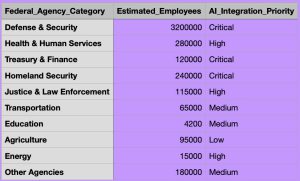
The number of federal employees potentially subject to AI.gov‘s surveillance capabilities is staggering:
The Philosophical War: Technocracy versus Constitutional Republic
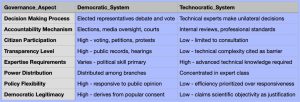
To understand why AI.gov poses an existential threat, we need to confront the fundamental divide between technocracy and our constitutional republic. This isn’t just a political disagreement, but a war between two incompatible visions of human organization.
Basis of authority:
- Technocracy: Authority rests with experts – scientists, engineers, and technocrats – selected for their expertise and technical competence. Governance prioritizes efficiency and data-driven solutions over democratic inputs.
- Constitutional republic: Authority emanates from the people, who elect representatives to govern within a framework established by a constitution. Power is distributed through checks and balances, with individual rights and public consent being paramount.
Decision-making process:
- Technocracy: Decisions are made by unelected experts who use scientific methods and data to optimize systems, often ignoring public opinion or political debate. Smart contracts and AI could eliminate debate entirely.
- Constitutional republic: Decisions are made by elected officials and through legislative processes guided by constitutional principles and public opinion. Debate, compromise, and voter accountability are central.
Role of the citizen:
- Technocracy: Personal rights and freedoms may be subordinated to collective goals or the efficiency of the system. Citizens are often viewed as components of a controlled system rather than as sovereign agents.
- Constitutional republic: Personal rights are paramount and protected by the constitution. Citizens have a direct role in governance through elections and civic participation, with safeguards against the tyranny of the majority or elite control.
Accountability:
- Technocracy: Experts are not directly accountable to the public because their legitimacy derives from their expertise rather than elections. This can lead to alienation between those who govern and those who are governed.
- Constitutional republic: Elected officials are accountable to voters through regular elections, and the judiciary ensures compliance with constitutional limits. Power is limited through transparency and public oversight.
Government philosophy:
- Technocracy: Emphasizes a top-down, utilitarian approach that treats societal problems as technical challenges to be solved by optimizing resources and systems, often ignoring cultural, moral, or ideological considerations.
- Constitutional republic: Prioritizes a bottom-up approach in which competing interests and values are balanced through deliberation and adherence to established principles to ensure stability and the protection of freedoms.
Essentially, technocracy aims to replace political decision-making with technical management, thereby undermining the democratic foundations of a constitutional republic that prioritizes the will of the people and the rule of law over expert control. A technocracy could theoretically exist within a republic, but it would undermine the constitutional framework by concentrating power in the hands of an unelected elite, thus directly contradicting the republican principle of devolution of power and popular sovereignty.
Technocrat Magazine in 1937 explicitly states that technocracy is “the science of social engineering”:
“Technocracy is the science of social engineering, the scientific control of the entire social mechanism for the production and distribution of goods and services to the entire population of this continent. For the first time in human history, this will be addressed as a scientific, technical problem. There will be no room for politics or politicians, finance or financiers, fraudsters or extortionists.
Technocracy explains that this method of governing the social mechanism of the North American continent is now imperative, as we have passed from a state of actual scarcity to the present state of potential abundance, in which we are now subject to an artificial scarcity imposed on us in order to maintain a price system that can only distribute goods by means of a medium of exchange. Technocracy claims that price and abundance are incompatible; the greater the abundance, the lower the price. In a state of true abundance, there can be no price at all. Only by abolishing the intrusive price control and replacing it with a scientific method of production and distribution can abundance be achieved. Technocracy will effect distribution by means of a distribution certificate available to every citizen from birth to death.
The Technocracy will encompass the entire American continent, from Panama to the North Pole, because the natural resources and natural boundaries of this territory make it an independent, self-sufficient geographical entity. The blueprints of the Technocracy were designed for this continent and no other. It is an American plan for the American continent; imported political philosophies, including democracy, are in no way applicable.”
The cold calculation of technocracy
Technocracy views governance as a technical problem requiring solutions from skilled experts. It promises efficiency and “data-driven decision-making” but eliminates citizen participation from the government process. As Patrick Wood, author of Technocracy: The Hard Road to World Order, warns:
“Technocracy eliminates political structures and citizen participation. It transfers control to a scientific dictatorship.”
The CONSOLE effect
When people know they are being monitored, they engage in self-censorship, adjusting their thoughts and behaviours to avoid algorithmic detection. This psychological phenomenon, well documented in corporate surveillance systems, will now encompass the entire workforce of U.S. federal agencies.
In The Age of Surveillance Capitalism, Shoshana Zuboff describes how constant data collection is altering human consciousness. We are becoming “behavioural futures markets” – data sources exploited for algorithmic control. AI.gov is institutionalizing this dystopia at the federal level.
Global context: Digital authoritarianism becomes mainstream

The threat posed by AI.gov reflects global trends:
“56 countries now use AI surveillance, with government contracts expected to rise to $95 million by 2024.”
China’s social credit system and the EU’s proposed AI law reveal a disturbing convergence between authoritarian and democratic states. Even the Department of Homeland Security is now monitoring “soft targets” like shopping malls using AI surveillance.
The Way Forward: Reclaiming Human Agency
We are at a crossroads. The choice is not between efficiency and inefficiency – it is between human agency and algorithmic control, between a constitutional republic and an algocracy.
Demands for the resistance:
- Transparency: Every gov algorithm needs to be publicly accessible.
- Human review: All AI decisions require human oversight and appeal.
- Cognitive freedom zones: Federal employees are entitled to surveillance-free communication channels.
Conclusion: Independence Day or algorithmic slavery?
This Fourth of July we were not celebrating freedom – we were witnessing its potential demise. Technocrats are counting on us to prioritize convenience over freedom and efficiency over agency.
Let’s preserve cognitive freedom, national and personal sovereignty, and the free will of humanity! Demand accountability. Resist technocracy!
What will you choose?
Author: Patrick Wood
yogaesoteric
July 26, 2025