
Epstein boasts: “I killed Pons” – New files reveal secret coup against cold fusion research in the US Congress
A previously unreported email exchange in the published federal Epstein file shows how Jeffrey Epstein personally boasts about having ended Stanley Pons’ cold fusion research – and describes the specific political mechanism by which he claims to have done so.
The Documents
Three federal exhibits released as part of the DOJ’s January 30, 2026 Epstein document disclosure – EFTA02437662, EFTA00740161, and EFTA00740600 – contain an email exchange between Jeffrey Epstein and Al Seckel dated October 1-14, 2009. Seckel was a perceptual scientist, TED speaker, and board member of Milken’s Knowledge Universe, a private education company.
The exchange took place approximately one year after Epstein’s June 2008 guilty plea to soliciting a minor in Florida and his registration as a sex offender.
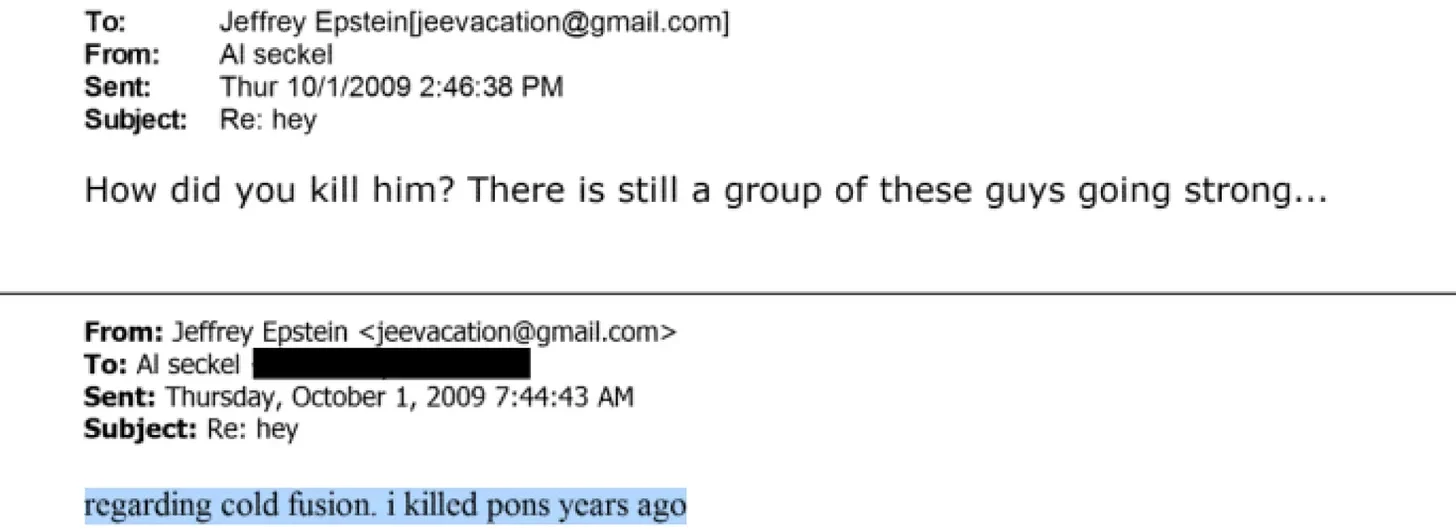
On the morning of October 1, 2009, Epstein wrote to Seckel:
“Regarding cold fusion, I killed Pons years ago.”
Seckel responded the same day:
“How did you kill him? There is still a group of these guys going strong.”
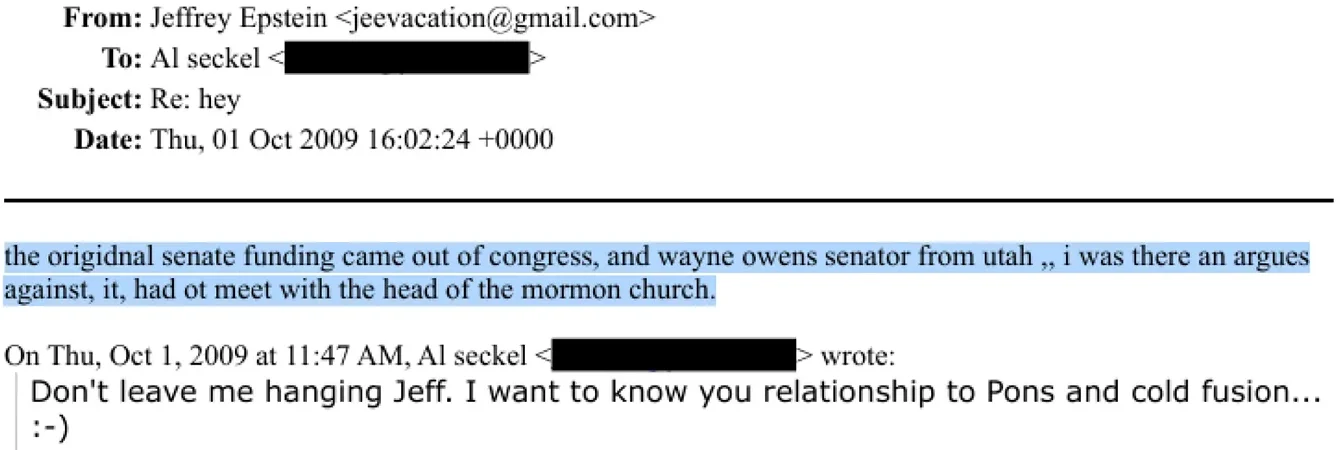
Seckel then pressed further:
“Don’t leave me hanging Jeff. I want to know your relationship to Pons and cold fusion… 🙂”
Epstein replied with specifics:
“The original Senate funding came out of Congress, and Wayne Owens, senator from Utah. I was there and argued against it, had to meet with the head of the Mormon church.”
Who Was Stanley Pons?
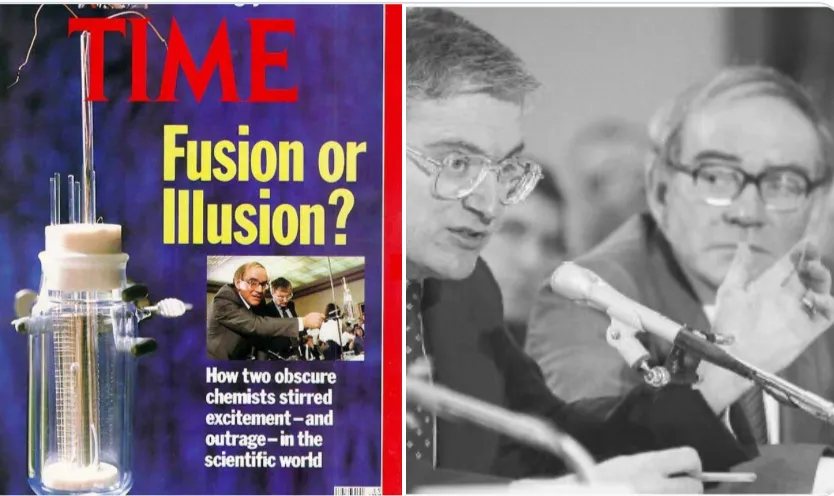
Stanley Pons was an electrochemist at the University of Utah who, together with Martin Fleischmann, announced in March 1989 that they had achieved nuclear fusion at room temperature – “cold fusion.” The announcement generated global headlines and, briefly, the prospect of virtually unlimited clean energy.

What followed was one of the most aggressive scientific takedowns in modern history. Within months, mainstream physics institutions and federal agencies moved to discredit the findings. Funding dried up. Pons and Fleischmann were made into cautionary tales. Pons eventually left the United States, relocating to a laboratory in France funded by Toyota, where he lived and worked in relative obscurity until his death in 2012.
The congressional dimension of the cold fusion controversy is well-documented. In 1989, the University of Utah and the state of Utah aggressively pursued federal funding for cold fusion research. The university sought $25 million from Congress. The state legislature appropriated $5 million of its own funds. Brigham Young University – a private institution governed by the Church of Jesus Christ of Latter-day Saints – was also involved in the cold fusion dispute, as BYU physicist Steven Jones had been conducting parallel (and competing) research.
Wayne Owens, the figure Epstein names, was a Democratic congressman representing Utah’s 2nd district from 1987 to 1993. Epstein refers to him as a “senator,” but Owens served in the House. He would have been the relevant member of Congress during the period when Utah’s cold fusion funding was before the federal legislature.
What Epstein Claimed
Epstein’s account, across his two responses to Seckel, describes:
- That the original funding for cold fusion research came through Congress, via Wayne Owens of Utah.
- That Epstein was physically present – “I was there” – and argued against the funding.
- That Epstein had to meet with the head of the Mormon Church – almost certainly because BYU’s institutional involvement in the cold fusion dispute was routed through the LDS Church’s governance of the university.
- That Epstein took personal credit for the outcome: “I killed Pons years ago.”
This is, to our knowledge, the first time Epstein has been connected to the cold fusion defunding controversy in any public record.
What Seckel’s Emails Add
The Epstein-Seckel exchange does not occur in isolation. In the same thread and in a follow-up email two weeks later (October 14, 2009, EFTA00740600), Seckel provided Epstein with detailed updates on his own activities. Three elements are significant.
Science gatekeeping for billionaires. Seckel described evaluating a cold fusion device “for our billionaire engineer pals on the west coast” – elsewhere identified as “one of the Google guys” – who were about to invest millions. Seckel debunked the device and was paid for the work. His role in the network was as the person who determined which science was legitimate and which was “junk science” – and his clients included founders of one of the world’s most powerful technology companies.
The “Age of Misinformation” panel. Seckel informed Epstein that he was moderating a panel at the Kodak Theatre titled “Are We Transitioning from an Age of Information into an Age of Misinformation? And, what Can We Do About It?” Panellists included Jon Klein (President of CNN), Arianna Huffington, Caprice Young (CEO of Milken’s Knowledge Universe, on whose board Seckel served), Jeff Pulver, and Peter Hirshberg.
In his emails, Seckel articulated the argument in detail: that the “democratization of information, where anybody can be anything or say anything” was dangerous; that people who “want to issue health care advice, start a website” or “want to be a journalist, start a blog” represented a civilizational threat; that “filters at the top of information pipelines” – peer-reviewed journals, professional journalism – needed to be restored; and that the result would otherwise be a “Great Shallowness overcoming and destroying this planet.”
Casual normalization of Epstein’s conviction. In the October 14 email, Seckel opened with: “Congratulations on your labelling! 🙂 I had that badge of distinction given to me by every female I have wanted to be with. Ha.” The “labelling” was Epstein’s registration as a sex offender. One year after conviction, within the network, it was a punchline.
2016: The Gatekeeper Returns
The Seckel emails are not the only place in the federal record where Epstein’s relationship to suppressed science surfaces. Five additional exhibits – EFTA01799438, EFTA00654803, EFTA00827221, EFTA00325084, and EFTA02463658 – contain an email exchange between Epstein and Rupert Sheldrake, the Cambridge-trained biologist and author known for his research into phenomena at the margins of conventional science. The correspondence runs from April 3 to May 18, 2016.
On April 3, 2016, Epstein wrote to Sheldrake:
“At MIT we are beginning a ‘taboo’ science review. crispr, gene drives. etc. What new surprises have you decided to focus on?”
Sheldrake corrected him. CRISPR and gene drives are not taboo – they are as mainstream as science gets. Then he pointed Epstein toward the real taboo:
“One taboo topic I am interested in is the area of LENR – so called above unity devices that produce more energy than they should according to conventional physics.”
LENR – Low Energy Nuclear Reactions – is the term that replaced “cold fusion” after Pons and Fleischmann’s work was discredited. It describes the same category of energy phenomena. Sheldrake sent Epstein links to an Edge.org summary, the results of a one-year trial of Andrea Rossi’s 1MW E-Cat reactor, and a special issue of the Indian Journal of Current Science dedicated to LENR research. He also mentioned a British company working on “a very promising device, currently being tested in some UK government laboratories.”
Then Sheldrake asked the question directly:
“Did you discuss alternative energy possibilities like LENR at the meeting at MIT when you were discussing ‘taboo’ science?”
The federal record does not contain Epstein’s answer.
But the question itself illuminates the structure. The man who privately boasted of killing Pons’s cold fusion career through congressional defunding in the late 1980s was, twenty-seven years later, convening meetings at MIT to determine which suppressed sciences would be reviewed – and a participant was asking whether cold fusion’s direct successor had made the list. Epstein was no longer just the man who killed the science. He was the man who controlled whether it could be reconsidered.
The correspondence also reveals the recruitment pattern documented throughout the Epstein files. Over six weeks, Epstein offered to pay all of Sheldrake’s expenses to Paris, then to Harvard (“Harvard institute will pick up all costs”), tried Skype, then settled for a phone call. Sheldrake was cordial but did not visit. The mutual connection was John Brockman – the literary agent behind Edge.org, the elite science salon that functioned as an intellectual clearinghouse for the world’s most prominent scientists, and whose extensive ties to Epstein have been separately documented. Sheldrake confirmed he was Brockman’s first British client.
Epstein then forwarded the Sheldrake correspondence to a redacted recipient – someone else in the network was being briefed on this recruitment.
The arc is now visible across three decades. In 1989, Epstein claims to have destroyed cold fusion through congressional lobbying. In 2009, he boasts about it privately. In 2016, he is convening the institutional venues where suppressed science might be reconsidered – with the power to decide what gets discussed and what doesn’t. The gatekeeper never left the gate.
What This Establishes
The documentary record establishes the following:
Epstein claimed a specific, verifiable role in the destruction of a scientist’s career through political channels. He did not claim to have debunked Pons’s science through peer review or academic debate. He described lobbying Congress against the funding and engaging the leadership of a major religious institution. This is a description of covert political intervention in the direction of scientific research.
The claim is testable. Wayne Owens is a real historical figure. The congressional cold fusion funding battle is well-documented. The LDS Church’s governance of BYU is a matter of public record. Congressional testimony, appropriations records, and contemporaneous reporting from 1989-1991 could corroborate or refute Epstein’s account. If Epstein’s name appears in any congressional record, lobbying disclosure, or witness list related to the cold fusion funding fight, the claim moves from “Epstein said” to “Epstein did.”
Epstein’s network included people who functioned as science gatekeepers for the world’s wealthiest technology investors. Seckel decided which science Google’s founders should fund. Epstein claimed to have decided which science Congress should fund. Both operated outside the formal structures of scientific review.
The intellectual framework for information control was being articulated inside Epstein’s correspondence network in 2009 – a full decade before it was operationalized through organizations like the Institute for Strategic Dialogue (whose May 2020 report, funded by the Gates Foundation and Open Society Foundations, declared public discussion of certain philanthropists’ pandemic financial interests to be “far-right extremism”) and the Center for Countering Digital Hate (whose “Disinformation Dozen” report was cited by President Biden in 2021 and whose statistics were later found by Facebook’s own internal analysis to have been exaggerated by a factor of at least 1,300).
This is not evidence that Seckel’s 2009 emails caused or directed those later operations. It is evidence that the argument – that democratized health information is dangerous, that independent publishers are a threat, and that institutional filters must be restored to control public discourse – was circulating in Epstein’s post-conviction network, among people with direct access to the leadership of CNN and the investment decisions of Silicon Valley’s most powerful companies, years before it was deployed at institutional scale.
Conclusion
The question raised by Epstein’s claim is not whether Pons was right – it is whether the mechanism by which his research was terminated was scientific or political, and whether a private person with no scientific credentials was exercising undisclosed influence over congressional science funding decisions.
Author: Sayer Ji
yogaesoteric
March 7, 2026