
Explosive! Even tech billionaires know the AI bubble will burst
AI is the mother of all bubbles. When it bursts, the explosion will wipe out most AI companies and all their suppliers. Work on half-finished data centres will be halted, others shut down due to lack of maintenance funds. When companies realize their multi-billion-dollar investments never paid off, many will collapse under their own weight. The scapegoat? Sam Altman (CEO of OpenAI).

Analysts estimate that the AI bubble is 17 times larger than the dot-com bubble and four times larger than the 2008 housing crisis – all because of a single factor: greed.
At the heart of it all is OpenAI. The company operates so-called ‘circular deals’. Put simply: A company invests in OpenAI – and OpenAI immediately uses the money to buy products from that same company.
OpenAI is not profitable. It’s burning through billions and is projected to accumulate losses of $115 billion by 2029. Despite this, gigantic contracts are being signed – and this is where it becomes absurd.
Microsoft: Money cycle as an accounting trick
Microsoft has invested over $13 billion in OpenAI and receives 20% of its revenue in return. But the trick lies in the accounting: Microsoft records OpenAI’s revenue as its own cloud growth.
When OpenAI pays Microsoft for cloud services – with money that originally came from Microsoft – Microsoft counts this as revenue growth.
“I give you $100, you give me back the same $100, and we both claim we each earned $100.” That’s exactly what occurs – only with hundreds of billions of dollars.
Oracle, Nvidia, AMD – a cycle of madness
Even more worrying: OpenAI has signed a $300 billion contract with Oracle over the next five years – despite the company posting an $8.5 billion loss this year. Even Altman admits that OpenAI won’t be profitable until 2029 at the earliest.
Oracle, in turn, buys chips from Nvidia, while Nvidia invests up to $100 billion in OpenAI. OpenAI takes this money – and buys Nvidia chips. Nvidia reports revenue growth, its stock rises – and everyone believes their pension funds are booming.
The Nvidia deal was announced on September 22nd. Just 14 days later, Altman signed a deal with AMD, Nvidia’s direct competitor. AMD granted him an option on up to 160 million shares (10% of the company), in return for which OpenAI was to purchase six gigawatts of AMD GPUs. With what money? Nobody knows.
Nvidia CEO Jensen Huang, when asked about the deal: “Not really.”
Altman “dates” investors at lightning speed – he knows the money will soon be gone. His strategy: New investors are meant to plug old holes. A classic Ponzi scheme.
Even more deals: Broadcom, Walmart & Co.
OpenAI also announced a collaboration with Broadcom – worth up to $500 billion – for chips that will power ChatGPT. In total, OpenAI has committed $1.3 trillion to spending in 2025 – while simultaneously incurring billions in losses. By comparison, the US government spent $1.2 trillion on defence in 2024.
Others are jumping on the bandwagon: Anthropic is collaborating with IBM, Deloitte, Amazon, and Google. Walmart is integrating OpenAI into its shopping experiences.
The AI industry is playing musical chairs with the same pile of money.
The dangerous concentration: The “Magnificent Seven”
Apple, Microsoft, Nvidia, Amazon, Meta, Google, and Tesla – these seven companies make up 34% of the entire S&P 500. An index that is supposed to represent 500 companies is dominated by seven giants – all with massive AI investments.
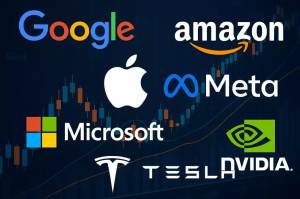
If you have a retirement plan or a 401(k), your money is directly tied to Sam Altman’s ability to attract new investors. Without these “Magnificent Seven,” the US stock market would not have grown in the last two years.
Historical parallels: A crash every decade
- 2000: Dot-com bubble – companies with no revenue, only with “.com” in their name.
- 2008: Real estate crash – 10% unemployment, 10 million families lost their homes.
- 2020: Pandemic crash – unemployment at 14.7%, billionaires increased their wealth by 58%.
Now the fourth crisis is looming, and this time every industry is affected. AI is everywhere: healthcare, insurance, education, power grids, logistics. Even the US government invested $328 billion (2019–2023).
If the bubble bursts, mass layoffs, real estate losses, unfinished data centres – and ultimately government bailouts for AI giants – are likely.
The billionaires’ retreat plan
Mark Zuckerberg owns a 1,400-acre estate in Hawaii with a 4,500-square-meter bunker. Sam Altman, on the other hand, reportedly has an agreement with Peter Thiel who will bring him to New Zealand in the event of a disaster.
Altman in an interview: “I think I really should build a good version of a bunker. It’s definitely on my list.”
Author Douglas Rushkoff describes how these billionaires already know what they are doing: “The most powerful men in the world feel completely powerless in the face of the future they themselves create – so they are preparing for collapse.”
According to Karen Hao (MIT Tech Review), OpenAI co-founder Ilia Sutskever also spoke about bunkers for scientists before they release AGI. [Artificial general intelligence (AGI) is a hypothetical stage in the development of machine learning (ML) in which an artificial intelligence (AI) system can match or exceed the cognitive abilities of human beings across any task.]
Among the super-rich, this is already commonplace – it’s called “Apocalypse Insurance”.
Technofeudalism instead of democracy
These billionaires are creating a world in which they themselves survive – secure, armed, and isolated – while the masses are left behind in chaos.
They are building superintelligence to replace humans, while simultaneously fearing that one day we will rise up against them – as the French once did against their monarchy. Except that today we don’t have kings, but tech overlords.
The empty promise
Sam Altman says: “There has never been a better time to create something new. Young people have access to tools that once required entire teams.”
But in reality: wages are stagnating, housing is unaffordable, birth rates are falling. AI is replacing jobs instead of making them easier.
And while people are entertained by chatbots, these same companies are consolidating power and surveillance.
Conclusion
This is not a market failure. It is the deliberate sell-off of society by tech billionaires who are squeezing the last drop of prosperity out of a dying system – while simultaneously building their own bunkers before the bubble bursts.
yogaesoteric
November 3, 2025