
‘From another world’: 3I/ATLAS shows off its multiple tails in stunning new image
An amazing new image shows the multi-tailed comet 3I/ATLAS shooting past a distant galaxy in the night sky. The stunning scene is a reminder of the object’s interstellar origins, photographer Satoru Murata claims.
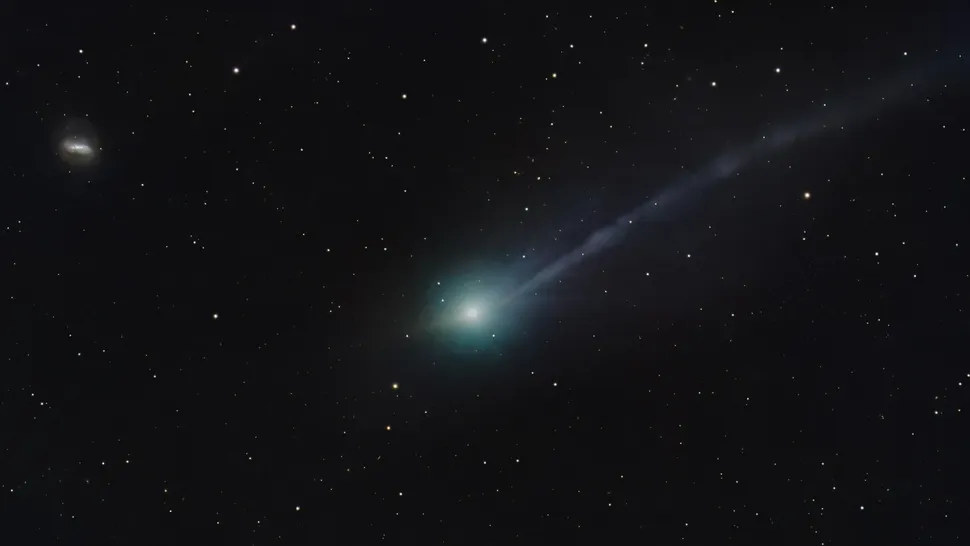
An astrophotographer has snapped a stunning shot of the interstellar visitor 3I/ATLAS photobombing a distant galaxy in the night sky. The remarkable image, which also captured the comet’s multiple tails, is a reminder of the object’s otherworldly nature – but that doesn’t mean it was necessarily made by extraterrestrial beings, the photographer insists.
Satoru Murata, a New Mexico-based photographer who has previously worked on multiple astronomical research projects, captured the new image using a 0.2-meter (0.7 feet) telescope on Sunday (Nov. 16) shortly before sunrise. It shows a familiar green glow coming from 3I/ATLAS’s coma, along with the comet’s long ion tail and the reemergence of its shorter anti-tail, which is likely caused by excess dust blowing off its surface. In recent weeks, the comet briefly appeared to lose both these tails, although this was an optical illusion due to its position relative to Earth.
Eagle-eyed observers may also be able to see several smaller jets of gas shooting outward from the comet’s coma. These are the result of “outgassing,” which occurs when solar radiation heats comets’ icy interiors, causing gasses to shoot out of cracks in their icy shells. This natural process provides a small amount of non-gravitational acceleration to the comet and was the basis of a recent rumour that wrongly claimed 3I/ATLAS had exploded.
In the top left of the image is the barred spiral galaxy NGC 4691, which is located around 70 million light-years from Earth. Seeing the interstellar comet alongside NGC 4691 “really gave the impression of the object being from another world,” Murata wrote in a recent Facebook post.
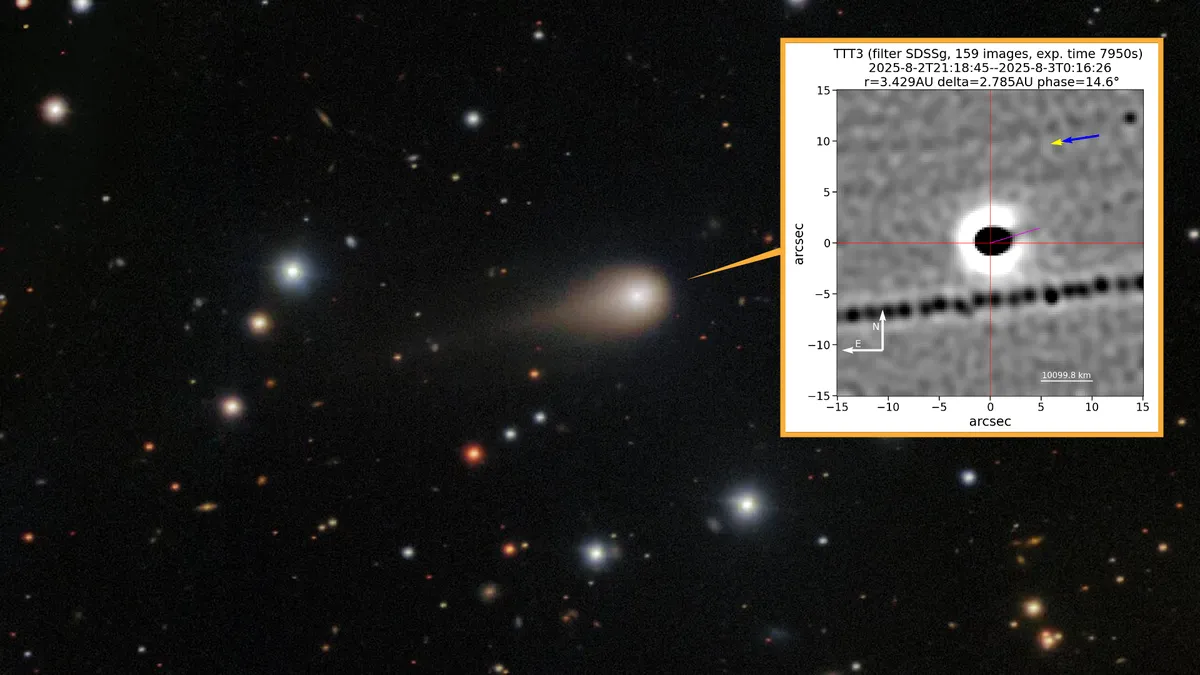
While Murata’s photo has given us an impressive glimpse of 3I/ATLAS, astronomers were eagerly awaiting new high-definition NASA photos of the comet, which were captured in October but released on November 19. These images were captured by NASA’s Mars Reconnaissance Orbiter during the comet’s close flyby of the Red Planet on Oct. 3 but have remained unreleased due to the recent government shutdown.
On November 14, the European Space Agency revealed that its own Mars photos had helped researchers narrow down 3I/ATLAS’s predicted trajectory through the solar system.
Interstellar visitor
3I/ATLAS is the third interstellar object discovered to date and was first spotted in early July, shooting toward the Sun at more than 130,000 mph (210,000 km/h). It likely originates from the “frontier” region of the Milky Way and could be up to 7 billion years old, making it significantly older than our solar system.
The comet recently reemerged from behind the Sun’s far-side relative to Earth, where it reached its closest point to our home star on Oct. 29. The trip around the Sun was eventful, with 3I/ATLAS experiencing an unexpected brightening event and a temporary colour modification. The comet has also displayed several other anomalous characteristics in recent months, including a highly irradiated surface and an overabundance of certain chemicals.
These unusual traits have led some researchers to controversially propose that 3I/ATLAS might be an extraterrestrial spaceship in disguise. However, the majority of the astronomical community agrees that the object is almost certainly a comet. (Similar claims were also made about the first interstellar object ‘Oumuamua, which was discovered in 2017.)
3I/ATLAS will reach its closest point to Earth on Dec. 19, when it will be at a minimum distance of 168 million miles (270 million km) from our planet.
yogaesoteric
November 20, 2025