
Huawei Introduces 5.5G Technology: Augmented Reality, Automation, and Advanced AI, Paving the Way For 6G
“5.5G is expected to support connectivity for up to 100 billion devices, paving the way for smart cities, automated industries, and advanced Internet of Things (IoT) applications.”
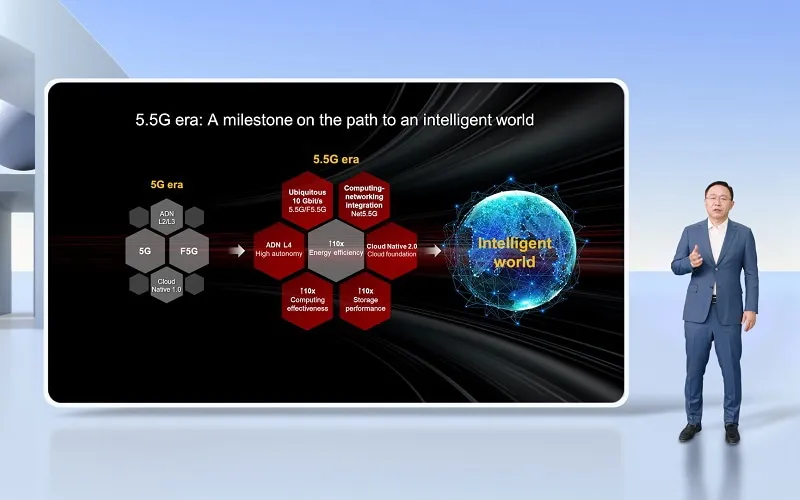
The following report is based on a 2023 presentation from Huawei. The aim of the article is not to promote 5G in any way, but to make the public aware of the final aim of the companies that are now already in full speed for 6G, and of the arguments they use to convince the public to accept this extremely harmful technology.
The Chinese technology and telecommunications company Huawei has quietly unveiled its “5.5G” technology, a subset of a cross-generation technology rollout before the world reaches 6G.
Essentially, 5.5G ushers in augmented reality and metaverse technologies coupled with and powered by complex AI systems. This enables real-time analytics across smart grids and the automation of factories and workflows. As a result, faster streaming and download speeds are possible, such as seamless streaming of content in 4K quality.
Tamas Boday, 5G solutions expert at Huawei, noted that the company is creating a “digital twin” of everything. IBM defines a digital twin as “a virtual representation of an object or system that is intended to accurately reflect a physical object. It encompasses the entire lifecycle of an object, is updated with real-time data, and uses simulations, machine learning, and inference to support decision-making.”
Ronald van Loon, CEO and Principal Analyst at Intelligent World and a Huawei partner, summarized the transition to 5.5G in a LinkedIn article. He wrote:
“Having witnessed the impact of 5G technology on shaping our global landscape, we now stand on the threshold of its next evolutionary milestone: 5.5G. I recently had the honour of moderating a panel discussion at Mobile World Congress in Barcelona entitled ‘5.5G Is Now, Building an Intelligent World Together,’ where I facilitated a dialogue with industry pioneers about the impending revolution in telecommunications. This groundbreaking advancement will modify our understanding of connectivity, speed, latency, and efficiency, setting unprecedented standards for digital innovation across various industries.
From my unique perspective as a Huawei partner, I was able to steer the discussion towards areas that focused on the most compelling features of 5.5G, consumer and B2B use cases that highlight the potential of 5.5G, and potential challenges that still need to be addressed”.
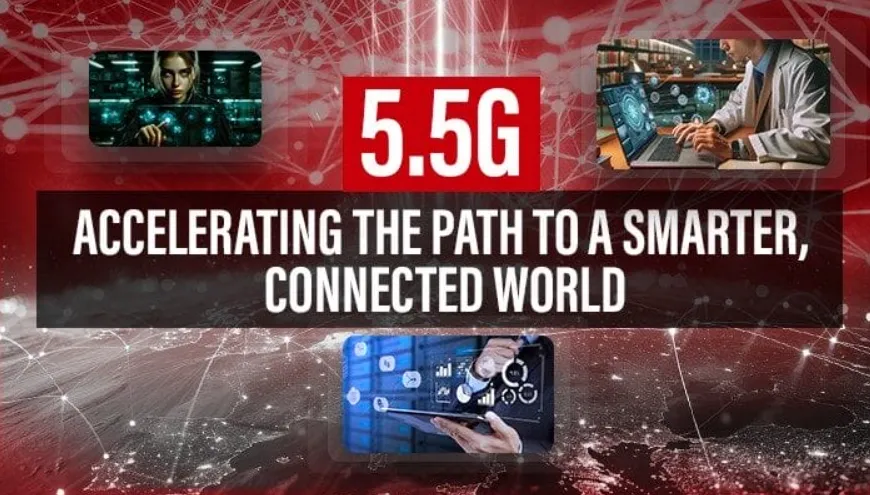
The performance of 5.5G
“The 5.5G technology aims to improve all aspects of network performance, including download speeds of up to 10 Gbps from the internet to devices and upload speeds of 1 Gbps from devices to the internet. Moreover, 5.5G is expected to support connectivity for up to 100 billion devices, paving the way for smart cities, automated industries, and advanced Internet of Things (IoT) applications”, Ronald van Loon said.
Impact on consumers
“For consumers, 5.5G opens up a world of possibilities, including ultra-HD video streaming, immersive augmented, virtual, and extended reality experiences, advanced IoT devices for smart homes, high-quality video calls, and wearables for health monitoring. The technology’s integrated sensor capabilities could revolutionize smart city applications, for example, by improving road traffic and enabling autonomous driving with minimal human intervention” says the tech expert.
Impact on the B2B sector
“In the B2B sector, 5.5G will modify entire industries through improved industrial automation and the possibility of smarter, more efficient networks enabled by AI integration. This also means the potential for highly precise and flexible manufacturing processes, remote healthcare delivery, smart grids for energy management, immersive training, and improved supply chain and logistics solutions. The creation of adaptable virtual networks through enhanced network slicing capabilities will enable tailored services that meet specific business needs.”
Challenges and future prospects
“However, the path to fully realizing the potential of 5.5G is not without its challenges. Upgrading existing networks to 5.5G standards requires significant investment in new infrastructure. Frequency availability and management, energy efficiency, security and data privacy, interoperability and standards, and the need for skilled personnel are among the key hurdles to overcome. Furthermore, there is a risk of widening the digital divide and creating inequalities in access to advanced services between urban and rural areas.
The more we understand the capabilities of 5.5G, the clearer it becomes that it will play a crucial role in jointly building a smart world. Collaboration between industry leaders, organizations, and governments will be essential to overcoming the challenges ahead and unlocking the full potential of this transformative technology”, concludes Ronald van Loon.
yogaesoteric
February 7, 2026