
NASA Suddenly Deploys Its Top Space Assets – Hubble, Webb, and SPHEREx – on 3I/ATLAS
NASA has just done something they never do: launched a dedicated, official webpage for a comet. Not just any comet, but 3I/ATLAS – the so-called “rarest interstellar comet” currently cutting across our solar system on a path that seems to be towards Earth.
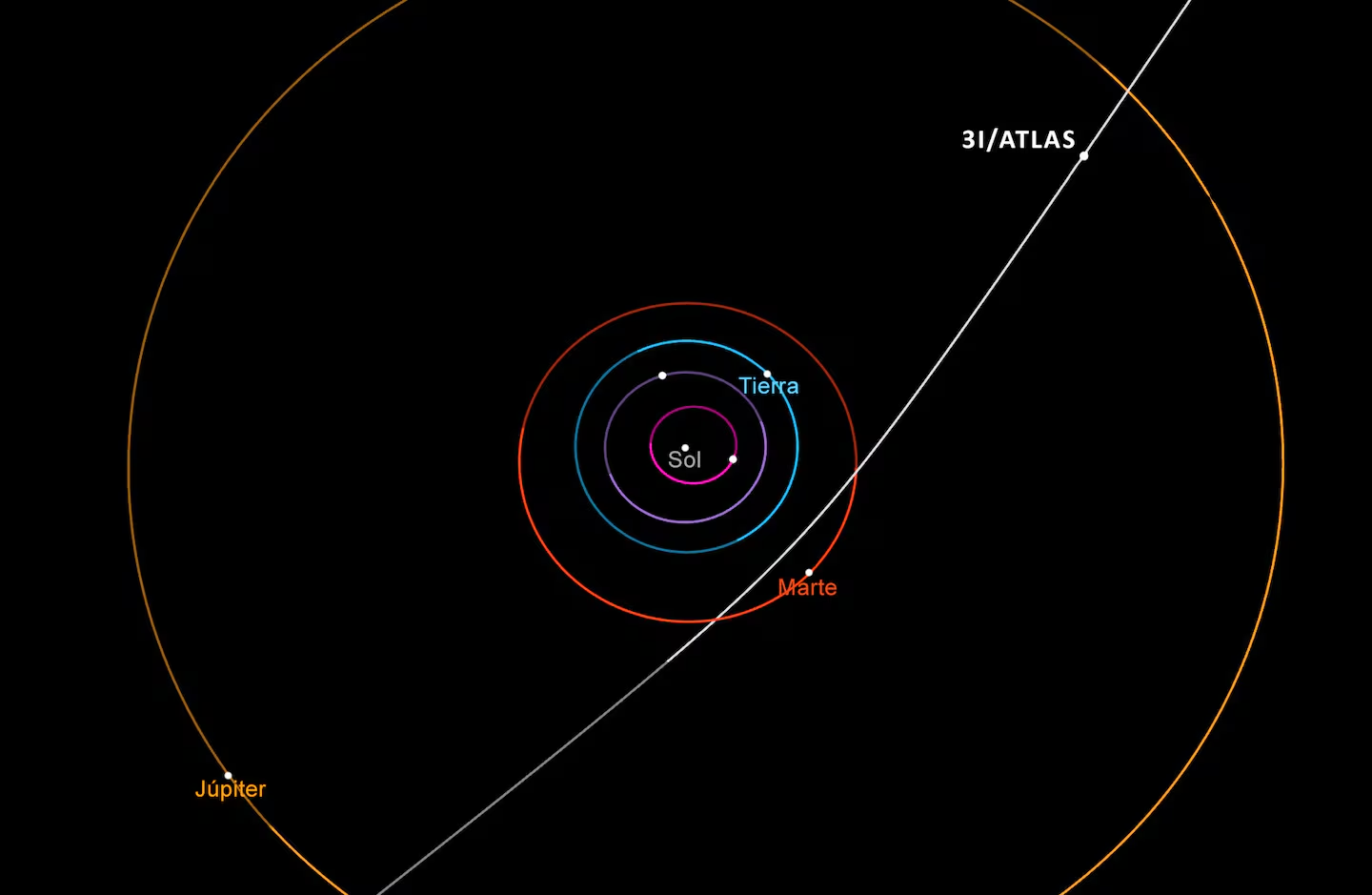
NASA isn’t just watching 3I/ATLAS with one or two telescopes – they’re mobilizing an armada of assets across the solar system. Planned observations involve some of the most advanced machines humanity has ever launched: Hubble, Webb, TESS, Swift, SPHEREx, the Perseverance and Curiosity rovers, the Mars Reconnaissance Orbiter, Europa Clipper, Lucy, Psyche, the Parker Solar Probe, PUNCH, and even joint missions like SOHO and Juice.
For a so-called “harmless comet,” that’s an unprecedented lineup of resources – raising the question of why this one object demands such extraordinary attention.
They didn’t do this for countless other comets. So why 3I/ATLAS? The answer seems obvious: because something big is going on.
From day one, 3I/ATLAS has been a rulebreaker. Its hyperbolic trajectory proves it isn’t from our solar system at all. Unlike Halley’s Comet or any other “native” visitor, this object is just passing through – inbound from parts unknown.
BREAKING🚨: NASA just released an official webpage for the 'rarest interstellar comet' passing through our solar system──something is cooking! pic.twitter.com/gXASKzMx7j
— All day Astronomy (@forallcurious) September 30, 2025
NASA itself admits it’s only the third interstellar body ever detected, after ʻOumuamua (2017) and Borisov (2019). And remember how both of those caused panic in the scientific community: ʻOumuamua with its strange cigar-shape and unexplained acceleration, and Borisov with its bizarre activity that didn’t match normal comet patterns. Now we’re on round three.
And unlike the others, 3I/ATLAS is huge. Hubble observations capped it at roughly 4 miles across, but new estimates suggest it could be 7 miles wide, making it the largest interstellar object humans have ever laid eyes on.
NASA says 3I/ATLAS is showing signs of activity – dust and gas forming a bright coma and tail. But the activity is uneven and inconsistent. The comet’s dust plume is asymmetric, with a sharp teardrop-shaped envelope that doesn’t match standard models.
Even more bizarre, astronomers described it as a “cosmic rainbow” when captured in polarized light – something never before seen with a comet.
Why would a natural icy body scatter light in such strange patterns? Some suggest it could be a sign of engineered materials – reflective dust or metallic particles, not random ice and rock.

The moment speculation began online about whether 3I/ATLAS might be artificial, mainstream outlets like The Guardian rushed to publish hit pieces declaring it was all “overhype” and mocking claims of extraterrestrial origin.
Sound familiar? This is exactly how they handled ʻOumuamua when Harvard’s Avi Loeb suggested it could be a probe. First mockery, then silence. Meanwhile, NASA just can’t stop studying it: Hubble, SPHEREx, ground observatories, and even proposals to turn the Juno spacecraft toward it.
If this were “just a rock,” why the frenzy? Why the resources? Why the secrecy?
Could 3I/ATLAS be an interstellar probe? A derelict extraterrestrial craft? A data-gathering vehicle sent to monitor Earth as our world destabilizes? NASA would never admit it – but their panicked actions speak louder than their denials.
yogaesoteric
October 6, 2025