
New Evidence Counters the Biggest Objection to the Shroud of Turin
Host Edgar Lujano welcomes Fr. Andrew Dalton to discuss the biggest objection to the Shroud of Turin.
Edgar Lujuno: I remember growing up from the secular side being told that the Shroud had been debunked, that its authenticity has been completely debunked back in the 80s, that they did some carbon dating on it or something to that effect, and that it was actually traced back to the Middle Ages and not actually the first century. And is this still true or what’s modern scholarship on the Shroud say now?
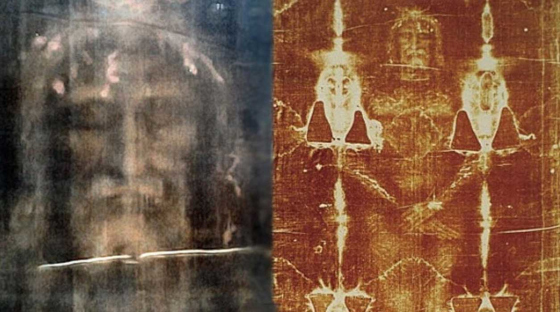
Fr. Andrew Dalton: Right, well, it is. You phrased it just right. […] Well, now we have more information. What do we know? Here’s the science experiment that you need to know about Tristan Casabianca. He is a French researcher. Well, it was the British Museum that had the charge to take an 8-centimeter slice of the Shroud from the top left corner and then it was redistributed. Little pieces were given to Tucson, Arizona, to Oxford, had its laboratory right there. And then also in Zurich, Tristan Casabianca used a Freedom of Information Act to require the laboratories to reveal the raw data, raw data that they suppressed for some three decades. And they didn’t tell you this, but each individual laboratory got its own punctual date. And they’re not the same.
What did they do? They gave you an average, lumping them all together as if they were all one. But they didn’t reveal that actually there’s a gradient that moves in a linear line, the linear function that moves as you go left to right across the cloth, it gets progressively younger. In the space of just 2cm, it gets about 200 years younger. And since it’s a linear function, you have to extrapolate and realize that if this continues, that by the time you get to the far-right corner of a cloth that’s 4.4 meters long, you’d have to imagine a date in the far-off future. And that’s just not possible.
So these are just some of the reasons that they came to conclude that it was an untenable result. Mostly because it’s not just that they were heterogeneous amongst themselves. Oxford, Arizona, Zurich. But they’re not like the rest of the Shroud, which is the whole. And so, what you typically would do is take samples from here, there and everywhere and then, you know, get a sense of the whole garment. But instead, they took one sample from the top left corner, which we knew to be chemically anomalous. It’s not like the rest of the Shroud. It’s not representative of the Shroud, of the hole.
And they already knew that 10 years prior. If they had just looked at the brightness map……. if you do, if you shine UV light and capture what fluoresces back, you can understand the chemical composition of the cloth. And it’s all the same colour, more or less these warm hues, except for that top left corner which is forest green. And so, they knew, or they ought to have known, that that portion of the cloth is not representative of the cloth as a whole. And yet that’s exactly where they drew the sample.
It’s not representative of the cloth as a whole. Some people think that there are contaminants in it, in that top left corner. Maybe there’s some fungus, maybe there’s some result of a fire, maybe there’s some weave from the 16th century having repaired the cloth. Maybe it’s because of the very event of the Resurrection that skewed those results. Pick the theory of your choice. The result is the same. That test proves nothing about the date of the Shroud as a whole.
Again, not my opinion, but a scholarly, international consensus on that point. So if somebody tells you the Shroud has been proven to be from the Middle Ages, you can know that they’re not up to speed on the latest scholarship. That was published in 2019. The research came out in 2017. And the only reason it was revealed in the end was because they were compelled by law to do so.
Edgar Lujuno: So they already knew that portion that they pulled from the Shroud itself was not like the rest of it.
Fr. Andrew Dalton: They certainly ought to have known, had they done their research, because that came out 10 years prior. But we have this on videotape, the moment they’re about to snip away 8cm of the most prized relic in the whole Christian world. And they’re debating amongst themselves, where should we cut the sample? I always said, do you think maybe you should have had that figured out? I don’t know, like the day before! This is ridiculous, you know, when they come to study the shroud in 78, they’ve prepared for a whole year so that all their tests would be non-destructive. They even made a stainless-steel backing and then with magnets mounted it so that they didn’t have to even with a pin kind of prick or damage in any way.
And here we are about to carbon date it. Carbonizing means charring, burning it to a crisp and then counting the C14 and comparing it to the C12. You’re going to ruin it forever. And yet they don’t know where they’re going to take the sample. This is really irresponsible, but it’s chronicled. Check out the book by Joe Marino that tells the story in some 800 pages of all the ins and outs of it.
But the bottom line will be the same, that it’s simply not proved anything about the date of the Shroud. We have other tests that do point towards the first century. It’s true that it would be lovely if we also had radiocarbon date that pinned it to the first century, if that’s even possible. And some say with the event of Resurrection, maybe that’s not even on the table as a viable way to date this particular cloth, given the unique circumstances which it finds itself in [the Resurrection].
I don’t know what that does to the chemical structure of anything. But I hope the bottom line is clear that people have often clung to that because it was convenient to do so. Right, because it was a way of dismissing all the rest. But here you have a plethora of evidence that points in the direction of authenticity. But you know what? I don’t need to look because I have one smoking gun that says ‘It’s medieval, it’s fake, so ignore the rest.’ That’s not how a good detective does his work. You don’t disregard all the rest of the evidence and just cling to the one piece that serves your own purposes.
Edgar Lujuno: Yes, well, not just disregard, but suppress evidence. And some of the most important evidence that you need in order to prove it’s authentic.
The Shroud of Turin is the most studied artifact in human history – and after hundreds of thousands of research hours across dozens of scientific disciplines, no one can explain it.
Still, there is plenty of evidence that this ancient linen cloth is the burial – and Resurrection – cloth of Jesus Christ.
From the photographic negative hidden for centuries before photography existed, to the 3D holographic body data, to the 34 trillion watts of energy required to produce the image, there are many scientific facts about the Shroud that point to its authenticity.
The Shroud also reveals information about the painful reality of Christ’s sacrifice – over 700 distinct injuries, the brutality of the scourging, the crown of thorns, and the forensic evidence of blood in exactly the Bible mentioned locations.
yogaesoteric
April 9, 2026