
No more hiding: Iris biometrics identifies people while walking
NEC’s “on-the-move” biometrics pave the way for total identity control.
With the introduction of a system that merges facial and iris biometrics into a single recognition unit and identifies people as they walk, the technology company NEC is crossing a crucial threshold. What is being sold as an efficiency gain for security and access control actually marks the transition from spot checks to permanent, invisible data collection.
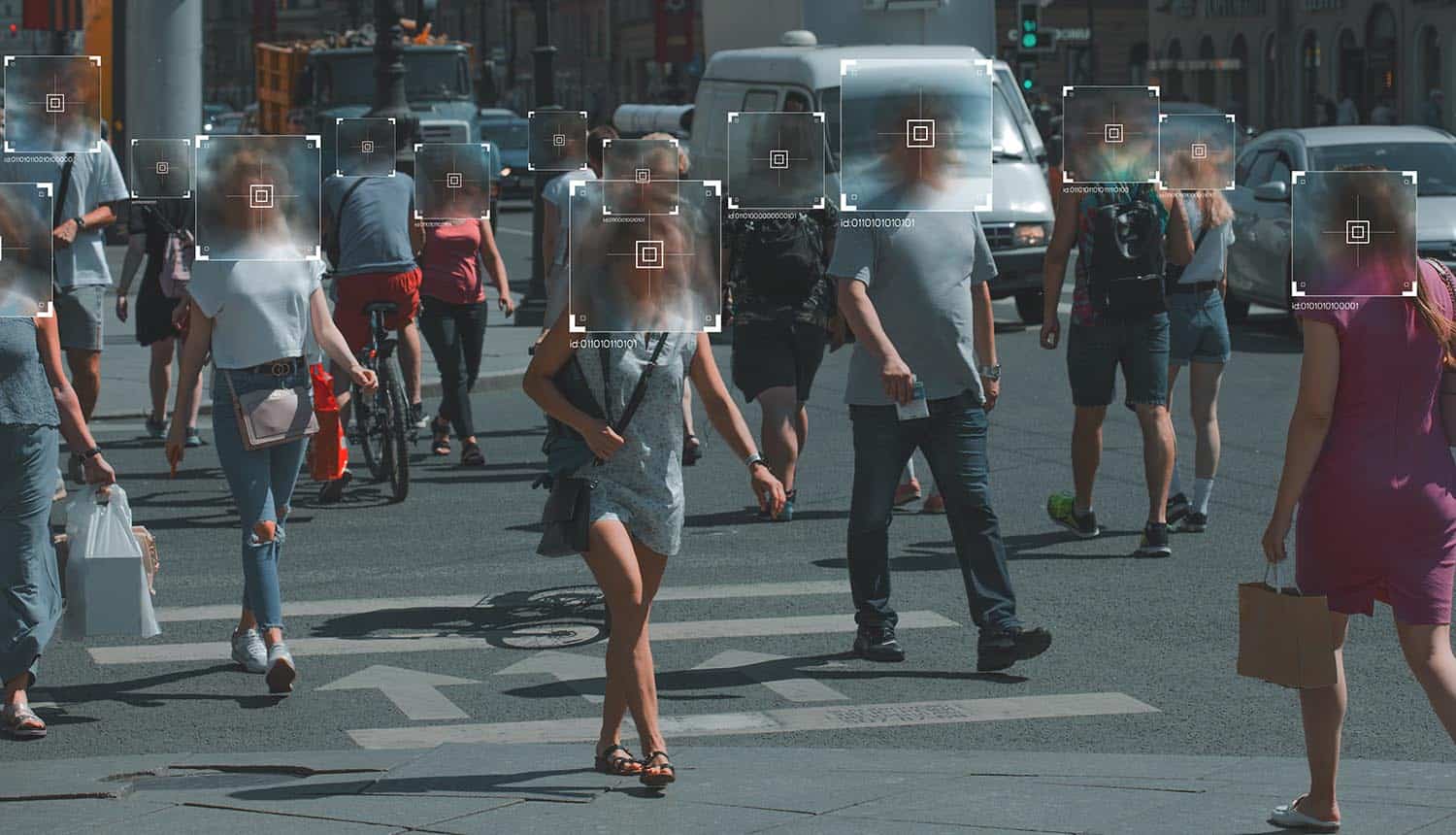
The core of this development lies not in the accuracy of the technology, not in the combination of two biometric characteristics, and not even in the size of the underlying databases. The crucial factor is the principle of identification “on the move.” People no longer need to stop, touch a device, or perform any conscious action. Recognition occurs automatically, from a distance, as they move through public spaces.
This effectively abolishes a previously established principle: the assumption that identity checks are tied to clearly defined places, moments, and consent. With this technology, control is decoupled from interaction. It becomes invisible, seamless, and therefore ubiquitous.
The oft-cited justification that biometrics serves solely for security and is only used voluntarily or at sensitive points such as borders thus loses its foundation. A system that can identify people in passing is no longer an access control system. It is a tool for comprehensive data collection in public spaces.
The scalability is particularly concerning. According to analysis, the system is capable of matching people against databases containing up to one hundred million identities. This no longer corresponds to user groups, but to entire populations. Infrastructures of this kind can be easily linked to digital identities, movement profiles, and behavioural analyses. What is technically possible will sooner or later be exploited for political purposes.
The fact that NEC is initially talking about tests and only envisions wider deployment by 2027 should not be reassuring. In the language of large technology companies, “proof of concept” rarely means an experiment without consequences. It’s the familiarization phase. Once such systems are established at airports, train stations, or major events, their expansion will seem logical. The question will then shift from “if” to “where else.”
Control is thus created not primarily through laws, but through infrastructure. Once it exists, it will be used.
As a result, the person becomes their own identification. Face and iris form a permanent, indelible identity that can be read at any time. Public space thus loses its last vestige of anonymity. Not because people have done anything, but simply because they are visible.
This development is not a technological fate. It is a political and societal decision. Those who accept such systems accept the normalization of permanent surveillance and the loss of control over their own identity.
The crucial question is not how precise this technology is, but whether a society is prepared to live in a dystopian world from which there is no escape.
yogaesoteric
February 5, 2026