
Pax Silica and the weaponization of AI supply chains: The new front in the US global economic war
Washington’s latest anti-China alliance aims to control the materials, technologies, and trust networks of the AI age by changing supply chains into political weapons.
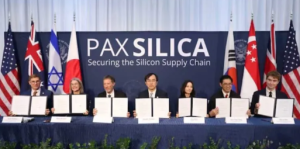
“If the 20th century was powered by oil and steel, the 21st century will be powered by computing power and the minerals that feed it.” This was explained by the US Under Secretary of State for Economic Affairs, Jacob Helberg, during the US State Department’s announcement of Pax Silica, the new flagship initiative for artificial intelligence (AI) and supply chain security.
With this declaration, Washington is drawing a new Iron Curtain through the global economic infrastructure – forged from rare metals, cutting-edge chips, and digital infrastructure, and justified by the familiar language of trust, security, and prosperity. In short, Pax Silica is a non-binding declaration of intent to form a political and economic alliance in the field of AI and its supply chains, primarily directed against China and encompassing seven countries.
What is Pax Silica?
According to the official announcement, Project Pax Silica is the Foreign Ministry’s latest initiative in the area of AI and supply chain security: “We believe that true economic security requires reducing excessive dependencies and building new relationships with reliable partners and suppliers committed to fair market practices.”
At its core, the alliance aims to dominate the AI economy by tightly controlling the supply chains that support it – from raw materials and shipping routes to data flows and chip manufacturing. Ostensibly framed as “economic security” and “trusted partnerships,” the initiative serves as a geopolitical instrument to isolate China and cement Western hegemony in the industries of the future.
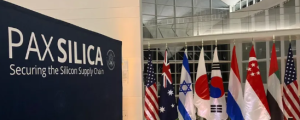
Despite its Latin name (Pax means peace and stability, Silica refers to the world of technology and computer chips, alluding to Silicon Valley), Pax Silica is the economic architecture of a new Cold War. The declaration was signed at the Pax Silica Summit in Washington on December 12, 2025 and the selection of member states – Australia, Japan, the Republic of South Korea, the United Kingdom, Singapore, Israel and the United States – reflects the containment coalitions of earlier eras.
Guest contributions from Taiwan, the EU, Canada, and the Organisation for Economic Co-operation and Development (OECD) further reinforce the Atlantic orientation of this emerging bloc. Partners in the Persian Gulf, as well as NATO member Turkey, are also considered likely candidates for accession, particularly given the country’s “deep industrial capacity and proximity to European markets.”
Trust as a weapon
Pax Silica functions less as an agreement than as a framework for political consolidation. Its real purpose is to establish a common vocabulary of risks and priorities in the AI economy – a kind of ideological supply chain. When states standardize their definitions of what constitutes a “risk,” a “sensitive technology,” or a “trusted partner,” they entrench exclusionary mechanisms in their policies.
Washington understands this strategy well. The initiative paves the way for treating computing power, chips, and rare metals as strategic assets, as instruments of influence rather than neutral market commodities. This creates opportunities for governments to override market mechanisms in favour of political loyalty.
Through stricter investment controls, the expansion of infrastructure within approved networks, and incentives for compliant industries, Washington is attempting to firmly integrate political loyalty into the circuits of the AI economy. Under this system, economic resilience no longer means market power, but rather loyalty to a strategic order.
From goods to leverage
Pax Silica signals a decisive shift away from open global markets toward a regime of restricted access and constructed alliances. Instead of interconnectedness, the new model prioritizes closed networks, guarded by political loyalty. Supply chains, once neutral infrastructure, are being recalibrated into instruments of influence and control.
By explaining AI and its critical inputs in relation to national security issues, Washington is changing economic interdependence into strategic leverage. Cloud infrastructure, data centres, refined metals, and even submarine cables are each becoming control nodes.
The emphasis on the “creativity and power” of the private sector reveals a shifting balance of power in which real authority lies with corporations. While these companies operate within national borders, their investment decisions – where they build, who they hire, whom they serve – are redrawing the geopolitical map. This dystopian fusion of state and corporation enables new forms of economic coercion: embargoes in everything but name.
The initiative also opens the door to the private sector becoming a key geopolitical actor. Companies’ investment decisions – where to build factories, data centres, or design centres – now shape international power dynamics as much as government policy. By controlling sensitive assets such as chips, cloud infrastructure, cables, and refined minerals, private firms can effectively change supply chain nodes into levers or instruments of coercion. This dynamic fosters the emergence of national “tech lobbies” that push governments toward stricter regulations or sanctions, thereby turning market competition into a political tool and increasing the potential for escalation between blocs.
The rise of the techno blocks
Pax Silica is less a defence pact than a forward deployment of economic discipline. It is the framework of a techno-political bloc – an economic organization for the AI age.
At its core lies a simple logic: whoever controls the raw materials and systems that make AI possible controls the future of the world. The text of the declaration itself acknowledges that the AI revolution is “reorganizing the global economy” and “reshaping supply chains,” and that “value and growth” will flow through “every level” of the global AI supply chain. In this way, the announcement defines the next competitive arena as a complete chain that begins with energy and metals and ends with chips, computing power, and digital infrastructure.
US officials openly compare Pax Silica to the G7 of the industrial age – and frame it as a coordination platform for an influence cartel. It is a governance structure not designed to manage competition, but to exclude rivals from the fundamental infrastructure of tomorrow’s economy.
China emerges as the most clearly implicit context in Western reporting on the initiative. The approach of US administration views control of certain sensitive links in the supply chain – particularly critical metals and chip-related industrial capabilities – as a factor that gives Beijing room to politically exploit “bottlenecks.”
China in focus
Helberg specifically mentioned China and the Belt and Road Initiative (BRI) and was quoted by POLITICO as saying:
“This is an industrial policy for the Economic Security Coalition, and it’s a turning point because there’s currently no group where we can come together in the field of AI economics and discuss how we’re going to compete with China in the AI space. By aligning our approaches to economic security, we can begin to act in a coordinated manner to essentially block China’s Belt and Road Initiative, which is designed to expand its export-oriented model by blocking China’s ability to buy up ports, major highways, and transportation and logistics corridors.”
Helberg added: “This group of countries will be for the AI age what the G7 was for the industrial age,” noting that it “commits us to a process in which we cooperate on aligning our export controls, screening foreign investments, and combating dumping, but with a very proactive agenda to secure bottlenecks in the global supply chain system.”
Beijing’s reaction was cautious. On December 12, Chinese Foreign Ministry spokesman Guo Jiakun stated: “We have taken note of the reports,” and called for “all parties to adhere to the principles of the market economy and fair competition and to work together to maintain the stability of the global supply chain.”
However, the state-run Global Times was much more direct, describing Pax Silica as a US attempt to decouple China from the global semiconductor supply chain – and warning that such a move would destabilize markets and drive up costs.
Israel’s pursuit of AI centrality
Tel Aviv’s prominent role in Pax Silica reflects both the alliance’s core objectives and Israel’s strategic recalibration. Israel is positioned not as a peripheral tech partner, but as a central hub in the AI economy – with access to resources, design expertise, and logistics.
Israeli commentators have openly described the move as a crucial alignment with Washington’s post-Chinese economic order. Tel Aviv is trading political loyalty for guaranteed access to the command centres of AI development and views its participation as part of the broader strategic rivalry between the US and China, as well as a “common front” against China’s dominance in critical minerals and advanced technologies. Once keen to avoid direct confrontation with Beijing, Israel now finds itself increasingly compelled to align with Washington – even at the cost of limiting its own strategic and economic flexibility.
“Israel’s joining the US-led Pax Silica initiative is a testament to the excellence of Israel and its high-tech industry,” said Avi Simhon, economic advisor to Israeli Prime Minister Benjamin Netanyahu, in a statement, “which is recognized as a global leader in innovation and artificial intelligence.”
This decision also highlights Israel’s regional dilemmas. Despite the expansion of normalization efforts – including ongoing diplomatic rapprochements with Syria and Tel Aviv’s recent recognition of Somaliland – Israel’s regional isolation remains unresolved.
Popular resistance to normalization persists across West Asia, and efforts to weaken Lebanese resistance militarily continue. In this context, Tel Aviv’s fallback option was to entrench itself in transnational infrastructures protected by US dominance.
Its integration into Pax Silica represents a calculated safeguard – an attempt to anchor its economic future in Washington-led frameworks while simultaneously managing the long-term consequences of its colonial consolidation.
A new phase of economic confrontation
Pax Silica marks a shift in how Washington projects economic influence. Instead of relying on traditional trade frameworks, it is reshaping the rules of trade to consolidate control over the lifeblood of the AI economy. Innovation, once seen as a driving force, now moves in lockstep with the security doctrine.
This shift situates AI within a hardened architecture of strategic planning, where access to materials, infrastructure, and data becomes a function of geopolitical loyalty. Economic networks no longer serve as shared platforms, but as instruments of division and leverage.
For countries outside the core bloc, particularly in the Global South, this consolidation narrows strategic options. As supply chains are redrawn along ideological lines, access to critical systems increasingly depends on political positioning rather than economic need.
India’s absence from the framework is conspicuous, but has been downplayed by US officials. Helberg pointed to ongoing talks with New Delhi, stating:
“We view India as a highly strategic potential partner in our efforts to ensure supply chain security and welcome the opportunity to engage with them.”
Washington’s endgame appears to be the construction of a digital fortress – an infrastructure of dominance guarded by standards, restrictions, and selective cooperation. Whether this vision endures depends as much on material flows as on the willingness of others to either resist or submit to the structure it imposes.
Author: Mohamad Hasan Swidan
yogaesoteric
January 12, 2026