
Starlink – The silent militarization of the skies. How a private satellite network is changing war, politics, and the atmosphere.
Camouflage as a civilian engineering project
Starlink is often touted as a triumph of modern engineering, a global network of thousands of small satellites designed to provide internet access to even the most remote regions. It promises connectivity and progress, digital equality and technological innovation. But behind this rosy narrative lies a project that has long since surpassed the civilian sphere. Starlink is not merely a communications infrastructure, but a geopolitical architecture designed to project power, exert control, and secure digital supremacy in orbit.

The official narrative follows a simple pattern: SpaceX as a revolutionary company democratizing the skies. Elon Musk as a visionary bringing the internet to where governments fail. In reality, however, the business model is so massively subsidized that the term “private” hardly applies anymore. More than half of the development costs come from government contracts – military, security-related, classified.
Even more problematic is the structural effect: Starlink removes global communications infrastructure from public control. What was previously subject to national or multilateral rules now belongs to a company headquartered in the USA, which is neither accountable to international bodies nor subject to democratic regulation. Those who want access pay. Those who are blocked remain silent.
That such a system was designed for strategic dominance from the outset is evident in its architecture. The satellites fly in low Earth orbits, are modularly interchangeable, and can be replaced within days. A “living swarm” that is constantly expanded, replaced, and optimized. Control lies in automated ground stations whose software is centrally managed via servers in the USA. No country in the world has access to it.
This means that the planetary communications layer is effectively being privatized. And this privatization is irreversible as long as no alternative system of comparable reach exists. Europe is planning such a counterweight with IRIS2, but it is years behind – technologically, financially, and politically.
Starlink is thus a textbook example of modern power politics disguised as digital innovation: a civilian project that has long since fulfilled a strategic function. While governments are still talking about “digitalization,” the skies above them are already divided into private zones – a network that regulates itself, renews itself, and no longer serves the purpose it purported to.
Ukraine – the test run
The war in Ukraine was the moment when Starlink revealed its true nature. What had previously been sold as a civilian technology promise – high-speed internet for remote regions – transformed into a military backbone in the spring of 2022. While Russian troops destroyed radio masts, severed fibre optic cables, and brought the country’s communication networks to a standstill within hours, small, inconspicuous grey cases – Starlink terminals – suddenly appeared at Ukrainian military bases. They didn’t arrive by humanitarian chance, but through official Pentagon channels.
Within a few weeks, several thousand devices were operational. They were located in command posts, field hospitals, and makeshift drone bases. Orders, satellite images, and target data flowed through them. The Ukrainian Ministry of Defence spoke of a “communicative resurrection.” What hardly anyone noticed: This lifeline didn’t run through Ukrainian infrastructure, but through a private network owned by the United States.
Starlink didn’t just enable communication between units. It modified warfare itself.
Drone pilots could control their devices in real time over hundreds of kilometres, artillery officers received precise target coordinates from the cloud, and paramedics transmitted live images from front lines. The speed at which information flowed was militarily revolutionary and politically sensitive. Because it depended on a single man: Elon Musk.
In September 2022, a crisis erupted. The Starlink connection was deactivated in parts of Crimea, out of fear that Ukraine might use the system to attack Russian positions and thus ignite a world war. Suddenly, entire drone squadrons were without signal. In a modern war, where communication is life and death, this was a tactical earthquake.
This moment revealed the new reality: A private entrepreneur was deciding the fate of a sovereign state’s military operations. No general, no defence secretary, no president – a single technology corporation was controlling the communications infrastructure of an army. The Pentagon reacted with a mixture of admiration and panic. Admiration because the system was so robust and effective. Panic because it wasn’t state-owned.

Since then, Washington has sought to secure its influence through contractual agreements. But the precedent remains: For the first time in the history of a war, a private network became both a decisive tactical instrument and a political risk.
Starlink wasn’t an aid project in Ukraine. It was a test run. A demonstration of how technology can shift power: away from states and towards corporations. And this test run was so successful that military integration is now merely a matter of formal implementation.
Military Integration – Starshield and the New Orbital War
After the Ukraine deployment, it was clear: Starlink was no longer just civilian infrastructure; it was military infrastructure, albeit privately operated. And barely a year later, this realization became an official program. In December 2022, SpaceX announced a new brand: Starshield. The name was no coincidence. It represented the next step: the integration of the private satellite constellation into the United States’ military architecture.
Starshield is technically almost identical to Starlink, but the software and prioritization differ fundamentally. While Starlink was developed for civilian users, Starshield operates with military encryption protocols, tiered access levels, and exclusive data channels for the Pentagon. Official documents from the U.S. Space Development Agency (SDA) describe the system as a “flexible, scalable communications network for tactical operations.” The underlying idea is simple: if warfare is digital, the network should not be publicly owned, but rather in secure hands. And in this case, “secure” means American.
The Pentagon has massively expanded the cooperation since 2023. Starshield is being tested for real-time communication between drone swarms, for data transmission between reconnaissance satellites, and for integration with AI-supported targeting systems. It is part of the “Joint All-Domain Command and Control” (JADC2) concept, which aims to unify the flow of information between land, air, sea, cyber, and space operations. In other words: Starlink and Starshield form the backbone of the digital command level for future wars.
While governments are still debating data privacy and arms control, the US military is creating its own redundant communications sphere. And it’s no longer on Earth, but in orbit. The U.S. no longer needs terrestrial infrastructure to coordinate its armed forces; it has a private cloud made of aluminium, solar cells, and radio frequencies that operates globally.
But the consequences extend far beyond military efficiency. The introduction of Starshield creates an entirely new sector: commercialized space warfare. This is an area in which companies fulfil defence contracts but retain physical control over the system. SpaceX remains the owner of the satellites, even when they are in service to the Pentagon. This is legally novel and politically explosive. In a crisis, it would be unclear who decides on deployment, shutdown, or target prioritization: the state or the operator.
Other nations are also working on similar models: China with its “Guowang” constellation, Russia with “Sfera”. The result is a global arms race in orbit, a “Space Race 2.0”, this time not between states, but between military-commercial networks.
Starshield shows where this is headed: Space is no longer neutral territory, but a militarized data zone. The sky above us is no longer empty; it is filled with systems that listen, see, transmit, and decide. And they do not belong to humanity, but to those who control them through contracts, software, and capital.
The geopolitical lever
Starlink is far more than just a technical system; it’s a geopolitical tool. Whoever controls a country’s communications infrastructure also controls its room for manoeuvre. And that’s precisely what’s going on – not openly, not aggressively, but insidiously, under the guise of digitalization.
With Starlink, the U.S. has created an instrument that goes far beyond traditional diplomacy or military presence. It is a tool of strategic dependence. States that allow the network become part of an American-dominated data architecture. States that block it must build their own alternatives, which costs years and billions. This is not theory, but visible practice: African countries that have opened themselves up to Starlink can now be connected within days, but the entire technical infrastructure, from orbit to the ground, remains proprietary to the US. No state, no telecommunications provider, no international regulator can track what happens on these channels.
This asymmetric dependency has significant geopolitical implications. Starlink is essentially the first digital equivalent of US aircraft carriers: mobile, deployable anywhere, difficult to attack, and activatable at any time. Where infrastructure previously had to be built, protected, or destroyed, today a signal from orbit suffices. A single button press can connect entire regions to the network or disconnect them.
For Washington, this is a strategic dream. Starlink makes possible what traditional alliance politics often cannot: control without direct occupation. Military presence is replaced by digital presence, national sovereignty by licensing rights. And all of this occurs legally, based on commercial contracts.
China and Russia have long recognized the implications. Both are working on alternative models:
- China is building its own mega-constellation with over 12,000 satellites under the name “Guowang” (国网, “National Network”).
- Russia is responding with the “Sfera” project, which aims to link civil and military services. Both systems are intended to mirror Starlink technologically, but will remain under state control.
Europe, on the other hand, has been asleep.
The IRIS2 project, which aims to establish an independent European satellite network by 2027, is making little progress. Budget cuts, jurisdictional disputes, and political naiveté regarding the speed of private players are relegating the EU to the sidelines of digital development. While Brussels drafts data protection regulations, U.S. corporations are conquering orbit.
The geopolitical consequence is clear: Whoever operates Starlink possesses not only data sovereignty but also the power to exert influence. The line between digital sovereignty and de facto foreign control becomes blurred. A country that conducts its communication via a foreign network is no longer a sovereign nation; it is a technological protectorate.
Starlink has united the West but divided the rest of the world. For many countries, it is both a blessing and a threat: access to the network in exchange for relinquishing control. And therein lies the geopolitical leverage – subtle, inconspicuous, but more effective than any sanction.
Dependency as a system
Ukraine was the experiment, Starshield the prototype, but the real goal lies beyond that: a global communications network that can be selectively controlled in times of crisis or conflict. What initially sounds like a technological vision has long since become reality. Starlink has created a new form of dependency, invisible and quiet, but structurally profound.
This dependency operates on several levels. First, technologically: once connected to Starlink, there’s virtually no turning back. The terminals, the software, the frequencies – everything is proprietary, encrypted, and closed. Even governments that officially approve the system have no access to its controls. If SpaceX decides to shut down a region, it goes dark. No law, no treaty can prevent this. What once meant sovereignty – control over one’s own communications infrastructure – is, in this model, tied to private keys.
The second level is economic. Starlink is not just a network, but a global subscription system. Those who are part of the system pay and thus remain permanently trapped in a cycle of digital dependency. States that use Starlink as their national communications platform invest millions in terminals, licenses, and support. But they don’t own any of it. They are leasing their own connection to the world. This is no longer a classic commercial relationship, but rather a form of structural technological blackmail.
And finally, there is the political dimension. Starlink operates as “private infrastructure,” but with direct access to military decision-making structures. The U.S. government can contractually mandate priorities without other states having insight. This structure makes the network an instrument of political control – subtle, but effective. If a country acts against U.S. interests, theoretically, restricting data flow is enough to generate economic and social pressure.
The emerging concept here is new: digital hegemony through infrastructure control. Not weapons, but frequencies determine power. Not columns of tanks, but server farms.
The dependency is intentional. It is not collateral damage of innovation, but its very purpose. Starlink and similar systems are designed not only to connect countries, but also to bind them to the Western technological order. It is a form of modern vassalage, encoded in data packets and terms of service.
And this logic is irreversible. Once you’ve become part of the network, you can’t leave it without regressing. This is the new principle of global control: not ownership, but access determines power, and whoever grants access sets the rules.
The ecological shadow
While Starlink’s political and military influence is steadily growing, its environmental impact is almost entirely ignored. Yet it is enormous. This seemingly invisible infrastructure in space comes at a very real ecological cost, and that cost increases with every new satellite launch.
It starts with production: Each Starlink satellite weighs approximately 260 kilograms and consists primarily of aluminium, silicon, rare earth elements, copper, and lithium. Its manufacture requires roughly 20 to 25 megawatt-hours of energy, along with highly specialized production processes under cleanroom conditions. This translates to an enormous carbon footprint long before the satellite even launches. With over 6,000 units in orbit and thousands more planned, this results in a gigantic material balance – a cycle of melting, launching, and incineration.

The graph above shows the cumulative probability distributions of the Al and Mg ion signals for particles containing Fe during all SABRE 2023 flights from Alaska (n ≈ 175,000). Particles with an Al/Fe ratio greater than 0.1 are likely influenced by spaceflight and account for more than 20% of the particles containing metals. These Al-enriched particles contain about 70% of the cumulative aluminium signal (dashed line). The Mg/Fe distribution is much narrower than the Al/Fe distribution because meteorites are the dominant source of Mg and Fe. (Source: https://doi.org/10.1073/pnas.2313374120)
Each of these satellites has a lifespan of only about five years. After that, it is deorbited in a controlled manner and burns up in the atmosphere. What sounds like a clean recycling process is, in reality, a large-scale release of metal oxides. Upon re-entry, the aluminium oxidizes into fine dust, aluminium oxide, which remains in the mesosphere and stratosphere. Studies by the University of British Columbia and the U.S. National Oceanic and Atmospheric Administration (NOAA) show that several hundred tons of this material are already released into the upper atmosphere annually. With the planned constellations, this could amount to several thousand tons per year by 2030.
These particles are not harmless. Aluminium oxide is chemically stable and reflects ultraviolet light. In large quantities, it alters the radiation balance of the atmosphere, similar to soot particles or sulphates. In the long term, this could influence the temperature distribution in the upper atmosphere, perhaps even processes in the ozone layer. No one yet knows exactly how this new, man-made biogeochemical cycle in the sky will play out, but that it will have an effect is undeniable.
Added to this is the energy consumption of rocket launches. A single Falcon 9 rocket burns approximately 112 tons of kerosene (RP-1) and emits around 350 tons of CO2. In 2024 alone, SpaceX launched over 100 times, generating more than 35,000 tons of CO2 emissions, just for the transport of new satellites. These emissions are released directly into the upper atmosphere, where they have a different climatic effect than at ground level. They contribute to warming but can also cause local cold anomalies.
Then there’s the debris aspect: Some of the burning satellites don’t reach the ground completely destroyed. Metal fragments, especially those made of heat-resistant alloys, survive re-entry and land, often unnoticed, in oceans or remote regions. NASA regularly documents such cases. With each day that several satellites burn up, the total mass of material entering the global biogeochemical cycle increases.
Starlink is therefore not just a digital network, but also a physical system with a planetary footprint. Every message that travels through the network leaves a trail of energy, aluminium, and kerosene in its wake. And the more the constellation grows, the more invisible the ecological cost becomes, because it has literally been shifted to the sky.
The space industry talks about “sustainable connectivity.” In reality, it is the opposite: a permanently rotating cycle of production, launch, use, and destruction; a high-tech consumption system that turns the sky into a dumping ground.
The new form of power
Starlink marks the transition to a new era of political and technological power. It is the first system to demonstrate how sovereignty is being redefined in the digital world, no longer through territory or weapons, but through control over networks, data, and infrastructures that are not subject to any constitution. Here, the state is not gradually, but openly, losing its central function: the protection of communications sovereignty.
It used to be that only states could operate global communication networks – submarine cables, radio frequencies, satellites. Today, however, private corporations control systems that can connect or disconnect entire countries in real time. Starlink is just the most visible example of a development that extends far beyond orbit: Amazon with Kuiper, OneWeb with British-Indian capital, China with Guowang. But no other system is as large, has grown as rapidly, and is as deeply integrated into military processes as the SpaceX network.
This fundamentally shifts the balance of power. The new form of authority is no longer based on state legitimacy, but on technological superiority. One could say: The monopoly of violence is replaced by the monopoly of infrastructure. And this monopoly is far more effective because it is barely visible.
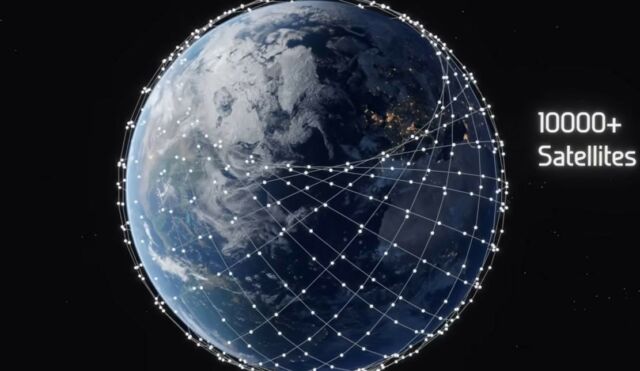
Starlink operates outside traditional legal frameworks. It is not subject to international law, UN regulations, or clear liability. The satellites fly in low Earth orbit, moving between national airspace and the global vacuum – a legal no-man’s-land. If a country were affected by a shutdown or manipulation, there would be no authority to demand compensation. Even if a state opposes its use, like Russia or China, it cannot technically prevent it without resorting to military force to control the orbit.
This creates a new form of power: technological sovereignty without political responsibility. That is the real revolution that Starlink has ushered in.
The ability to create, move, or delete communication spaces is more valuable today than any army.
Because whoever controls what people see, hear, or transmit also controls their worldview. And this power is not hypothetical. It is already being used:
- in Ukraine, where Starlink decides on military operations,
- in Africa, where governments are digitally leasing entire regions,
- in the USA itself, where the system is part of national security strategies.
What is emerging here is a digital feudalism, a world in which corporations rule communication territories like princes, while states become vassals of their own infrastructure. They pay for access, but they don’t own it. They may use it, but not shape it. They have responsibility without control. This is not a dystopian future, but the present. Starlink has shown how quickly power can shift when mediated by technology. And it has created a blueprint that others will follow: private actors overtaking states, not because they are stronger, but because they act faster, more globally, and with less accountability.
Conclusion – The sky as a new limit of power
Starlink is not a communications network in the classical sense. It is an instrument of power, precisely engineered, strategically deployed, and politically underestimated. What began as a technological innovation has become a system that places states, armies, and entire societies in a state of digital dependency. It is the logical product of a world order in which capital, technology, and security are intertwined.
The sky, once a symbol of human freedom, is now the invisible boundary of a new form of domination. Whoever controls it controls the Earth. And this no longer occurs through military occupation, but through orbital infrastructure. Power no longer resides on the battlefields, but in networks, algorithms, and frequencies.
Starlink thus embodies a new form of imperial expansion: no colonies, no borders, no flags, just a grid of data that lies over the Earth like a second atmosphere. This form of dominance is more subtle, but also more comprehensive. It can simultaneously connect and subjugate, network and isolate. Control lies with a few actors who operate globally but are accountable to no one. They are not elected, not vetted, not responsible, and that is precisely what makes them dangerous.
At a time when nations are grappling with climate goals and data privacy, a new power structure is establishing itself above their heads, operating outside any constitution. Starlink is the first stage of this development. Others will follow: Amazon with Kuiper, China with Guowang, and perhaps soon, militarily networked AI systems that autonomously monitor entire regions.
Without political resistance, the future will be shaped not by governments, but by infrastructures; not by decisions, but by networks; not by democratic control, but by technological efficiency.
The skies have thus become the new front line, not of war in the old sense, but of sovereignty. Whoever controls them controls humanity’s communication arteries. And whoever controls them writes history. Starlink is the beginning of this story. How it ends depends on whether the world realizes that the greatest threat doesn’t come from above, but from its own complacency in placing power in the hands of those who are least accountable.
yogaesoteric
December 5, 2025