
The media continue to push the WEF message “You will own nothing and be happy” – CNN says: “Affordability is in crisis: You will never own anything again”
They say we abolished slavery. That’s not true; it has merely evolved and turned us into free-range cattle, and what we have today makes the plantation system seem like child’s play.
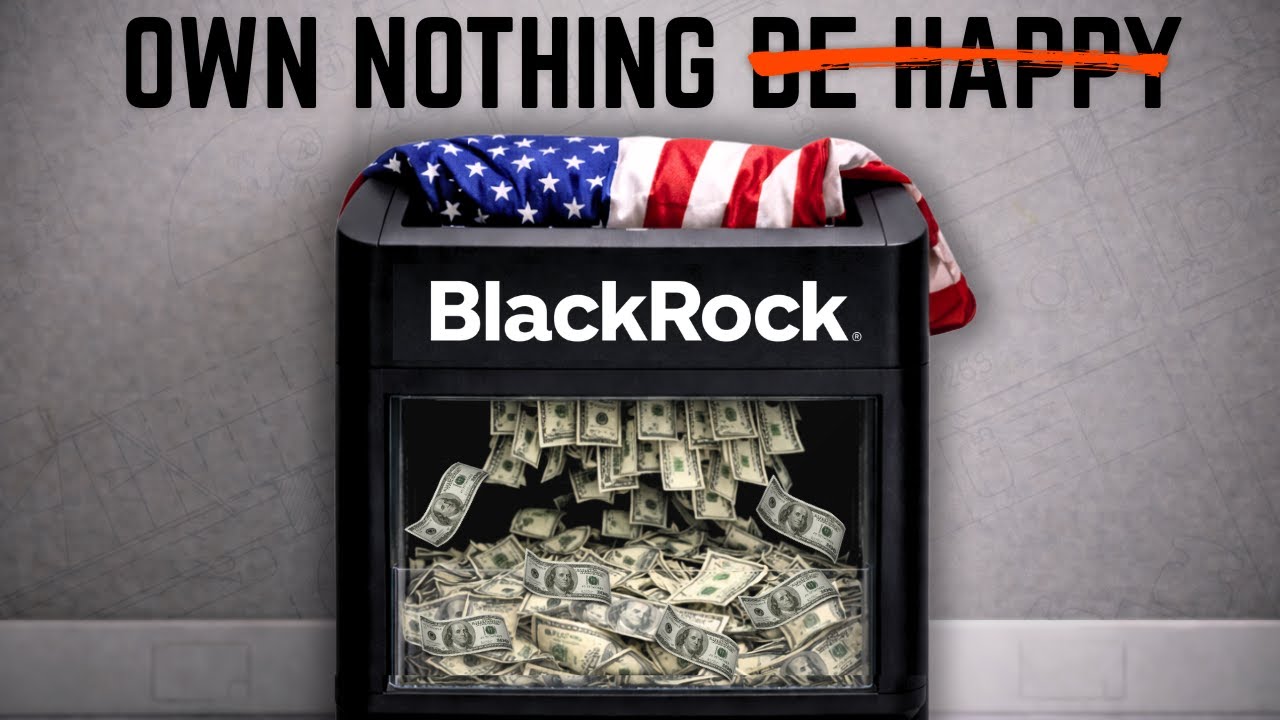
As the cost of living continues to rise for many Americans (and for Europeans alike), many are gradually coming to the conclusion, or have already realized, that owning what once was elementary (a car, a house) is now unattainable. This fulfils the World Economic Forum’s prediction that by 2030, “we will own nothing and be happy” – a slogan quietly introduced in 2015 when very few people paid attention.
Furthermore, around the same time, the WEF published an essay describing what life would be like in 2030. After a number of people became aware of it after 2020, the author issued a statement claiming it shouldn’t be taken literally, but people didn’t believe him, and the WEF eventually quietly removed the article.
The article reads as follows:
“This is how life in my city could change by 2030
Welcome to the year 2030. Welcome to my city – or should I say, our city. I own nothing. I don’t own a car. I don’t own a house. I don’t own any household appliances or clothes.
This might seem strange to you, but for us in this city, it makes perfect sense. Everything you previously considered a product has now become a service. We have access to transportation, housing, food, and everything we need in daily life. Gradually, all these elements became free, so it no longer made sense for us to own much.
First, communication became digital and free for everyone. Then, when clean energy also became free, everything occurred very quickly. Transportation prices plummeted. Owning a car no longer made sense, as we could summon a driverless vehicle or a flying car within minutes for longer journeys. We began to travel in a much more organized and coordinated way as public transportation became easier, faster, and more convenient than cars. Today, I can hardly believe we accepted traffic jams and congestion, not to mention the air pollution from combustion engines. What were we thinking?
Sometimes I use my bicycle when I visit friends. I enjoy the exercise and the ride. It’s as if my soul comes along for the ride. It’s funny how some aspects of life never lose their appeal: walking, cycling, cooking, drawing, and growing plants. This makes perfect sense and reminds us how our culture arose from a close relationship with nature.
In our city, we don’t pay rent because someone else uses our free space when we don’t need it. My living room is used for business meetings when I’m not there.
Every now and then I decide to cook for myself. It’s so easy – the necessary kitchen appliances are delivered to my door within minutes. Since delivery became free, we no longer have all these devices crammed into our apartment. Why should we store a pasta machine and a crepe maker in our cupboards? We can simply order them when we need them.
This has also facilitated the breakthrough of the circular economy. When products become services, no one is interested in short-lived items anymore. Everything is designed for durability, repairability, and recyclability. Materials flow more quickly through our economy and can be relatively easily transformed into new products. Environmental problems seem far away because we only use clean energy and clean production methods. The air is clean, the water is clean, and no one would dare encroach on nature reserves because they are so valuable to our well-being. Cities have plenty of green space, with plants and trees everywhere. I still don’t understand why we filled all the open space in the city with concrete in the past.
Shopping? I can’t really remember what that is anymore. For most of us, it’s evolved into selecting items we want to use. Sometimes I enjoy doing that, and sometimes I just want the algorithm to do it for me. It knows my taste better than I do myself by now.
When AI and robots took over much of our work, we suddenly had time to eat well, sleep well, and spend time with other people. The concept of rush hour no longer makes sense, since the work we do can be done at any time. I don’t know if I would still call it work. It’s more like time for reflection, creation, and development.
For a while, everything became entertainment, and people didn’t want to deal with difficult topics. Only at the last minute did we discover how we could use all these new technologies for better purposes than just passing the time.
My greatest concern is for all those who don’t live in our city. Those we’ve lost along the way. Those who decided all this technology had become too much for them. Those who felt superfluous and useless when robots and AI took over so many of our jobs. Those who grew angry at the political system and turned against it. They live a different life outside the city. Some have formed small, self-sufficient communities. Others have simply remained in the empty and abandoned houses of small 19th-century villages.
Sometimes I get annoyed that I don’t have any real privacy. There’s nowhere I can go without being registered. I know that somewhere everything I do, think, and dream is being recorded. I just hope no one will use it against me.
All in all, it’s a good life. Much better than the path we had chosen, which made it so clear that we couldn’t continue with the same growth model. We had all these terrible situations: diseases of civilization, climate change, the refugee crisis, environmental destruction, completely overburdened cities, water and air pollution, social unrest, and unemployment. We lost far too many people before we realized that we could live differently.”
But for something as fictitious and hypothetical as the WEF claims, it actually seems to be developing as predicted in the article.
In 2024, The Wall Street Journal published this utterly ludicrous piece of propaganda suggesting that some Americans had already adopted this lifestyle: a life in which they don’t even own the shirt they’re wearing, just as the WEF had predicted. The article was titled “The Extreme Renters Who Own Nothing, Not Even Their Jeans; It’s Not Just About Leasing Your Car. Christmas Trees, Camping Equipment, and Even Coffins Can Be Rented.”
Well, the mainstream propaganda ministry is once again spreading a similar message.
In November 2025, CNN sent the same message with a headline that sums it up perfectly: “Affordability is in crisis. The solution: You’ll never own anything again.”
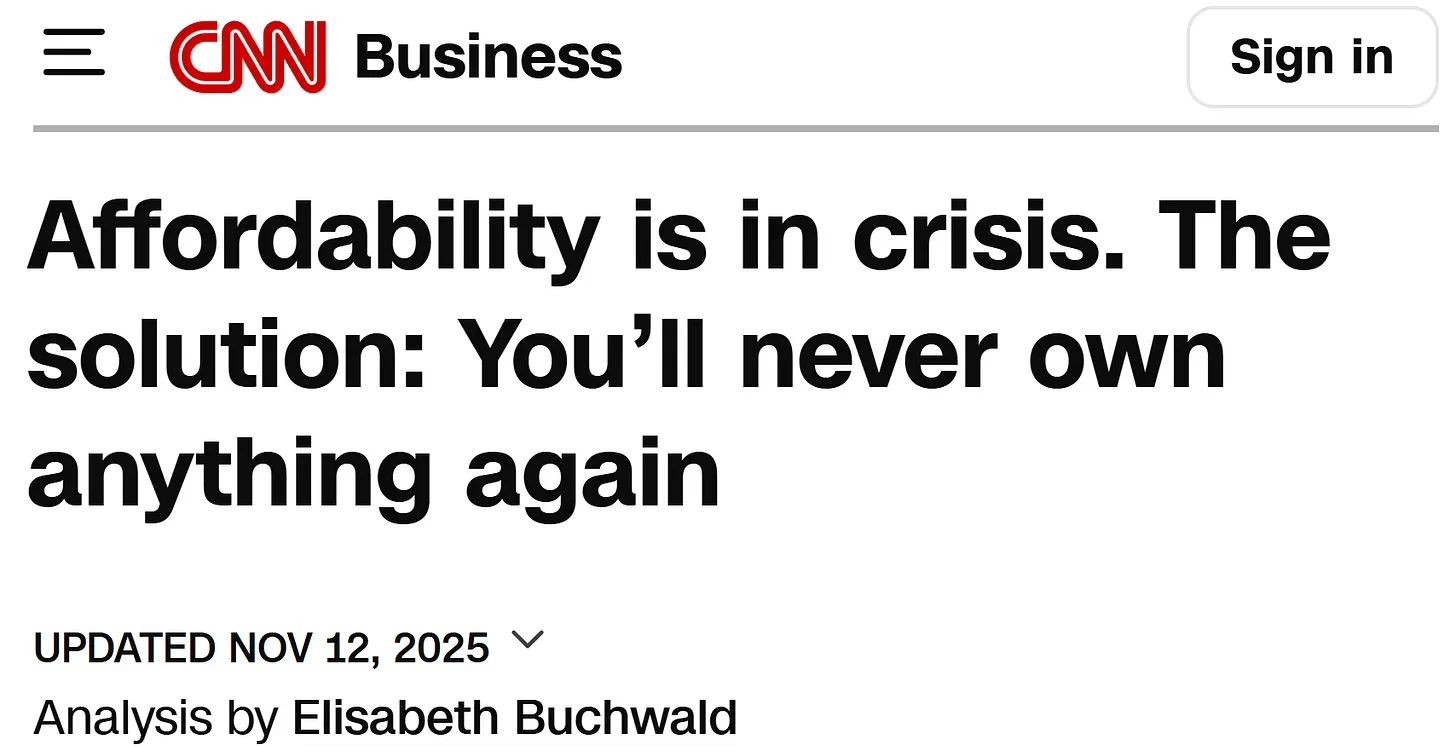
The article begins with the words: “Persistent inflation continues to make the cost of living unbearable for many Americans. A number of innovative solutions have emerged – but they all have one aspect in common: they drive consumers deeper into debt.”
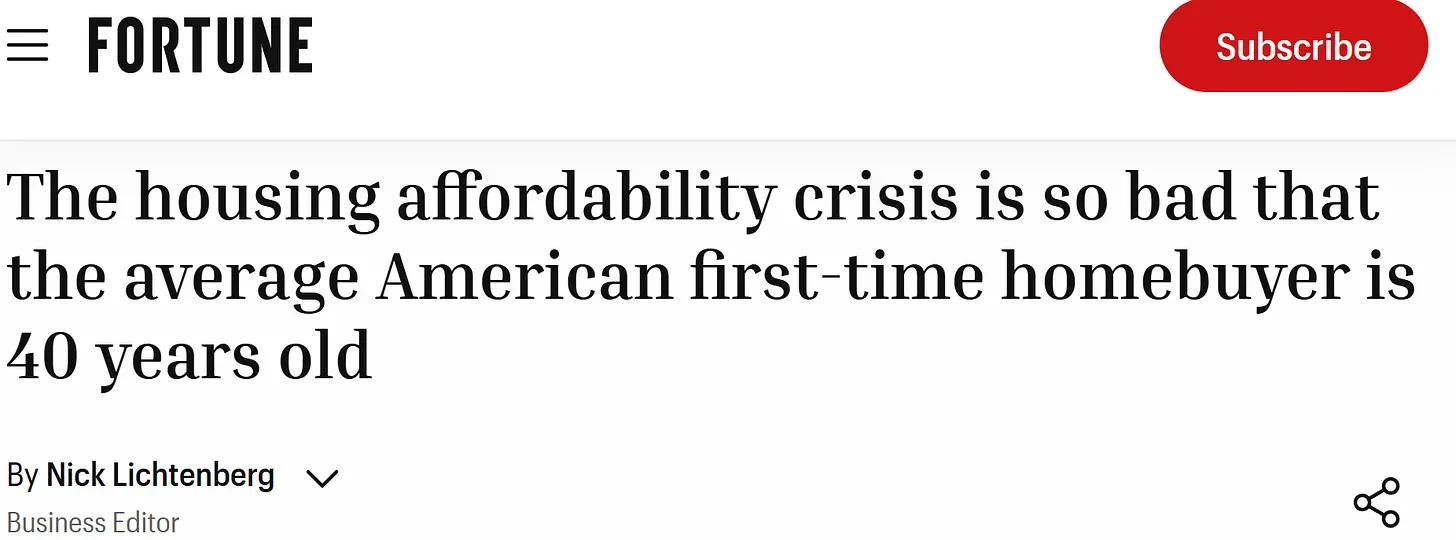
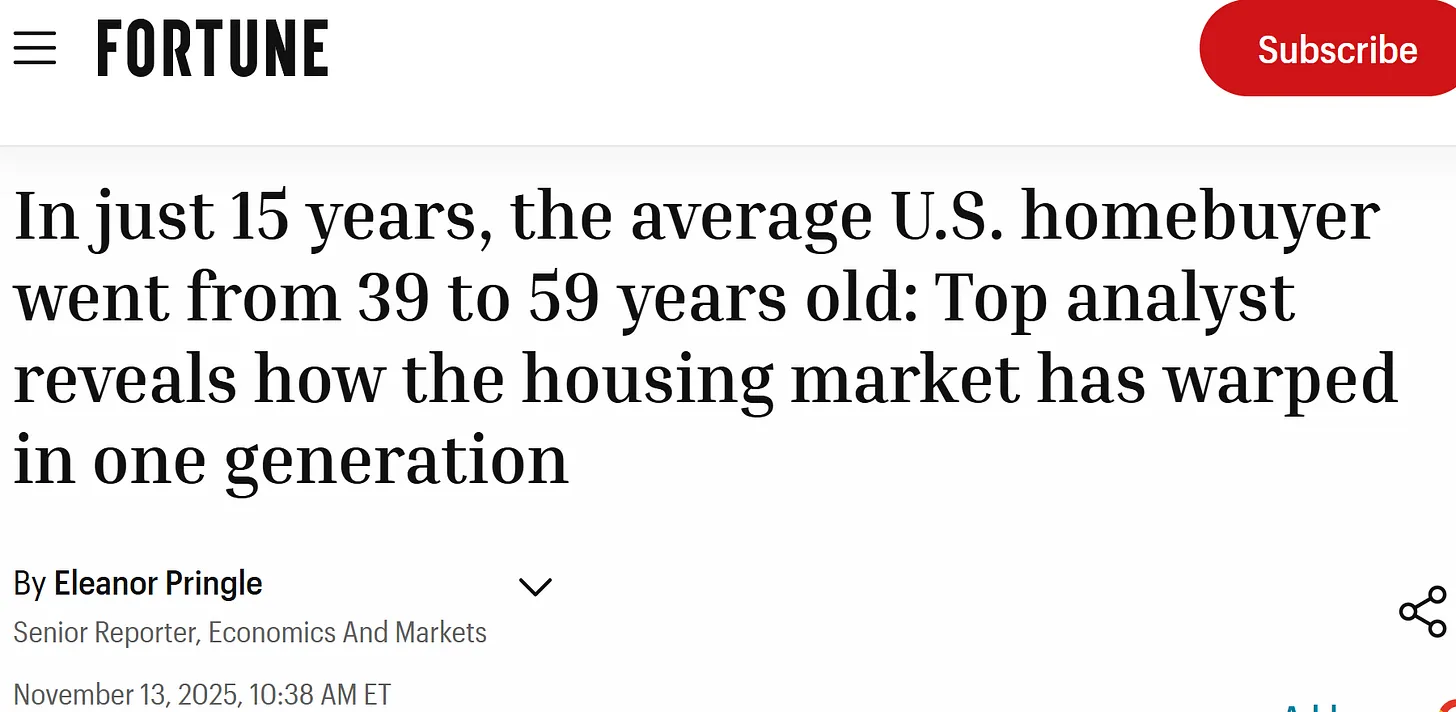
The authors then cite US administration’s recent concept of a 50-year mortgage, which would financially ruin someone for the rest of their life, since the average homebuyer today is in their early 40s. Therefore, anyone foolishly taking on this mortgage won’t even live long enough to pay it off, and even if they somehow manage to pay it off, they will die a few years later.
The interest costs for that are almost twice as high as for a 30-year mortgage, which was crazy for the time, but I guess the US administration doesn’t care.
Furthermore, according to UBS analysts, governments will look for ways to divert pensions and inheritances from shrinking older generations to pay off debts (which in reality means the elite will pocket these funds). Since there will undoubtedly be fools who actually sign up for this and then perhaps die, this mortgage will simply be passed on to someone else who now has the “misfortune” of also being burdened with this debt.
The CNN article goes on to discuss “Buy now, pay later” (BNPL) applications for financing weekly living expenses.
“But increasingly, consumers – especially younger ones – are making purchases they might not otherwise be able to afford, as the recent rise in payment defaults shows.
A study of BNPL users published in 2024 by the Federal Reserve reported that adults who report lower levels of financial well-being and those who appear to be experiencing liquidity or credit constraints were not only among those most likely to use BNPL, but most of these consumers also stated that they used BNPL because it was the only way they could afford the purchases.”
In April 2025, the Washington Post cited a report by Lending Tree stating that 25% of Americans use BNPL apps to pay for groceries.
But BNPL companies are in their own credit bubble and are living on credit.
Meanwhile, as CNN further reports, total consumer and household debt continues to reach new record highs. According to the latest data from the Federal Reserve, Americans are also increasingly falling into serious payment arrears.
“Credit ratings have fallen in 2025 at the fastest rate since the Great Recession. When a person’s credit rating drops, financing existing or new debt usually becomes more expensive, as lenders view the borrower as a greater risk. To compensate for this, they charge higher interest rates.”
But back to the topic of homeownership: Younger generations are realizing that this is unattainable for them in most cases. CNN wrote:
“Owning a home has long been an essential part of the American dream, and for good reason.
While renting has its advantages, the biggest advantage of owning is that real estate tends to appreciate in value over time, generating a stream of wealth to draw on later in life and enabling people to retire.
Not to mention the tax advantages associated with homeownership, such as the ability to deduct mortgage interest payments to reduce overall tax burden. There is no comparable option for rent payments.
‘For a long time, homeownership was one of the most accessible ways for the average person to build wealth,’ said Schulz. But given the high property prices and mortgage rates of recent years, it has become yet another financial decision that makes people hesitate.”
And that’s it: That’s how the article ends.
Basically, everything is too expensive and people are increasingly being driven into deeper debt bondage; and according to CNN, the solution is: “They will never own anything again.”
That has always been the goal of central banks, the modern-day “money changers”: to own everything, to become the lenders and buyers of last resort, where everyone becomes a serf begging for state-subsidized bread, with a digital ID linked to a social credit rating in a tokenized economy.
The CNN article only scratches the surface, because you realize that so many elementary items are becoming unattainable, everything is becoming a service or a subscription, everything is being digitized, so that even paper documents are disappearing.
They say we abolished slavery. That’s not true; it has merely evolved and turned us into free-range cattle, and what we have now makes the plantation system seem like child’s play.
Author: Jacob M. Thompson
yogaesoteric
January 9, 2026