
The Shroud of Turin and the Tucker Carlson Interview
Tucker Carlson, arguably in the top three of America’s most influential political commentators, released an interview (on August 9) with Jeremiah Johnston of the Christian Thinkers Society (CTS) about that Shroud of Turin. Mr. Carlson has 16.5 million followers on X, 5.3 million on Instagram and 4.4 million on YouTube. Anything he promotes is going to gain traction in the wider culture, so the fact that the Shroud of Turin is receiving international attention is good news.
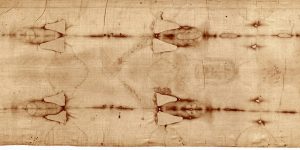
In the interview with Carlson, Jeremiah Johnston spoke enthusiastically and with clarity about all the aspects of the Shroud which lend credence to its likely status as Christ’s burial cloth. Some dot points:
- Injuries are consistent with the gospel accounts of the crucifixion.
- The bloodstain patterns – 120 of them matching the Sudarium of Oviedo, the cloth presumed to match the one mentioned in John 20:6-7.
- The image resides only on the uppermost fibres of the cloth, ruling out the possibility of chemical reactions forming the image.
- Although the image shows the entire body, not all parts of the cloth touched the body.
- The image was not created by vapours from chemicals or the body itself. A major breakthrough in understanding the Shroud of Turin came when John Jackson proposed that an intense burst of ultraviolet (UV) radiation created the image on the uppermost fibrils of the cloth. According to this theory, the body wrapped in the Shroud emitted a powerful flash of vacuum ultraviolet radiation, forming the perfect 3D negative image of the body on both the front and back of the cloth without scorching it. This process, however, is unlike any natural phenomenon we know of, as no known human body can emit such radiation.
- The Shroud has a double image on both the front and back but no image in the middle, suggesting that the cloth collapsed into a mechanically transparent body.
- The image reveals details inside the body, resembling an X-ray effect.
- Anatomical precision and detail, not typical of medieval art.
- The mystery of how the image was created, since there is no evidence of paint, dye, ink or other art materials, and the image penetrates to a depth of only 2 micrometres.
- The presence of pollen grains typical of Jerusalem.
- The physical presence of both pre- and post-mortem type AB blood as well as serum, separately from the image of the body. The blood absorbs all the way through the material (unlike the image). The blood matches that of the Sudarium and moreover, the separate occurrence of the blood and serum match St John’s description of “blood and water” flowing out after the piercing with the lance.
- The previous attempt at radiocarbon dating which dated the shroud to the medieval period, has now been shown to be on a part of the shroud which had been patched by nuns during the late medieval period, using cotton, not the linen comprising the main section of the shroud. No radiocarbon dating has been carried out on the “linen only” parts of the cloth.
- The herringbone weave of the linen is typical of Middle Eastern linen shrouds of the first century, and not of medieval European cloth.
The full interview can be seen here.
yogaesoteric
September 6, 2025