
Three Myths About World Hunger
What do you do when someone makes a well-meaning but misguided comment about the starving? You can sit in silence, or you can help them see that hunger isn’t about laziness, nature, or “too many mouths to feed.” Hunger is political. Hunger is manufactured. Hunger is about power and who controls resources.
Here are three of the biggest myths about world hunger – and why they’re wrong.

Myth One: Overpopulation
We’ve all heard it: “There are just too many people in the world. That’s why there’s hunger.” It sounds logical on the surface – but it’s flat-out false.
The world already produces more than enough food to feed everyone. In fact, global food production provides well over 2,800 calories per person per day, and that’s before counting vegetables, fruits, pulses, and animals/birds raised on grass for eggs and milk. The reality isn’t scarcity – it’s distribution.
The problem is who eats and who doesn’t. The richest countries consume far more than they need. The U.S., with only about 4% of the world’s population, devours around 25% of its resources. Meanwhile, entire regions in the Global South struggle to survive on scraps.
Western countries have enough money to support their populations. There’s little relationship between hunger and the availability of land. Holland has 1,350 people per square mile and Bolivia just 26–31, yet the Dutch are one of the best-fed people in the world and the Bolivian poor among the world’s most undernourished. And Africa may have the world’s greatest food problem – but it isn’t for the lack of land. At the moment only a quarter of Africa’s potential arable land is being cultivated.
Population growth is often thrown into the mix, especially in Africa. But families in poverty have more children not out of ignorance, but necessity. When one in four children dies before reaching adulthood, and more hands are needed in the fields, large families are a survival strategy. Historically, population growth slowed in Europe and North America only after living standards improved. Poverty reduction leads to smaller families, not the other way around.
So, the real issue is not “too many people” – but too much wealth hoarded by too few.
Myth Two: The Weather
When famine hits, mainstream headlines point to “drought,” “flooding,” or “failed rains.” But weather is rarely the root cause of hunger. Poverty and inequality are.
Natural disasters occur everywhere. Hurricanes hit the U.S., earthquakes shake Japan, droughts scorch Australia. Yet death tolls are low in wealthy nations. Why? Because they have safety nets, infrastructure, and resources to respond.
In poorer nations, it’s the poor who are forced onto dangerous lands – floodplains, cyclone-prone coasts, fragile soils. When disaster strikes, they pay the price. In Bangladesh, for example, cyclones often kill the poor who were forced to settle on unstable islands in the Bay of Bengal. Wealthier citizens, with safer homes and access to aid, survive.
In the U.S., farmers once starved during droughts in the 1800s, but today, crop insurance, government subsidies, and infrastructure prevent that. Saudi Arabia even grows wheat in the desert with enough cash and technology. So hunger in Africa isn’t about the climate – it’s about the absence of money, infrastructure, and political will.
And today “climate change” is adding fuel to the fire. But again – whether people starve or survive comes down to poverty, inequality, and access to resources, not just rainfall.
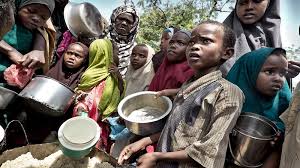
When we say “famine was caused by drought,” we let governments and corporations off the hook. The truth: disasters reveal who has been pushed to the margins – and who is left to die.
Myth Three: Science
The third myth is that technology and science will end hunger once and for all. The Green Revolution of the 20th century – with its high-yield seeds, fertilizers, and pesticides – was sold as the solution for all troubles. But in reality, it solved very little and, in many cases, made everything worse.
High-yield crops look good on paper. But they require expensive fertilizers, pesticides, and irrigation. Wealthy farmers can afford these. Poor farmers cannot. The result? Rich farmers thrive, poor farmers fall into debt, and land ownership consolidates in fewer hands.
Yes, India went from famine to being a net food exporter. But millions of Indians remain undernourished. Why? Because food is produced for markets, not for people. Grain is exported, while poor families cannot afford to eat. Hunger persists not because there isn’t food, but because food is not accessible to those who need it most.
And there are hidden costs. The Green Revolution has depleted soils, poisoned water systems, and driven farmers into debt. In India, thousands of farmers have taken their own lives because of crushing debts tied to chemical farming and seed dependency. Corporations that sell seeds and chemicals profit, while small farmers are left destitute.
Science isn’t inherently bad. Agroecology, crop diversity, and local knowledge offer real, sustainable solutions. But these approaches don’t make corporations rich, so they’re ignored in favour of industrial models that deepen inequality.
Hunger isn’t waiting for a scientific breakthrough. The solutions already exist: land reform, debt cancellation, local food sovereignty, and the end of treating food as just another commodity.
The Hard Truth
World hunger is not about nature, science, or “too many mouths to feed.” It is about politics, greed, and power. There is enough food. There are enough resources. But under a system where the wealthy consume and control more than they need, millions are left to starve.
The next time someone shrugs and says, “Well, that’s just the way it is,” remember: hunger is not inevitable. It is man-made – and it can be unmade.
Hunger Is Caused by Laziness and Corruption
Some people blame the hungry themselves, claiming poverty is the result of laziness or corruption. This is not only false – it’s dangerous and dehumanizing.
Most hungry people work tirelessly just to survive. Farmers in Africa, Asia, and Latin America often labour 12–16 hours a day, yet struggle to feed their families due to low market prices, exploitative trade systems, or climate shocks. Informal labourers and street vendors work endlessly, yet face eviction, debt, or lack of access to basic services.
Corruption exists in many countries, but it is not the root cause of hunger. More often, it’s global structures and policies that allow corruption to flourish: foreign debt, unfair trade deals, corporate land grabs, and exploitative aid programs. When food systems are controlled by multinational corporations or political elites, even honest farmers and communities can’t escape poverty.
Blaming the poor is a way for those in power to shift responsibility away from themselves. Hunger is not laziness. Hunger is denied opportunity.
yogaesoteric
September 29, 2025