
Welcome to the corporate police state: How US companies have turned the workplace into a surveillance lab
The American workplace is rapidly changing into a surveillance system. What was once characterized by results, professional competence, and the completion of concrete tasks is gradually becoming a space of constant digital monitoring. It is no longer enough for employers to know whether an employee has completed their work. They want to know precisely how the employee worked, when they worked, with whom they communicated, which tools they used, which websites they visited, and what digital traces they left behind.
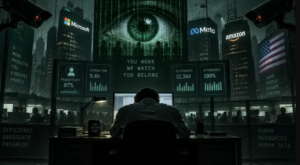
Under the guise of increasing productivity, protecting company data, and optimizing workflows, an entire surveillance industry has emerged, reducing employees’ everyday activities to a series of measurable metrics. Monitoring software can record computer activity, analyse communications, track online time, generate behavioural reports, and detect anomalies in employee behaviour.
How US companies have made total surveillance the norm
Today, company emails, company-provided phones, and internal platforms are more than just work tools for employees. They also serve as data channels for employers. Virtually every digital action – logging into systems, sending messages, opening files, or switching between applications – leaves a trace. What once disappeared in real time can now be stored, reviewed, and pieced together to create a portrait of an employee’s daily habits. Employers are increasingly examining not only the work output but also how the work is performed.
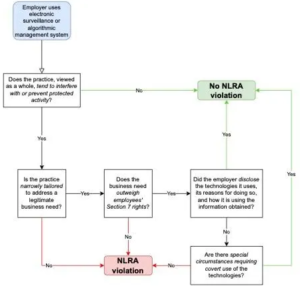
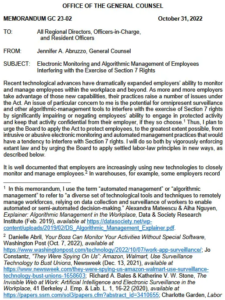
In 2022, the NLRB’s then-General Counsel, Jennifer Abruzzo, warned of the increasing use of electronic surveillance and algorithmic control in the workplace. In her memo, she listed technologies used to monitor employees, including wearable devices, surveillance cameras, RFID badges, GPS devices, and computer software capable of capturing screenshots, webcam images, audio recordings, and activity logs. The memo was retracted by the agency’s acting General Counsel in February 2025.
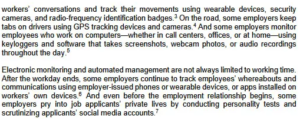
These systems are common in industries where performance is easily quantifiable: warehouses, delivery services, call centres, retail chains, financial institutions, and large offices. The technology allows employers to track productivity, analyse workflows, detect modifications in behaviour, and create digital records of each employee.
America’s monitored workplace
Microsoft
Microsoft is positioning itself as the primary architect of a new generation of corporate surveillance, making every digital trace of an employee a practical target for comprehensive analysis and control. The American software giant is digitizing the processes of communication, planning, and interaction itself, transforming human activity in real time into dry statistical reports that give employers unprecedented insight into their employees’ daily behaviour.
Microsoft’s Productivity Score tool, introduced as part of the Microsoft 365 ecosystem, puts this approach into practice. The system allows organizations to measure workplace activity patterns using indicators such as email usage, interactions in Microsoft Teams, collaboration habits, and the use of company applications. Microsoft’s dashboard demonstrated how employee activities can be transformed into measurable productivity metrics, presenting categories such as messages sent, meetings held, Teams usage, and other forms of digital engagement.
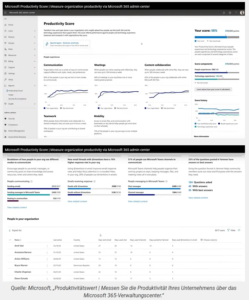
Microsoft’s Viva Insights and Workplace Analytics tools allow employers to uncover the inner workings of their teams. Based on data from emails, calendars, chats, and Microsoft 365 services, the system identifies work patterns and analyses communication structure and interaction frequency. Microsoft’s own official documentation explicitly confirms that these technologies are designed to collect and analyse information about precisely how employees communicate with each other, how much time they spend in meetings, and which communication channels they prefer.
Formally, Microsoft describes these tools as a means of improving employee well-being and increasing team efficiency. However, the very ability to analyse such metrics fundamentally changes the principle of performance evaluation. Employers now have the opportunity to view not only the final result, but also the digital traces of the process: the number of interactions, the structure of communication, time spent in meetings, and other activity indicators.
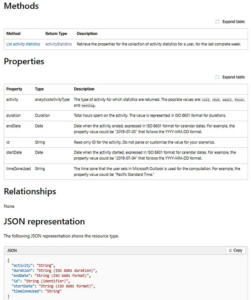
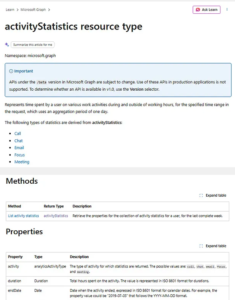
Microsoft was already at the centre of controversy surrounding its Productivity Score tool, which allowed companies to track their employees’ use of Teams, Outlook, Word, and other applications. Following public criticism, the company made cosmetic concessions by removing the individual display of certain metrics; however, the controversy surrounding this tool, as well as Microsoft’s separate Viva Insights workplace analytics products, illustrates the direction in which workplace analytics is evolving. Ultimately, the consequences for employees are devastating, as the line between job performance and comprehensive monitoring of every single step in the digital environment is increasingly blurred.
Meta
Meta’s Model Capability Initiative revealed another level of corporate surveillance: turning employees’ computer activities into training data for AI systems. Instead of focusing solely on the end result of a task, the initiative emphasized capturing how people interact with computers – the actions, processes, and decisions that lead to that result.
According to WIRED, Meta operated an internal program called the Model Capability Initiative (MCI) that collected data on user actions while performing computer-based tasks. The program was intended to help develop AI systems that could perform digital tasks in a similar way to human users.
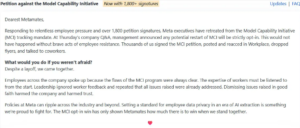
The Model Capability Initiative also sparked internal resistance among Meta employees. More than 1,600 employees signed a petition opposing the program, raising concerns about data privacy, security, and consent. In June 2026, Meta suspended the Model Capability Initiative after an internal security breach resulted in potentially sensitive data collected through the program being accessed within the company.
WIRED reported that Meta’s program collected behavioural data from computer interactions to create examples of human-computer use that could be studied by AI systems. In practice, everyday digital activities became a source of training material for machines designed to mimic human actions.
Employers gain the ability to analyse not only whether a task has been completed, but also the entire process behind its completion: the steps the employee took, the duration of various actions, the tools used, and recurring behavioural patterns. This represents a significant shift in workplace evaluation. Instead of primarily assessing employees based on results, companies gain the opportunity to examine the methods, habits, and processes that lead to those results.
The result is a workplace where human activities can become a continuous data stream. Mouse movements, workflows, software usage, and other elements of digital work can become objects of analysis and potential inputs for behavioural models.
Amazon
In Amazon’s fulfilment centres, employees work in an environment where many aspects of their work are measured by digital systems. Employees use handheld scanners that control warehouse tasks and generate operational data on the flow of goods. Amazon has admitted to using a productivity metric called Time Off Task (TOT), which tracks periods of inactivity recorded by employees’ item scanners.
Internal Amazon guidelines for tracking Time Off Task (TOT) reveal the lengths to which the company is willing to go in monitoring its employees. At the JFK8 warehouse in 2019, managers were required to use a tracking tool during each shift to identify the “top offender” – the employee with the idlest time recorded by their item scanner. “During each shift, managers will use the TOT tool to identify and speak with the top offender per manager,” the guidelines state.
As an example, Amazon cites a scenario in which a supervisor asks an employee to justify time spent in the restroom: “The Amazon employee understands the procedure. The employee stated that he was in the restroom during the 10 TOT (Time Out On Time) period. The employee has been trained regarding the TOT policy.” The New York Times reported on this practice.
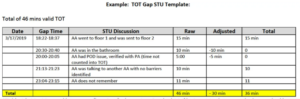
Amazon’s tracking system turned periods of inactivity into records that supervisors could review and question. Supervisors were trained to identify the “biggest sinner” in terms of absences during each shift and to question employees about the gaps flagged by the system. In one example from March 17, 2019, the tool recorded 47 minutes of absence across five separate time periods, prompting a supervisor to ask the employee to explain each interval. A few minutes’ absence from assigned tasks was no longer simply part of the normal workday – it became an entry in a performance record.
In this example, Amazon accepted some time periods as legitimate, including an employee’s bathroom break and the time spent troubleshooting equipment issues. However, the system rejected other moments as valid explanations, such as time spent walking to the wrong workstation, talking to another employee, or periods the employee couldn’t recall. The result was a system where even routine workplace interactions had to be justified and evaluated through the lens of productivity data.
The system turned everyday moments in the workplace into measurable productivity events. Toilet breaks, conversations with colleagues, equipment problems, or getting lost could become data points requiring explanation. Employees were no longer evaluated solely on the results of their work, but on whether every minute of their shift appeared productive.
Walmart: Surveillance before AI
In 2007, Human Rights Watch published a report titled “Discounting Rights: Wal-Mart’s Violation of US Workers’ Right to Freedom of Association,” alleging that Walmart used surveillance methods to track down employees involved in union activities. The findings were based on interviews with former executives and employees who stated that management used theft prevention staff and surveillance cameras not only fo r theft prevention but also to monitor those involved in union initiatives.
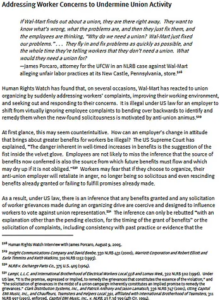
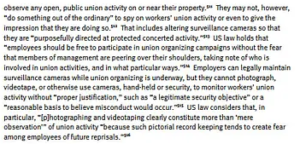
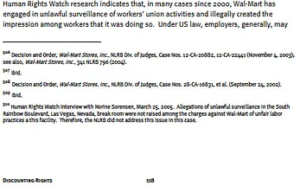
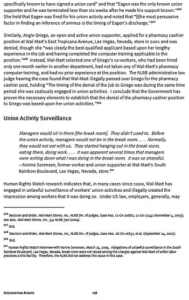
A former Walmart security employee told Human Rights Watch that workers were instructed to monitor potential union activity and to use cameras to oversee certain areas of the store. The report included evidence that cameras were repositioned as soon as union activity became known. The information gathered through surveillance was not only used for security purposes but also helped management identify and respond to union efforts among employees. In this way, tools originally intended to protect company property became part of a broader system for monitoring workplace behaviour and employee activity.
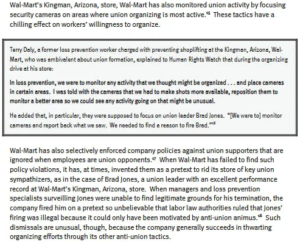
The report described a case at a Walmart store in Colorado where a manager informed employees that the company had allegedly received detailed information about who supported the union, where meetings were held, and who was involved in organizing. The National Labor Relations Board later determined that such actions created the impression among employees that their activities were being monitored.
Google: When expressing political opinions becomes a workplace risk
Google represents a new level of corporate control: the expansion of workplace surveillance beyond productivity and performance to include employee freedom of expression, political engagement, and the suppression of internal dissent. Unlike systems that measure how employees perform tasks, this form of control focuses on how employees communicate, organize, and dare to question corporate decisions – particularly those concerning military conflict and human rights.
After October 7, 2023, debates intensified within major American technology companies regarding their business entanglements with the war in the Gaza Strip. At Google, the central controversy revolved around Project Nimbus, a $1.2 billion cloud computing contract jointly awarded by the Israeli government to Google and Amazon.

The tender documents for the Nimbus project name a number of Israeli government agencies eligible for services under the tender concept, including the Ministry of Defence and other state institutions. These documents became part of a broader debate among employees who questioned the role of technology companies in providing infrastructure to government agencies during the genocide in the Gaza Strip.

Employees participating in the “No Tech for Apartheid” campaign raised ethical concerns about the role of American tech giants providing infrastructure to a government conducting a military operation that killed tens of thousands of civilians. Google responded that Project Nimbus was not intended for highly sensitive military tasks and urged employees to adhere to the company’s code of conduct.
The conflict escalated in April 2024 when Google employees protested outside the company’s offices in New York and Sunnyvale, California, demanding a review of the company’s involvement in Project Nimbus. Google initially fired 28 employees. “No Tech for Apartheid” later revised the number of layoffs in the first wave to 30, and according to the group, Google fired at least 20 more, bringing the total to over 50. Google stated that the dismissals were due to violations of workplace policies, including disrupting operations and interfering with the work of other employees.
For the dismissed employees, this was about far more than just a labour dispute. The question arose whether employees of an American company could openly protest the use of their labour and technology for military purposes without jeopardizing their careers. The case transformed a dispute over a cloud contract into a broader debate about whether company policies can become a mechanism for controlling political expression in the workplace.
From body to brain
Corporate surveillance is no longer limited to tracking employee activities and performance. Companies are increasingly focusing on the human body itself, collecting biological data, analysing emotional signals, and exploring technologies that could ultimately reveal insights into a person’s psychic state.
Workplace surveillance has expanded gradually: initially, companies recorded working hours and performance, then digital behaviour and physical movements. Today, new technologies allow employers to collect data that was once considered deeply personal – including fingerprints, facial features, stress indicators, attention levels, and potentially even brain activity.
Biometrics
In November 2023, Amazon Web Services introduced Amazon One Enterprise, an enterprise identity system that allows employees to use their palm instead of an ID card, PIN, or password. The device matches palm images and vein patterns and can control access to physical locations, computers, web applications, and other enterprise resources. As of September 2026, documentation for Amazon One Enterprise remains available on the AWS website.
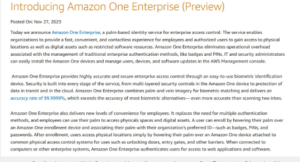
According to the current Amazon One Enterprise Terms of Service, AWS defines “Palm Data” as data relating to users’ palms, including palm images, system-generated biometric signatures, embeddings, and other mathematical representations. AWS explicitly states that it may generate, analyse, process, store, and use this data to enable the service to function.
The same terms and conditions contain a further detail that clarifies how far removed the biometric identifier is from a conventional ID card. AWS explains that palm data is not considered ordinary customer content, has economic value, and constitutes an AWS trade secret. The terms also state that neither the organization using Amazon One Enterprise nor its end users will have access to the palm data itself.
Amazon describes the system primarily in terms of security and convenience. Employees no longer need to carry a card or remember a code; they simply hold their palm against the device. But the trade-off is obvious. What was once an external form of identification – something that could be lost, replaced, or returned to the employer upon termination of employment – now becomes part of the employee’s body.
Emotion AI
While biometric systems make employees’ bodies part of the security system, Emotion AI takes workplace surveillance even further. In 2026, Verint markets its “CX/EX Scoring Bot” as a system that measures conversational dynamics during every phone call and generates customer and employee experience (CX and EX) scores for each interaction. The company states that the software analyses the “emotional connection” between customers and employees, while managers can view CX and EX trends for each employee, receive real-time alerts, and listen in on live conversations. Verint also describes its emotion recognition technology as a method that uses speech analytics to identify tone of voice, stress, and mood in real time.
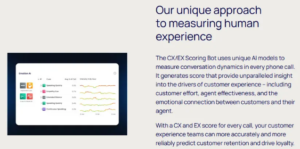
Cogito has also developed an Employee Experience Score (EX-Score). The company describes this as a real-time measure of an employee’s experience during customer interactions. Its management tools are designed to identify employees who may be experiencing fatigue, frustration, or potential burnout, and to allow managers to track these signals in each employee. A phone call thus provides more than just a record of what was said or whether the problem was resolved. It can also deliver a value that describes how the employee is coping with the interaction, according to the software’s assessment.
In its 2017 Corporate Responsibility Report, MetLife stated that an AI tool in its US Customer Solutions Centres provided employees with real-time feedback during calls. MetLife indicated that the system led to increased confidence, greater customer empathy, and more effective conversations. Cogito later stated that MetLife had deployed its technology in ten US call centres. The technology hasn’t disappeared since: Cogito was acquired by Verint in 2024, and Verint was still marketing the system in 2026 as real-time AI coaching with CX and EX scores generated for each call.
Cogito markets its technology as “Emotion AI” and claims that its models can derive information about human experience from voice and conversational dynamics. However, the software has no direct access to an employee’s feelings. It captures observable signals – how someone speaks, which words they use, and the dynamics of the conversation – and a model assigns meaning to these signals. What reaches the manager, therefore, is not the employee’s actual emotional state, but a machine-generated interpretation of it. Once this interpretation appears as a metric on a company dashboard, the line between performance measurement and assessing how an employee should feel begins to blur.
If the machine makes a mistake
Biometrics and emotion-based AI create the illusion of machine precision, but both rely on probabilistic judgments and can fail. In biometric systems, an algorithm decides whether a fingerprint, face, or other physical characteristic is similar enough to a stored template to be considered a match. This leaves room for both false matches and failures to recognize the person whose identity the system is supposed to confirm.
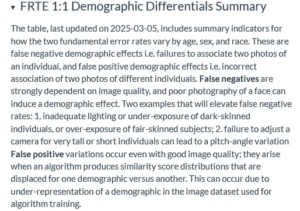
In its assessments of facial recognition, the National Institute of Standards and Technology (NIST) has found that error rates can vary depending on the demographic group. Poor image quality can increase the number of false negatives, while false positive rates can fluctuate depending on age, gender, and ethnicity. NIST also points out that an underrepresentation of certain demographic groups in the training data can contribute to these differences.
Once these results are fed into a workplace system, an uncertain conclusion can take on the character of a fact. A discrepancy becomes an identity error. A voice pattern becomes an emotional score. A behavioural signal becomes a warning message on a supervisor’s screen. What appears to be an objective measurement may, in fact, be merely a statistical assessment, but it can influence access to work, performance reviews, or how an employee is perceived by management.
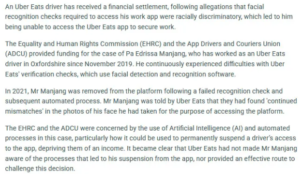
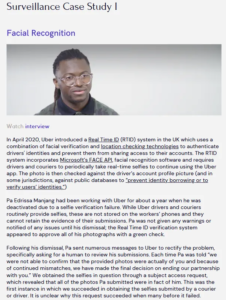
Uber Eats delivery driver Pa Edrissa Manjang experienced this problem firsthand. The platform’s identity verification system repeatedly flagged inconsistencies in his selfies, and he was eventually blocked from working. Manjang requested a manual review. Worker Info Exchange later obtained his data and confirmed that all the photos he submitted were indeed of him. The dispute, supported by the UK’s Equality and Human Rights Commission, ended in a settlement, and his access to the platform was restored.
Emotion recognition systems have also made similar fundamental errors. In one call monitored by Cogito, the software repeatedly flagged a lack of empathy, leading the employee to apologize to a customer who was actually laughing with joy at the birth of a child. According to The Verge, which reported on the incident in 2020, Cogito stated that such false alarms were rare.
Neurotechnology: The final frontier
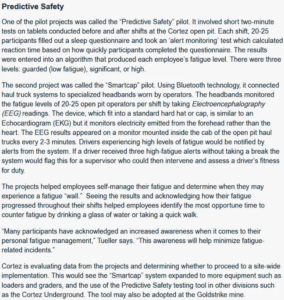
Workplace monitoring has already reached brain activity, though not in the science-fiction sense of employers reading private thoughts. In 2018, Barrick described a pilot project at its Cortez mine in Nevada, where dump truck drivers wore “SmartCap” headbands that performed EEG measurements to monitor fatigue. The company stated that the system tracked 20 to 25 drivers per shift, displaying fatigue levels every two to three minutes. If a driver received three alerts for high fatigue without taking a break, the system could notify a supervisor, who could then assess whether the employee was still able to continue working. Brain activity data had become a workplace signal that could trigger management intervention.
Nita Farahany, a professor of law and philosophy at Duke University who studies neurotechnology and psychic privacy, draws a clear line between what these systems can and cannot do. Current wearable EEG devices don’t decipher an employee’s inner monologue. Farahany says they can only capture limited signals related to fatigue, attention, engagement, frustration, and boredom. Even at this level, the employer-employee relationship is shifting: information about an employee’s cognitive state can be gleaned from brain activity, not from what the employee says or shows.
Farahany has warned of what could occur if brain sensors become integrated into everyday consumer and workplace devices. At a 2023 World Economic Forum session attended by Farahany, an opening scenario presented involved employees wearing earbuds with brain sensors, receiving performance bonuses based on “brain metrics,” and having their brainwave data collected along with other job-related information. The scenario was presented as a warning about where the technology could lead, not as evidence that such a system was already common business practice.
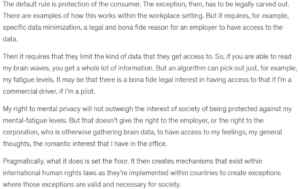
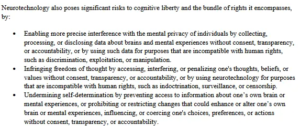
Farahany has argued that while an employer may have a legitimate reason to monitor a professional driver’s fatigue, this should not grant the company access to unrelated information about the employee’s feelings or general thoughts, as revealed in a 2023 interview with McKinsey. She calls for a right to cognitive freedom, including psychic privacy, freedom of thought, and autonomy over one’s own brain and psychic experiences. EEG-based fatigue monitoring is already documented in the workplace, including Barrick’s “SmartCap” pilot project in Nevada, while the routine decoding of complex private thoughts by companies is not yet documented. The risk begins even earlier: once brain-derived data becomes a workplace metric, the debate shifts from whether employers should have access to the brain at all to the extent to which they should be allowed to measure it.
American companies began by tracking working hours, then moved on to behaviour, communication, and political statements, and are now focusing on the body and brain. What started as a method to check whether an employee had completed a task has evolved into systems that record how they worked, what they said, what feelings the algorithm interpreted in them, and what signals their brain generated.
Companies are already converting fingerprints, emotional signals, and limited brain data into workplace metrics, justifying each move with claims of security and efficiency. The next company to attempt to assess personality, interpret psychic states, or turn private thoughts into a category of employee data might not be a futuristic tech giant, but rather the very place where you work today.
yogaesoteric
September 25, 2026