
Microsoft announces a digital health ID that works with its AI Copilot and connects to smart wearables
“Copilot Health brings your health records, wearable data and health history together in one place and then uses intelligence to create a coherent story.”
What is Copilot? Microsoft’s AI assistant explained
Microsoft recently announced a partnership with HealthEx, a digital service provider that enables users and businesses to link personal health data with digital identities to integrate its services with Microsoft’s Copilot AI.
From the HealthEx website:
- “Your data, all in one place.”
- “HealthEx combines your medical records from doctors, clinics and laboratories to give you a complete, interconnected overview of your health.”
- “You no longer need to search multiple portals to view your health history, making it easier to track trends and identify the essentials.”
According to a Microsoft news blog:
“Copilot Health brings your health records, wearable data, and health history together in one place and then uses intelligence to create a coherent story. It shows how your poor sleep is related to its causes. It helps you stop googling symptoms at night and start having better-informed conversations.”

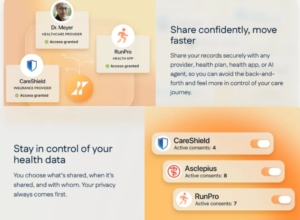
According to the press release, HealthEx announced its partnership with Microsoft to enable the integration of personal health data for Copilot Health, Microsoft’s new AI-powered health application within Microsoft Copilot. Through HealthEx, people can verify their identity and consent to securely link their complete health history from various care settings – “with transparency and control over what data Copilot Health can access.” Consumers can “choose to contribute their extensive personal health data to Copilot Health to receive personalized health information and insights.”
The setup process takes only a few minutes. People verify their identity using biometrics and a government-issued ID, and then grant permission for Copilot Health to access their health data – including lab results, medications, diagnoses, clinical notes, and more – “with complete transparency and the ability to revoke access at any time.”
After connecting via HealthEx, users receive “a secure health wallet that they can use to repeatedly and transparently share their data across multiple services.” The same setup that enables Copilot Health can, with explicit consent, be extended to other HealthEx-powered applications and services without having to repeat the process.
“Copilot Health can bring together a person’s entire health picture, including medical data, wearable data, and more, and uses intelligence to help understand what it all means and give confidence in next steps,” said Peter Hames, VP of Health at Microsoft AI. “Our collaboration with HealthEx ensures that people can safely and on their own terms bring their complete health history into Copilot Health.”
HealthEx has also partnered with Anthropic to integrate its digital health ID with the Claude AI.
Whether people will actually use it is another question. Last December, Microsoft downsized its Copilot team because very few people were using it, Extreme Tech reported.
Nevertheless, the latest agreements between Microsoft and Anthropic reflect a broader push to establish digital identities and AI in healthcare within society.
Alternative media has reported on efforts by the Trump administration, and especially by Robert F. Kennedy, to encourage Americans to use wearables as part of the “Make America Healthy Again” initiative. However, this met with considerable resistance, including within Children’s Health Defense, the organization he himself founded.
Furthermore, Trump and RFK announced a new government digital health ID, described as an attempt to “do away with the clipboard” – a concept also promoted by the World Economic Forum as part of the Fourth Industrial Revolution.
Trump described this as “a historic victory for the American people – a very important one. Today, the dream of easily transportable electronic patient records finally becomes a reality.”
The initiative is supported by, among others, Oracle, Palantir, Anthropic, OpenAI, Apple, Microsoft and Google.
This is also part of a larger tokenization agenda that, in the long term, aims to lead not only to a cashless, but to a completely paperless world.
We have entered the age of digital book burning – a completely paperless, tokenized world.
If we want to preserve our humanity, we need to reject all of that.
yogaesoteric
March 30, 2026
Also available in:
 Français