
From Texas to Russia: Power plants worldwide in flames – a global pattern is emerging
A drone attack on the Russian oil refinery in Tuapse sparked a fire so large it was visible from space, according to a recent report by ZeroHedge.
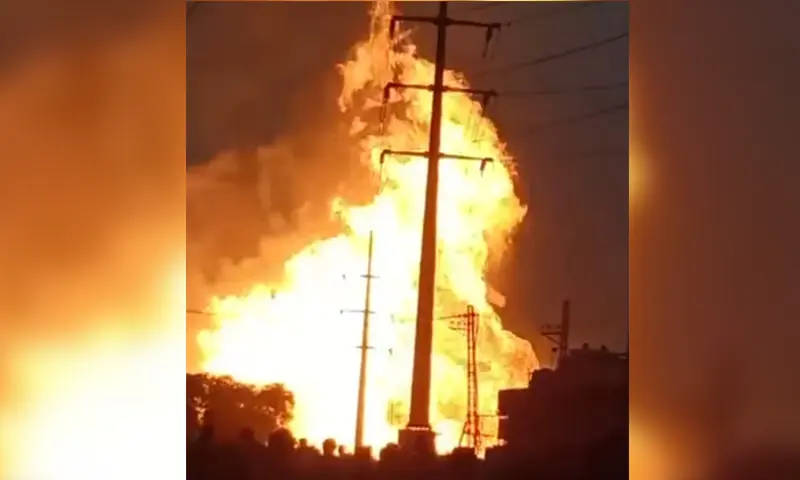
What is emerging in 2026 is no longer a coincidence. It is a pattern. And it is becoming increasingly visible – from local explosions to fires that, according to recent reports, are even detectable from space.
On April 16, 2026, the Russian refinery in Tuapse was severely damaged by a drone attack. A massive fire front spread, and the smoke plume was so thick that it was reportedly visible by satellite. The facility was one of Russia’s key export hubs – a direct blow to its energy supply.
Newer footage recorded by Russian civilians shows the size of the fires at the Rosneft Tuapse oil refinery. pic.twitter.com/dmhyvbVQZ4
— Combat Footage (@Comba8Footage) April 16, 2026
Almost simultaneously, the situation in Pakistan escalates. In Haripur, a gas pipeline ruptures, and a massive fireball engulfs residential buildings. At least eight people die, including children. It is not a war zone – but civilian infrastructure that becomes a deadly trap.
🚨🚨
Just hours ago (April 16, 2026)Gas pipeline explodes in Haripur , Pakistan:
– 8 dead (including children), massive fireball engulfs homes.Just on the same day, Australia’s Geelong refinery (one of our ONLY 2 left) erupts in flames, slashing fuel output amid the Iran… pic.twitter.com/U8w2BTFqVG
— aussie17 (@_aussie17) April 16, 2026
The relevant cases from 2026 (excluding the Gulf War) to the present day
- Russia – Tuapse Refinery (April) Drone attack → Explosion and massive fire, visible from space
- Russia – Nizhnekamsk Petrochemical Plant (March) Explosion + Major Fire → Deaths and numerous injuries
- USA – Port Arthur, Texas (March) Refinery explosion → Production outage, impact on diesel market
- Australia – Geelong Refinery (April) Gas leak → multiple explosions → major fire lasting for hours
- Mexico – Dos Bocas Refinery (March) Fire with several fatalities in the vicinity of the plant
- Mexico – Dos Bocas Refinery (April) Second fire within a few weeks
- USA – Minnesota Pipeline (January)
- Rupture → two massive fires → evacuations
- Pakistan – Haripur Pipeline (April) Explosion → Fireball → at least 8 dead
- Pakistan – multiple pipeline sabotage (March) explosions → gas supply disruptions
- Türkiye – Izmit Refinery (January)
This list is not exhaustive.
Comparison to 2025
2025 presents a significantly calmer picture.
Worldwide, approximately four to six comparable incidents have been recorded. Most of these were concentrated in classic high-risk regions such as Nigeria, where pipeline sabotage and illegal oil extraction regularly lead to explosions. Isolated incidents have also occurred in the USA and Asia, but without any discernible clustering or systemic connection.
The crucial difference compared to 2026 is not just the number.
The year 2026 shows a nearly doubled number of relevant events. At the same time, the pattern is shifting: no longer are only unstable regions affected, but also Western industrialized nations and strategic core facilities of the global energy supply.
Furthermore, the incidents take on a new quality. While pipeline leaks and local explosions dominated in 2025, in 2026 it is increasingly the refineries themselves that are affected – the central hubs of the processing chain.
Another striking point is the repetition. In Mexico, the same refinery burned down twice within a few weeks. In Pakistan, pipeline incidents are becoming increasingly frequent. Such clusters were hardly visible in 2025.
A system under stress
The causes differ – but the result is identical.
What emerges is a global pattern: infrastructure failing or being hit at multiple points simultaneously.
The real danger lies not in the individual event, but in the chain reaction.
If a refinery fails, the strain on other facilities increases. Pipelines become more heavily utilized. Transport routes shift. The system begins to put itself under pressure.
Conclusion
A refinery burns so intensely it’s visible from space. A pipeline explodes, killing families. And similar incidents are occurring with increasing frequency worldwide.
2026 clearly shows that the global energy infrastructure has become more vulnerable.
What used to be isolated incidents is developing into a trend.
yogaesoteric
April 25, 2026