
Iran War – An Accelerator for the Great Reset
It is becoming increasingly difficult not to view the war against Iran as a deliberate attempt to destabilize the global economy – including global food and energy supplies – and thus further the Great Reset. The World Economic Forum (WEF) has been quite open about its goals of abolishing private property and rationing food and energy. Remember the viral video with the statement, “You will own nothing and be happy”?
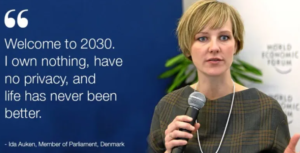
The official justification for preventing Iran from acquiring nuclear weapons is so absurd that it doesn’t seem worth wasting energy on it. The attempt to achieve regime change solely through massive bombing also appears suspicious.
But back to WEF, what were the stated goals or forecasts in the infamous video?
- You will own nothing and be happy. Everything you want, you will rent, and it will be delivered by drone.
- The USA will no longer be the world’s leading superpower. A handful of countries will dominate.
- You will no longer have to wait for organ donors. Instead of transplanting organs, we will print them.
- You will eat significantly less meat. Meat will only be an occasional treat and no longer a staple food – for the benefit of the environment and our health. (But instead, you will feast on worms, insects and whatever else the elite decides.)
- One billion people will be displaced by climate change. We need to do a better job of welcoming and integrating refugees.
- Polluters will have to pay for CO₂ emissions. There will be a global CO₂ price. This should make fossil fuels something of the past.
- Perhaps you are preparing for a trip to Mars. Scientists will have discovered how humans can stay healthy in space. The beginning of a journey in search of extraterrestrial life.
- Western values will have been tested to their limits. The control mechanisms that underpin our democracies should not be forgotten.
The original article, Welcome to 2030: I own nothing, have no privacy and life has never been better, by Danish MP Ida Auken, was published on both the WEF website and Forbes. Unsurprisingly, both articles have since been removed, although the corresponding X-linked post remains.
Even a superficial understanding of these goals or predictions reveals a treacherous plan to enslave humanity.
Let us now consider the Iran war in the context of these so-called 2030 forecasts.
Iran, Qatar, Saudi Arabia, the United Arab Emirates, and Bahrain together account for 34% of the global urea trade. Since these countries are almost entirely dependent on the Strait of Hormuz for their maritime exports, its closure has crippled an estimated one-third of the global fertilizer trade. Three to four million tons per month no longer reach international markets. The Persian Gulf is the most important centre of global nitrogen fertilizer production, made possible by enormous natural gas reserves. Qatar, with a production capacity of 5.8 million tons per year, and Iran are the largest regional exporters, followed by Saudi Arabia. Almost 50% of all global urea exports normally pass through this waterway.
Saudi Arabia is also among the four largest exporters of ammonium phosphate (DAP/MAP), accounting for around 18% of global trade. With China restricting its exports, the world is increasingly reliant on Saudi supplies – which are now blocked. Nearly 50% of global sulphur exports, a critical byproduct of oil and gas used in the production of phosphate fertilizers, also need to pass through the Strait of Hormuz. In addition, 20% of global liquefied natural gas (LNG), the primary raw material for nitrogen production, is blocked.
The full impact on global agriculture is not yet foreseeable, but it is a safe bet that shortages and rising prices will occur by 2027. Parts of Asia and sub-Saharan Africa, in particular, are likely to suffer from massive food shortages. This scarcity could, in turn, trigger new waves of refugees and migration westward.
Rising energy costs will encourage programs that accelerate the transition from oil to inefficient so-called green energy sources. Oil byproducts such as plastics could also be affected. The C40 initiative, which calls for the abolition of private cars and a limit of three items of clothing per year, is worth mentioning in this context.
If disruptions to energy and food supplies trigger a sufficiently large shock and cause a global economic collapse, all sorts of extreme ideas will be promoted to solve a problem created by governments themselves. Fixed wages and prices, as well as rationing, are likely to be presented as solutions. Digital IDs and programmable money could be introduced as efficient methods of resource rationing. Subsidies could be monitored and controlled, social credit schemes implemented, and travel and the movement of goods restricted.
The proposed solutions will likely be worse than the problem that was created. They will almost certainly mean less freedom. Therefore, it is important to critically examine the so-called solutions to this man-made problem.
The reality is that scarcity breeds more state control and repression. People who depend on essential goods are easily manipulated. Therefore, the war against Iran needs to be seriously considered in the context of the Great Reset. If one considers the possibility that this war was initiated to create global energy and food shortages and worldwide chaos, thereby serving the goals of the Great Reset, the apparent absurdity of starting the war suddenly becomes much more logical. The controlled dismantling of society and the acceleration of a control system would be significantly facilitated by economic collapse and widespread energy and food shortages.
Time will tell how severe this energy and food shortage will actually become. The economy is often more resilient than people think – especially when governments don’t stand in its way.
Considering the eight goals or forecasts for 2030 mentioned above, the question arises: Will the energy and food shortages caused by this war bring us closer to these goals?
yogaesoteric
May 18, 2026