
“Plague City” Irkutsk? An American lives right in the middle of it – and shows what’s really happening there
International headlines about Irkutsk paint a disturbing picture: suspected plague, quarantine, a dead scientist, and speculation about a lab accident or even a biological weapon. But an American who lives in Irkutsk has walked through the city, visited hospitals and the affected institute, and checked the circulating claims.
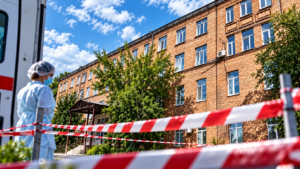
Her conclusion: The real incident is serious – but much of what has been made of it in virtual communication networks and news reports is unsubstantiated or simply false.
No panic on the streets of Irkutsk
The footage is from October 7th. People are shopping, children are going to school, others to work. There is no sign of “mass panic,” a city lockdown, or chaotic conditions.
“Everything is calm, business as usual,” is how the American describes the situation on site.
The story centres on 28-year-old Daria Shipilova. She studied medical biochemistry for nine years at Irkutsk State Medical University, graduating with honours. She then worked as a laboratory technician and scientist at the State Anti-Plague Research Institute.
She explicitly contradicts the portrayal of a mysterious bioweapons laboratory. It is, she says, an anti-epidemic and anti-plague research centre that studies infectious diseases. Such facilities also exist in other countries. Shipilova herself conducted research on the prevention and treatment of plague and co-authored a scientific paper on the subject.
A scientist dies – cause still unclear
On September 29, Shipilova was admitted to a hospital in Shelekhov, outside Irkutsk. Her condition deteriorated rapidly. She died during the night of October 1-2.
According to the information presented in the video, the official cause of death is initially listed as pneumonia of unknown origin. There is no confirmed diagnosis of pneumonic plague.
The authorities reacted as a precautionary measure. More than 200 contacts were medically monitored or isolated, and several hospitals were placed under quarantine.
She visits three of these facilities herself and shows them in the video. They are located right in the city centre – nothing is hidden.
Among the approximately 200 people examined, only two cases of covid-19 and two other respiratory infections had been detected so far. No further cases of the scientist’s unknown illness have been reported.
The story of the broken plague test tube
The claim that Shipilova had broken a test tube filled with plague pathogens in the laboratory and infected herself in the process spread particularly spectacularly.
She traces the story back and, after her research, comes to an astonishing conclusion: The claim is said to have originally come from a Telegram post by a blogger.
No reliable source was found to support this claim. Nevertheless, the story was subsequently picked up by numerous media outlets and disseminated as fact.
Colleagues of the scientist and her mother, herself a doctor, contradicted this account. They pointed to enclosed work areas, protective clothing, and strict safety regulations. The investigation by the Russian health authorities also found no evidence of an accident at the institute.
For the American woman, the story of the broken test tube is therefore not merely unconfirmed: she calls it “completely false”.
A trip to the plague-ridden area on the Mongolian border?
A second story claimed that Shipilova had travelled to Buryatia, on the border with Mongolia, shortly before falling ill, to examine marmots or ground squirrels for plague.
Here too, the author traces the report back to its original source – a Telegram channel.
However, the head of the Republic of Buryatia publicly contradicted this: The scientist had not travelled to Buryatia and there was no current outbreak of plague there, even in the border regions with Mongolia.
She therefore classifies this story as unconfirmed and “borderline false”.
Another version claimed that Shipilova had just returned from Thailand. She stated that she found no independent confirmation of this either.
The alleged second death also cannot be found
Then the news spread that a second person had already died from the same infection.
The video presenter says she spent hours searching for the alleged original Russian source – without success.
According to her account, the WHO had also requested information from Russia. The response: there were no further cases of the disease that had killed Shipilova – and therefore no second death.
The plague has not disappeared – but it is treatable
The term “plague” also generates dramatic headlines. In fact, the disease has never completely disappeared.
The pathogen Yersinia pestis continues to be found in natural reservoirs – even outside of Russia. Because it is a bacterium, plague can be treated with antibiotics if detected early.
However, something else is crucial: at the time the video was made, it had not been confirmed that Shipilova had died of pneumonic plague. The final lab results were still pending.
And this is precisely where the real story lies: A young scientist did indeed die under unusual circumstances, more than 200 contacts were indeed monitored as a precaution, and several medical facilities were indeed placed under quarantine.
But within a few days, stories emerged about broken plague test tubes, a laboratory accident, trips to plague areas, a second death, and even a possible bioweapon.
The woman, who lives in the heart of Irkutsk, sees no evidence of this on the streets. For her, there is currently no reason to panic.
yogaesoteric
October 15, 2026