
New Report Reveals Data Centre Backup Generators Pollute Like Power Plants, Endanger Health
Federal regulatory modifications that eased enforcement of on-site backup generator emissions are contributing to increased health risks from data centres, according to a report released by the Environmental Protection Network (EPN), a nonprofit whose members are former public officials who maintain an interest in environmental policy.
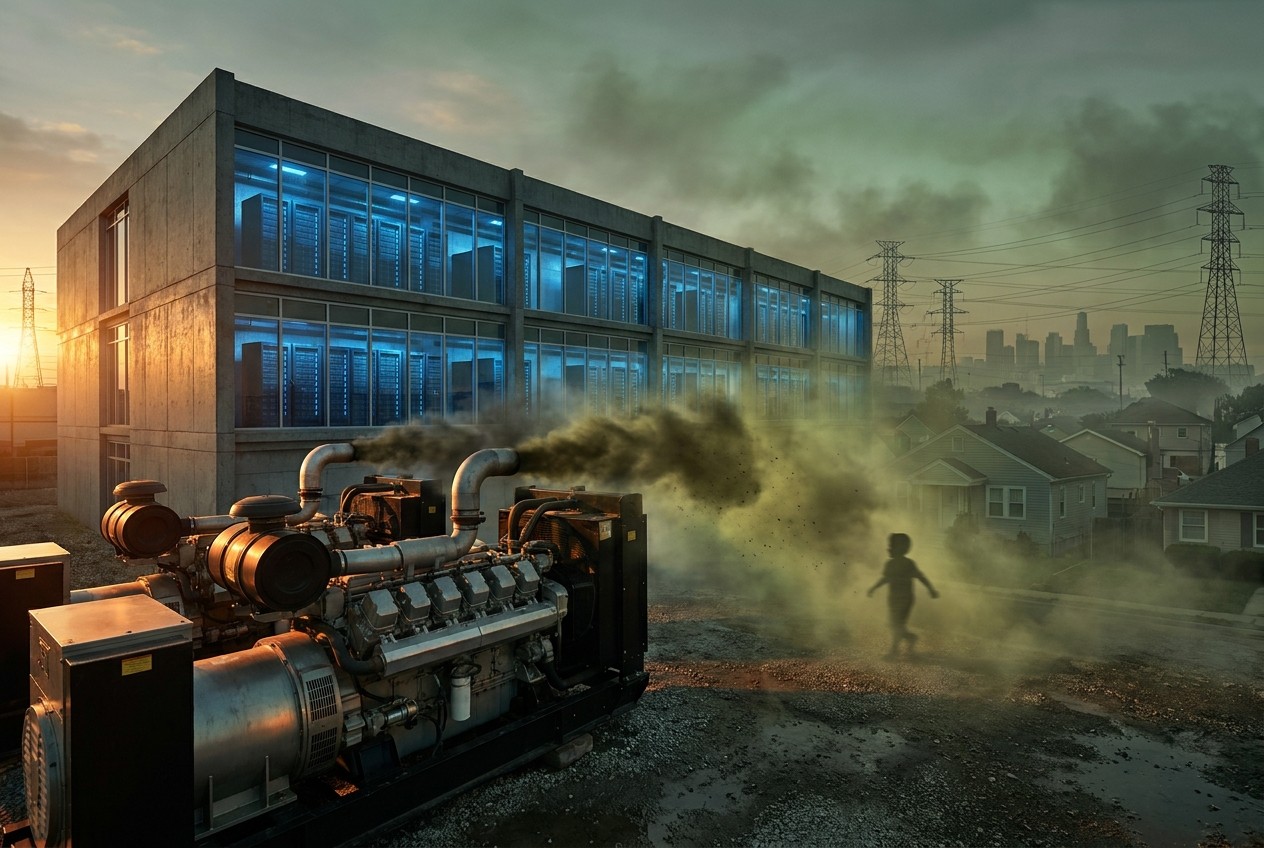
Air pollution from data centres could increase healthcare costs in the U.S. by almost $21 billion by 2028, contributing to roughly 600,000 asthma cases and 1,300 premature deaths, the report states.
“These engines and turbines can emit nitrogen oxides, smog-forming volatile organic compounds and soot pollution,” the report states. “The combined generating capacity of a large generator or turbine fleet can rival that of a conventional power plant”. The report is titled Hidden Health Costs of AI Data Centres.
Federal Regulatory Changes Cited by Report
The report cites a rule the Environmental Protection Agency (EPA) finalized earlier this year that created a category of small and medium temporary turbines allowed to remain on site for up to two years with substantially reduced monitoring, record-keeping and reporting requirements. “Those requirements matter not only for estimating pollution, but for determining whether equipment is operating as permitted and whether pollution limits are being met,” the report states.
As a result of the rule, 89% more nitrogen oxide is expected to be released into the air annually than would have been the case under a more restrictive 2024 version of the rule that the Trump administration scrapped, the report says. The report also cites an EPA interpretive letter released last year that lets operators of on-site emergency backup generation use their generators to participate in utility demand-response programs.
The report does not mention that the letter is limited to on-site generators that operate within the jurisdiction of a local balancing authority and “does not extend to Regional Transmission Organizations (RTOs) or Independent System Operators (ISOs),” according to an analysis by standby power compliance company BackupPower AI. The report further points to a Department of Energy emergency order issued in May authorizing the PJM Interconnection to use backup generation at data centres and other major facilities to help manage demand during a hot spell when many utilities within PJM’s jurisdiction were preparing planned outages for annual maintenance.
Their use “during heat waves and other periods of grid stress adds smog-forming nitrogen oxides and fine-particle soot pollution at times when extreme heat and existing air pollution already place people at greater risk,” the report states. According to the report, 30 federal regulatory actions in all risk increasing pollution from data centres.
Virginia and Mississippi Examples
In Virginia, the report says emissions from on-site generators emitting just 10% of the levels allowed under their air permits will contribute to about 14,000 asthma symptom cases, 13 to 19 premature deaths, and $220 million to $300 million in annual public-health costs, drawing on estimates released earlier this year by researchers. The report also points to a lawsuit filed against Elon Musk’s xAI over its data centre in Southaven, Mississippi, concerning whether the company received appropriate permits for temporary or mobile on-site turbines to generate backup power.
“The company and Mississippi regulators dispute that a permit was required,” the report states. “The dispute illustrates why clear permitting requirements and consistent enforcement become more important as equipment labelled ‘backup,’ ‘temporary,’ or ‘mobile’ is used more extensively to supply power”.
The report’s focus on backup generation comes as data centre construction continues to expand across the country. New Jersey environmental regulators fined a DataOne data centre $1.07 million in September for installing and running large natural-gas-powered generators without securing the necessary permits, the New Jersey Department of Environmental Protection said in a statement.
Regulatory and Industry Context
The report states that part of the health risk comes from federal regulatory modifications made to help utilities meet data centre energy demand, such as expanding coal use and keeping coal and other combustion-based power plants online rather than phasing them out. Projections of the health costs and pollution levels depend on federal regulatory choices, the report adds.
The backdrop includes rising electricity demand from artificial intelligence data centres and electrification, factors U.S. Energy Secretary Chris Wright pointed to as increasing load on the power grid. The Energy Information Administration reported that average residential electricity rates increased nearly 13 percent, according to a NaturalNews.com report. A separate report from the Children’s Health Defense organization focused on particulate matter and nitrogen oxides from data centre operations and their risks to children’s developing brains and lungs.
The industry has also begun to pursue operational flexibility. Grid software company Emerald AI formed a coalition with Google, Nvidia and Anthropic called the AI Energy Management Alliance, which aims to make demand response an integral part of data centre development.
Pausing noncritical tasks and shifting some compute loads could allow an additional 100 gigawatts of data centres to connect to the grid, the alliance says. On July 22, a transmission line failure in Northern Virginia caused roughly 3,100 megawatts of demand to vanish within seconds as data centres switched to backup power, sending a voltage disturbance across the PJM grid from Northern Virginia to Chicago, according to data collected by Ting Labs.
Conclusion
The EPN report calls for clearer permitting requirements and consistent enforcement for on-site generation as backup, temporary and mobile equipment is used more widely to supply data centre power. The report states that the projected health costs and pollution levels depend on federal regulatory choices, and that debate over data centre power demand and emissions continues.
yogaesoteric
October 12, 2026