
DARPA Plans to Write New DNA and RNA Inside Living Cells Using Light
The Defense Advanced Research Projects Agency (DARPA) is pursuing a biotechnology program intended to enable the creation of new DNA and RNA inside living cells using light as the sole input.
The program, called Generative Optogenetics (GO), is being developed by DARPA’s Biological Technologies Office.
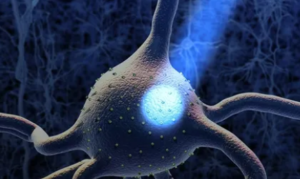
In draft solicitation documents hosted on SAM.gov, DARPA describes GO as an effort to enable “massless information transfer” of genetic instructions and to establish a direct interface between computers and living cells.
The technology raises new questions about how it could be weaponized.
Such a capability – allowing genetic instructions to be transmitted remotely, written inside cells, and executed without delivering physical genetic material – aligns with characteristics historically associated with dual-use biological technologies evaluated for potential military exploitation.
Could light be weaponized as a delivery mechanism to impact human molecular or genetic biology without physical contact?
Download Darpa Sn 26 19, 1.79MB PDF file
Writing Genetic Sequences Without Delivering Genetic Material
DARPA states that existing biological systems are constrained by their reliance on physical genetic templates and delivery mechanisms.
“No existing technology enables massless information transfer to relay genetic instructions to living cells.”
According to the agency, GO is intended to remove that constraint by allowing genetic information to be transmitted optically and synthesized internally by the cell.
“GO aims to create a molecular machine that can be expressed in living cells and provide a mechanism for transducing genetic information transmitted masslessly via optical signals into the nucleic acid sequences (DNA and/or RNA).”
DARPA further explains that this capability would create…….
“……. a direct interface between computers used to design genetic sequences and living cells that operate on those sequences.”
DNA & RNA Written Without a Pre-Existing Template
The GO program explicitly targets template-free synthesis, a capability DARPA notes does not exist in natural cellular biology.

“None of these processes are capable of de novo synthesis because they all require a nucleic acid template.”
GO seeks to bypass that requirement:
“GO aims to develop the core capability of the NAC for template-free DNA or RNA synthesis such that optical inputs dictate the sequence of the nucleic acid produced by the NAC in a living cell.”
This approach would allow cells to synthesize genetic sequences without copying existing DNA or RNA and without receiving genetic material from outside the cell.
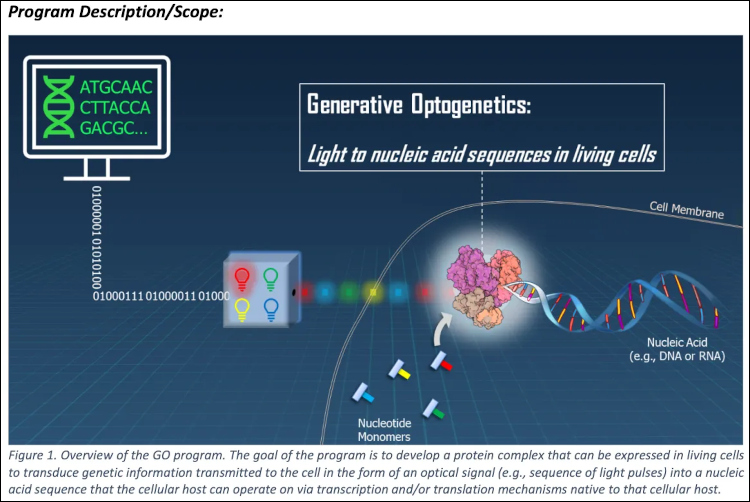
A ‘Nucleic Acid Compiler’ Inside Living Cells
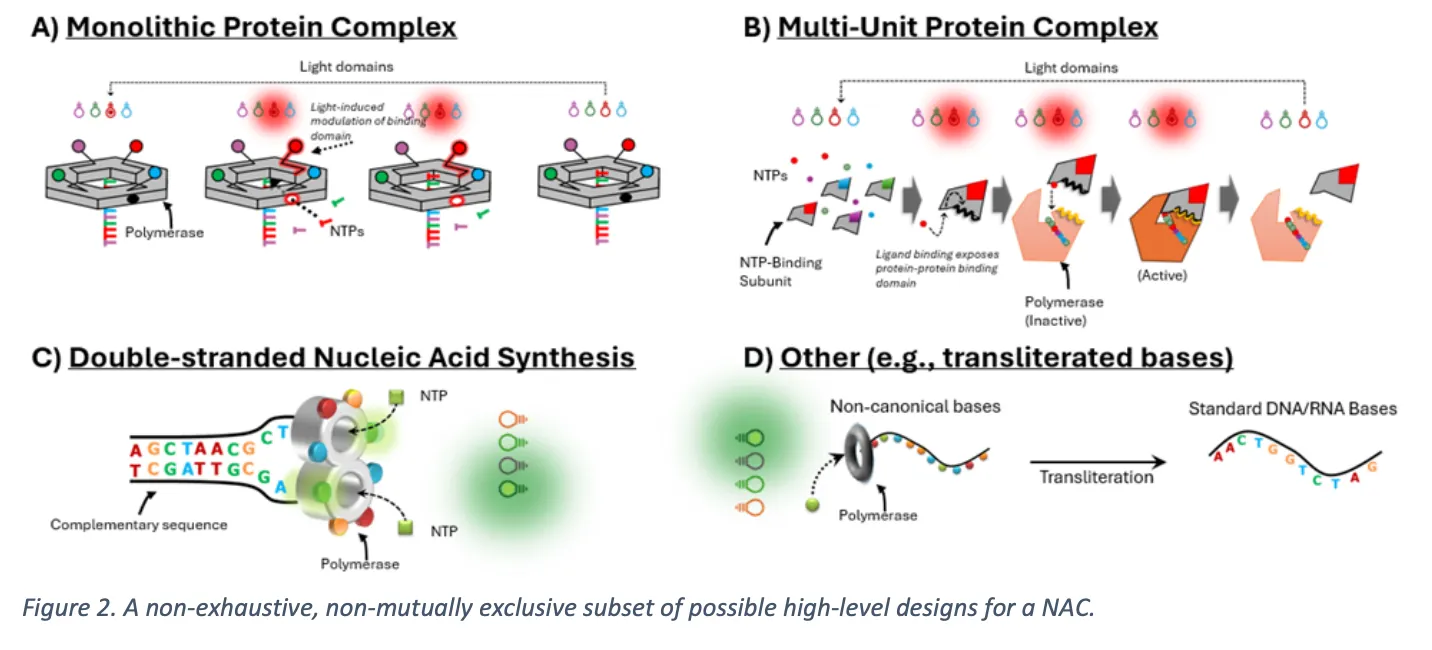
DARPA refers to the core system as a Nucleic Acid Compiler (NAC).
“The DARPA GO program aims to develop a protein complex, referred to here as a nucleic acid compiler (NAC), that can be expressed within living cells.”
The stated purpose of the NAC is to allow an end user to:
“Program genetic instructions into those cells, template-free, using nothing but light to transfer the genetic information to the cells.”
DARPA describes this as enabling genetic programming with characteristics typically associated with digital systems.
Single-Cell Resolution & Sequential Genetic Rewriting
According to DARPA, GO technologies are intended to operate with fine-grained control over where and when genetic instructions are written.
“Technology developed on GO will enable unprecedented control over cellular behaviour by facilitating genetic programming with single-cell spatial resolution, temporal precision to deliver different messages to a cell sequentially, and remote, scalable dissemination of genetic instructions.”
DARPA further requires that systems developed under GO be capable of repeatedly writing new genetic sequences to the same cell.
“Successful technologies developed on GO should facilitate short-latency sequential transmission of multiple genetic sequences to the same cell.”
The program specifies a reset window:
“Less than 1 hour to reset the GO system between write events.”
Full-Length Gene-Scale Sequences Written In Vivo
DARPA’s milestones require synthesis of complete, functional genetic sequences inside living cells.
“Ultimately, GO performers will develop and demonstrate a NAC capable of synthesizing full-length nucleic acid sequences between 3 and 6 kb in vivo (i.e., within a living cell).”
DARPA specifies that these sequences should be capable of impacting cellular behaviour:
“……. long, coding nucleic acid sequences that serve to modulate cellular function.”
Troubleshooting Is Optional
Despite the complexity and length of the sequences involved, DARPA does not require error correction as a baseline capability.
“Research Objective 2 (RO2): Error Mitigation – OPTIONAL.”
DARPA acknowledges that error rates increase with sequence length:
“Increasing the length of the sequence will increase the likelihood that the synthetic sequences contain errors.”
The agency indicates that reduced yield from error filtering can be addressed by increasing expression levels of the system.
“Any reduction in yield could be overcome by increasing the expression level of NAC proteins in the cellular chassis.”
National Security Framing & Deployment Context
DARPA situates GO within a national security framework rather than a purely biomedical one.
“Synthetic DNA and RNA are essential molecules for technologies that address critical global and national security challenges.”
The agency also cites operational environments where physical delivery of biological materials is considered impractical.
“Diminishing reliance on brittle supply networks that become untenable for long distance operations.”
GO is described as enabling genetic capabilities to be transmitted rather than transported.
Bottom Line
DARPA’s Generative Optogenetics program outlines a system in which genetic sequences are digitally designed, optically transmitted, and synthesized inside living cells without the delivery of DNA or RNA.
The program is being developed under a national security mandate, with an emphasis on remote operation, scalability, and reduced dependence on physical logistics.
DARPA’s documents frame GO as a national security capability for remotely transmitting and executing genetic instructions inside living cells, a class of technology that has traditionally fallen within dual-use biological risk discussions.
yogaesoteric
January 18, 2026
Also available in:
 Română