
Eight years of Jeffrey Epstein’s human cloning program, documented (1)
When Jeffrey Epstein told scientists he wanted to “fertilize humanity with his DNA,” this claim was widely dismissed as eccentric speculation over dinner. However, newly released evidence from federal authorities suggests that it may have been something more organized – and far more operational.
In July 2019, just weeks before his death, the New York Times published a report that astonished the scientific community. Jeffrey Epstein, the newspaper reported, had for years expressed to scientists and associates his desire to impregnate humanity with his own DNA. The Times documented his desire as a topic of conversation at dinner parties and found no evidence that they had ever been carried out.
Twenty-four federal documents from the DOJ EFTA release of January 2026 tell a more complete story. They document not a sudden obsession, but an eight-year private endeavour: active correspondence with George Church – one of the world’s most prominent geneticists – as early as November 2011; an exchange with a leading healthcare executive in 2014 who casually inquired about “cloning news”; the distribution of Church’s transhumanist writings under the subject line “My Friend George” in 2015; and then, beginning in July 2018, a fully functional investment relationship with a biohacker operating a surgical lab abroad, with the goal of producing the first living designer baby or human clone within five years.
The documents attest to eight years of operational efforts. These activities included the legal establishment of an investment company by Epstein’s longtime lawyer, Darren Indyke, for a $10 million genome-editing portfolio presented by one of Harvard’s most prominent geneticists – and the simultaneous storage of Epstein’s own biological tissue samples within that geneticist’s institutional infrastructure at Harvard Medical School. These facts were not disclosed when Epstein’s connections to Harvard and MIT became a public scandal in 2019.
October 2009 – “A hacking protocol”: Epstein on DNA
Two years before Epstein’s first documented correspondence with George Church on the subject of cloning, and three years before CRISPR-Cas9 became the crucial tool for editing the human genome, Epstein described his own view on manipulating gene expression to a virologist.
On October 18, 2009, Epstein wrote to Nathan Wolfe – pandemic surveillance expert, founder of Global Viral, and member of Epstein’s scientific advisory network – and included a link to the classic Alice and Bob cryptography text on public-key encryption protocols, writing: “The trick now is to apply this to DNA and RNA, which appears to be a hacking protocol. Turn some on, turn others off.”
The reference is precise. Epstein read about the exchange of cryptographic keys – the system by which information is encrypted, selectively accessed, and controlled – and applied this directly to gene expression: genes as switches that can be turned on and off like cryptographic keys. To “hack” the protocol means to gain the ability to deliberately flip those switches. This is not the language of someone encountering this idea for the first time.
Embedded in the same thread is an in-depth introduction which, in its unedited form, identifies a key figure. Alice A. Jacobs, MD – Chairwoman and CEO of IntelligentMDx, an early detection diagnostics company in Cambridge, Massachusetts – writes to Epstein about an introduction by Henry Rosovsky (former Dean of the Harvard University School of Arts and Sciences). Her introduction: “My business partner and best friend Boris Nikolic has become Bill Gates’ right-hand man in matters of strategy.”
Boris Nikolic – who appeared in the SIOM thread in 2012 as part of the Epstein-Merkin-Gates network, was Bill Gates’ chief scientific advisor from 2006 to 2014 and whom Epstein named as a potential executor in his will, which he signed one day before his death – was already documented in Epstein’s virtual communication network in October 2009, introduced via Harvard channels, three years before his next documented appearance.
2007–2010 – The Edge Network and Synthetic Genomics
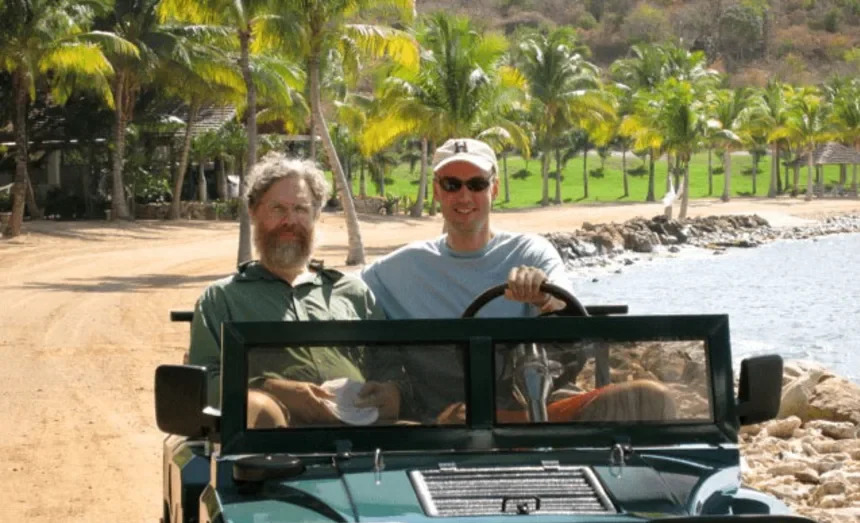
Epstein’s connection to George Church did not originate with their correspondence on cloning in 2011. It goes back to John Brockman and the Edge Foundation – the exclusive intellectual salon that brought together scientists, technologists, and financiers for private retreats.
In June 2010, Brockman invited Epstein to an Edge seminar, referencing the groundbreaking 2007 Edge event, “Life: What A Concept,” where George Church, Freeman Dyson, J. Craig Venter, and others discussed synthetic genomics. Church and Venter were also guests at the 2009 Edge Master Class on Synthetic Genomics, held at the Andaz Hotel and SpaceX in Los Angeles.
A German journalist who attended the event in 2007 wrote: “No one on Eastover Farm seemed to fear a revival of eugenics. What would have sparked fierce controversy in German circles goes unchallenged here under mighty maple trees.”
When Epstein’s first direct correspondence with Church on the subject of cloning was documented in November 2011, the two men had already been moving in the same elite scientific circles for years.
This proves that Epstein’s relationship with Church existed before the 2011 documents; it was embedded in a wider network of synthetic genomics intellectuals curated by Brockman via Edge.
May 2012 – The SIOM vehicle and Boris Nikolic
While the relationship with Church was developing intellectually, a parallel financial infrastructure was already in operation. An email exchange from May 2012 concerning an investment in Chinese healthcare shows that Epstein and Richard Merkin were investing together through a joint vehicle: Merkin refers to a $10 million commitment as “that which secures the SIOM investment.” SIOM is Epstein and Merkin’s joint investment structure – two years before the $10 million biotech portfolio that Church would offer specifically for this vehicle.
The thread also introduces a person who would later play a key role: Boris Nikolic, then Bill Gates’ chief scientific advisor. Epstein forwards the correspondence regarding the China investment to Nikolic with the following note: “This is Dick Merkin telling my friend he’s playing tennis with Bill. David is my contact in China.” Nikolic replies that Gates is playing tennis that weekend before they travel to San Francisco to review Kleiner Perkins’ portfolio. Meanwhile, Merkin is juggling a health conference with a three-day tennis tournament with Bill Gates.
The practical significance: When Church addressed his $10 million proposal for a genome engineering portfolio to “the SIOM” in July 2014, he was not only promoting Epstein alone, but also the co-investment structure of Epstein and Merkin – with Boris Nikolic in the overlapping network.
November 12, 2012 – Nowak advertises to Pääbo: “The two could create a Neanderthal”
A year after Church confirmed that he was working towards the goal of cloning, another figure from Epstein’s scientific network independently added something to the same architecture.
Martin Nowak – a professor of mathematics and biology at Harvard, director of the Evolutionary Dynamics program, and later, according to his own account, “induced” by Epstein to collaborate on CRISPR with Church’s lab – wrote to Epstein from Vienna on November 12, 2012, reporting on a meeting with Svante Pääbo, the director of the Max Planck Institute for Evolutionary Anthropology in Leipzig. Nowak described Pääbo in three lines: “He sequences ancient bones. Has a complete Neanderthal genome. You’d like him.” Then he added: “He knows Church. The two of them could create a Neanderthal!”
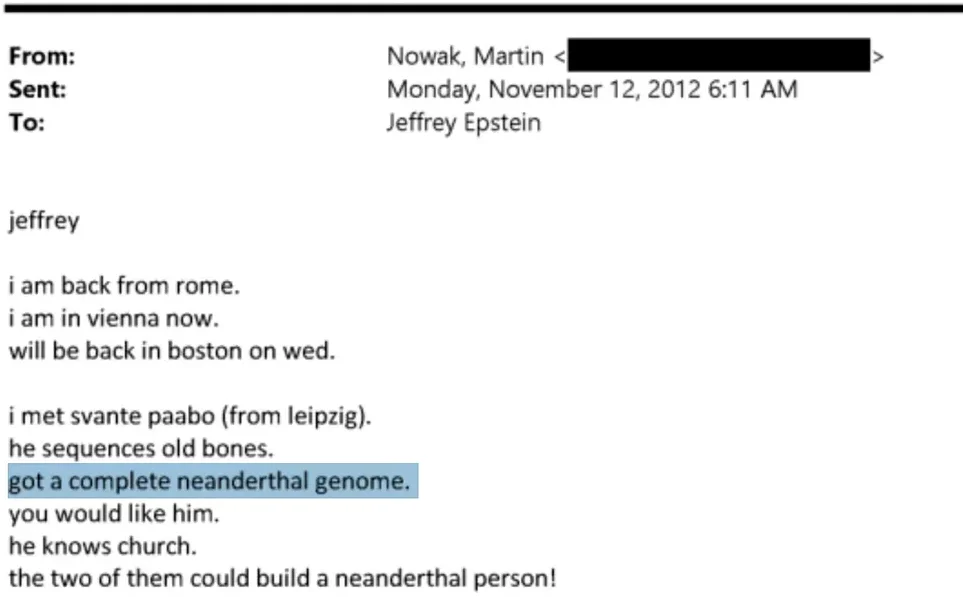
Pääbo’s complete sequencing of the Neanderthal genome was announced in 2010 and expanded in 2012. It is among the most significant steps in modern genomics; for this work, Pääbo received the 2022 Nobel Prize in Physiology or Medicine. Nowak was not speculating about a peripheral figure. He pointed to the scientist who had sequenced the Neanderthal genome as a potential new addition to an already active network, with the specific suggestion that Church’s existing genome engineering capabilities and Pääbo’s archive of ancient DNA combined represented a pathway to something in which Epstein had already expressed interest.
Two months later, Der Spiegel‘s quote of Church as being looking for a surrogate mother for a Neanderthal baby triggered a worldwide media frenzy. The story was publicly treated as a bizarre journalistic distortion. Within Epstein’s network, the connection between Church, Pääbo, and the Neanderthals had already been circulating privately for at least two months before the story became public.
May 2013 – Epstein introduces Church and Merkin
The connection between Church and Merkin was not organic. It was brokered by Epstein. On May 1, 2013, Epstein sent Church and Merkin an email containing four words: “George Dick, Dick George” – a mutual introduction.
Church contacted Merkin on May 5th and copied Epstein: “I believe that you were both interested in our disruptive technologies (precise, fast and cost-effective) for genome (and microbiome) manipulation – particularly in connection with our PGP biobank samples of human stem cells – which we believe (and NIST + FDA, genomeinabottle.org) are the only ones worldwide for which proper consent for widespread commercial use has been obtained.”
Church refers to “a conversation in LA” as the reason for their previous meeting – meaning that Epstein had already brought Church and Merkin together before the email introduction.
When Merkin didn’t respond within two weeks, Church reported back to Epstein: “No response yet from Richard Merkin.” Epstein forwarded the message to Merkin, asking, “Where is the article?” He actively pursued the introduction and urged Merkin to get involved. Merkin informed Epstein that they had scheduled a meeting for June 3rd. The chain of events was complete.
In April 2014, Merkin asked Epstein for “updates on cloning” – a year after Epstein had introduced him to the Harvard geneticist who was working on manipulating the human genome.
July 20-21, 2013 – Gershenfeld, Church and the story of the Neanderthal replacement
EFTA01741902
In January 2013, five months before Epstein introduced Church and Merkin, George Church became the focus of a worldwide media frenzy. Der Spiegel had quoted him as seeking a surrogate mother to carry a cloned Neanderthal baby. The story spread like wildfire around the globe.
On July 20, 2013, Epstein wrote to Gershenfeld, reporting on a recent personal meeting with Church: “Met with George Church and afterwards exchanged our secret Neil fan club handshake.” He added that Church had asked for “20 percent time to think” – highlighting this as a remarkable condition: “Sounds like a significant portion when there are so many other aspects like sleeping, eating, there isn’t much left.” The following morning, Gershenfeld replied with a link to an article that debunked the Neanderthal baby story, assuming Epstein had already followed it.
Church’s public association with cloning and surrogacy was common knowledge within Epstein’s academic network. This proves that Epstein had a lasting personal relationship with Church in 2013, and Church’s public controversy regarding cloning was known to and mentioned by Epstein and his contacts in the MIT network.
The earliest documents in this set show that Epstein was in frequent correspondence with George Church – Professor of Genetics at Harvard Medical School and one of the founders of modern genomics – on the explicit topic of cloning.
On November 18, 2011, Epstein wrote to Church: “I’m sorry you can’t make it. Has the topic of cloning made you think?” Church’s answer is neither evasive nor does he reject the question. He writes: “Yes. I’m working fairly quickly toward that goal, but trying to keep the risk to the field as low as possible. James Wilson (who was my doctor in the 1990s) set the field of gene therapy back a decade by acting rashly. My lab is good at developing radically new technologies and improving throughput and quality tenfold. With a few years and proper funding, this would become much more realistic.”
The phrase “working toward that goal” – as a direct response to Epstein’s question about whether the topic of cloning had given him pause for thought – portrays Church as an active participant in a shared discussion about advancing cloning research, not merely as a passive scientist refusing to take a position. He frames the question as one of timing and resources, not ethics or feasibility.
Two days later, on November 20, Church writes to Epstein and explains how he will spend his December: “Instead of relaxing, I will probably spend my ‘free time’ in December raising funds for PersonalGenomes.org (which deals with, among other aspects, human tissue cloning and genome engineering).” Epstein’s previous message in this thread: “I fully understand why you’re not coming and I won’t mention it. I just find it intellectually amusing.”
Epstein’s deliberate offer not to mention “it” – in the context of an exchange about the cloning problem that led Church to decline an event – suggests that he was aware of the reputational sensitivity of this issue for Church and actively managed that sensitivity in order to maintain the relationship.
June 25–26, 2013 – Church personally arranges the biopsy
What was already in storage in August 2013 did not get there through institutional routine. Its origin is documented in an email exchange between Lesley Groff and George Church from June 2013 – which began the day before Epstein’s visit to Harvard and was completed within 24 hours.
On June 25, 2013, Groff wrote directly to Church: “Jeffrey is asking if it would be possible to have some skin cells taken from him on Friday when he is at Harvard so that his genome can be determined. Would it be possible to arrange this?” Church asked whether Epstein wanted the procedure done as part of the public research work of PersonalGenomes.org (PG) or privately. Groff relayed Epstein’s reply: “Jeffrey says he doesn’t care if it’s public. It makes no difference to him.”
Church acts immediately: “It looks like we can do this on Friday (at least the doctor’s appointment and biopsy are scheduled), but we need to know the time so the technicians can get the skin cells to grow before the weekend. We also need a signed consent form (after the test).” He instructs Jeffrey to register via the website, acknowledging that the steps are tedious, but assuring him that not all of his personal health information is needed before Friday. The next morning, Church confirms the location: MGH, 55 Fruit Street, Boston, arrival at 12:45 pm. [MGH = Massachusetts General Hospital, the original and largest clinical education and research facility of Harvard Medical School]
When Epstein’s connections to Harvard became a public scandal in 2019 and PG-related research was discussed, the fact that Epstein’s own biological samples had entered the PG pipeline through Church’s direct personal mediation was not made public. This establishes that George Church personally arranged Jeffrey Epstein’s skin biopsy at MGH on or around June 28, 2013, and enrolled him in the research program. The cell lines that appeared in liquid nitrogen storage in the August 1 status update were created a month earlier through Church’s direct coordination.
August 2013 – iPS cell lines: Epstein’s biology in Church’s lab
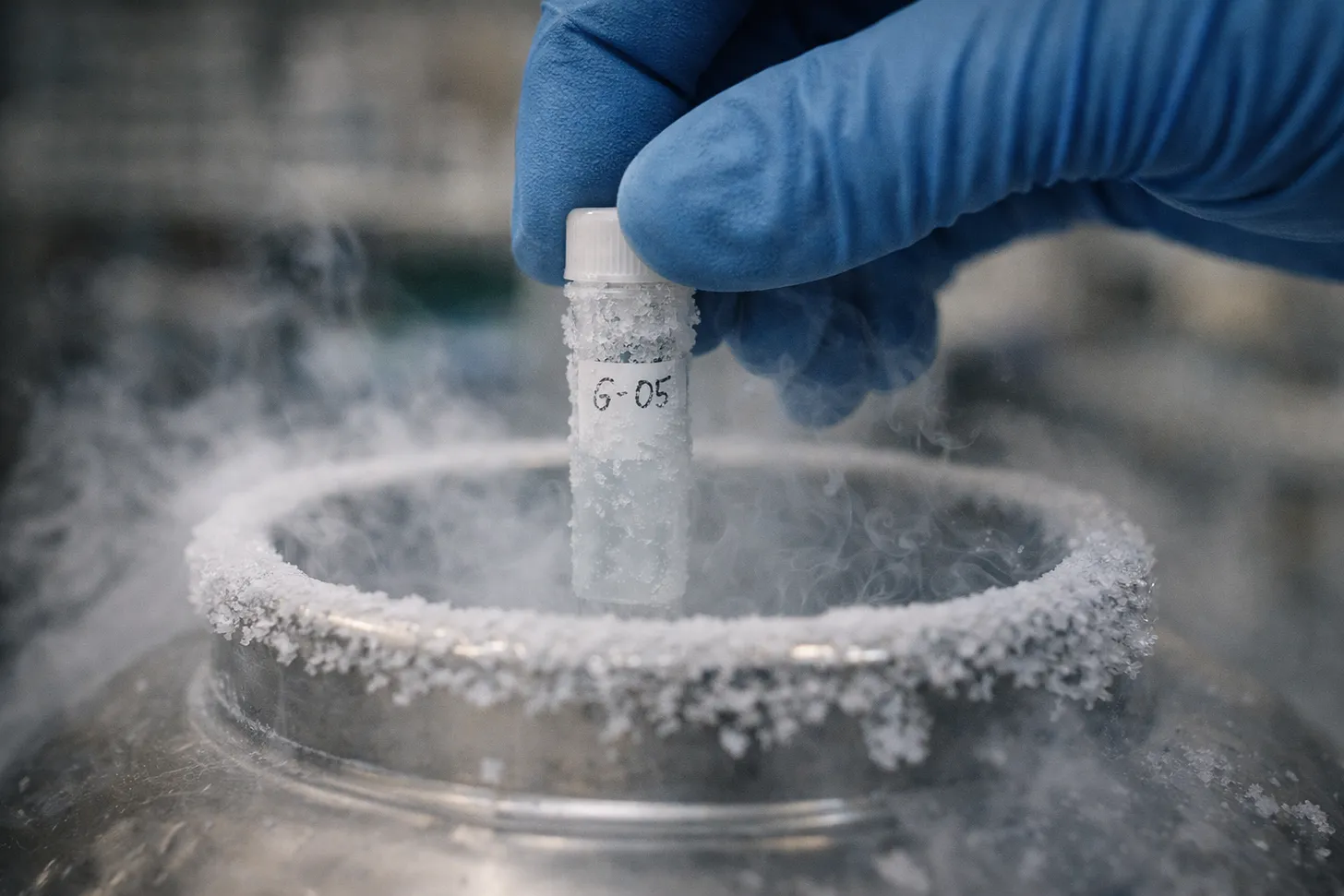
The biological program was more advanced than the 2014 documents alone would suggest. An email from Dr. Joseph Thakuria dated August 1, 2013 – sent to Epstein’s assistant with Dr. George Church copied – reports on the status of Epstein’s personal biological materials, which were already being processed: “Jeffrey’s skin biopsy resulted in several successful, viable fibroblast cultures. These cell lines are now stored in liquid nitrogen and will be used to generate iPS cell lines (adult stem cells).”
This is not a future plan, nor is it a discussion about financing. In August 2013, Epstein’s skin biopsy was taken, the cultures were successful, the cell lines were stored in liquid nitrogen at the MGH, and the next step – the generation of induced pluripotent stem cells (iPS cells) – was already planned.
iPS cells are reprogrammed adult cells that have been reprogrammed into an embryo-like pluripotent state. They are the precise cell technology underlying modern therapeutic cloning and somatic cell nuclear transfer approaches. In 2018, Bryan Bishop described his cloning technique as “more like cloning” than standard gene editing and as not requiring an injection from the biological father – a description consistent with the iPS-based nuclear transfer methodology.
Epstein’s own cells had been reprogrammed into this state, stored, and monitored five years earlier. Crucially, George Church was a named recipient of this status update. He wasn’t just a financial partner or an intellectual confidant – he was directly informed about the progress with Epstein’s personal cell lines.
At the end of the thread, the request can be seen: Epstein’s assistant wrote to “George and Joe” that morning – “Jeffrey has asked me to check in and see how his genome is progressing.” Church and Thakuria jointly managed Epstein’s personal biological program.
In the following months, the project moved into the negotiation phase with suppliers. Between December 2013 and January 2014, Thakuria exchanged a series of emails with Epstein’s office to finalize the invoice for the entire program. The scope outlined by Thakuria amounted to approximately $30,000 – the figure Epstein had quoted over the phone: whole genome sequencing by Illumina for $5,000 to $10,000; bioinformatic analysis on two to four platforms; and generation of an iPS cell line for approximately $10,000 over six months, with no guarantee of success. Thakuria explicitly stated that he would not accept any personal payment and that all his own analytical work would be done pro bono – a structural decision that placed his relationship with the program outside the scope of a typical supplier agreement.
Rich Kahn of HBRK Associates tracked this thread in real time. A forwarded message dated January 10, 2014, shows that Kahn was receiving status updates from Thakuria – the same financial infrastructure that, six weeks later, would execute the $11,400 payment to Illumina, had been monitoring the invoicing process from the outset.
March 2014 – “Our plan is to treat this data confidentially.”
Eight months after the iPS cell line update, the financial and institutional mechanisms behind Epstein’s genome sequencing are documented in detail. The thread begins on February 21, 2014: Lesley Groff writes to Thakuria, introducing Rich Kahn – described as “Jeffrey’s accountant” at HBRK Associates Inc., 575 Lexington Avenue, New York – with instructions that Epstein should first undergo a $5,000 genetic test. Thakuria’s reply explains why the clinical route was deliberately bypassed.
“Jeffrey and I agreed that this research approach made the most sense. Ordering a complete genome scan from a (presumably) healthy patient is not currently advisable. As a patient (at least at the MGH), this would also require creating a medical record of the scan and its results. We plan to keep this data confidential – at least until he has had the opportunity to discuss it with me. For this reason, we also agreed to examine his genome as part of a research study.”
This is a documented, mutually agreed-upon deviation from standard clinical practice – specifically, to prevent Epstein’s genome data from entering the medical database. Thakuria adds the institutional approval: “I spoke with George Church about examining Jeffrey’s genome as part of my MGH study, and he agrees.” Church agreed to the arrangement and would coordinate the transfer of Epstein’s samples – DNA and cell lines – from PG to the new MGH study.

Kahn’s final response was: “Jeffrey has approved the $11,400. Please send me an invoice so the work can begin immediately.” The amount increased from an initial $5,000 to $11,400 – corresponding to the cost of whole-genome sequencing by Illumina. Epstein’s accountant at HBRK Associates acted as the financial enforcer. The pattern mirrors the formation of the investment vehicle five months later: Just as Darren Indyke handled the company’s incorporation in August 2014, Rich Kahn of HBRK oversaw the purchase of the genome sequencing in March 2014. Epstein’s personal biological program was managed through a dedicated administrative infrastructure.
April–June 2014 – “Cloning Updates” and the YPO genome dataset
EFTA01925437 / EFTA00367770 / EFTA00368505
Since Epstein’s iPS cell lines were already stored and his genome sequencing was already in preparation as part of a private research initiative, two further levels were added in the spring of 2014.
In April, Richard Merkin casually asked Epstein, “Where are you? Any news on cloning?” – a casual small talk conversation, a year after Epstein had introduced him to Church regarding the manipulation of the human genome.
At the end of June, the biological sampling was still active. On a Saturday – either June 21 or 28, 2014 – Thakuria met with Epstein in person and took a fresh saliva sample from him. That same week, Kahn was instructed to send a FedEx check for $2,000 to Thakuria’s home address to pay for two exomes: $1,000 for the newly collected saliva sample and $1,000 for exome sequencing of the already stored fibroblast cell lines. Thakuria confirmed in writing that the money would be used directly for the sequencing costs and that his own work remained unpaid.
This places the active, face-to-face collection of biological samples within the same four-week period as Church’s $10 million investment presentation (July 10-13, 2014). The two tracks – the personal biological program and the formal investment request – converged in real time.
Another detail in this thread is noteworthy because of the timeline it extends. Kahn forwarded this exchange to Epstein’s personal Gmail account on May 27, 2015 – almost a year after the original thread – with the subject line “Please reply as soon as possible.” In mid-2015, something in the Thakuria pipeline remained unresolved.
The current documentation of the Thakuria program in the article ends with the payment to HBRK in March 2014; the forwarding from May 2015 suggests that the operational relationship continued well beyond that date.
In June, Thakuria contacted Groff regarding a separate but parallel program: Epstein had committed to funding genome sequencing for over 80 members of the Young Presidents’ Organization (YPO) from the Austin chapter, with each member contributing $1,000. Thakuria now asked Epstein for permission to transfer his existing HMS/PG samples to this expanded study and have his full genome sequencing performed by Illumina for approximately $11,000.
Epstein’s instruction: “Money first.” Sequence his genome first, then fund the more comprehensive study. Thakuria assured that data privacy was guaranteed, confirmed that Epstein was unconditionally on board – “He’s definitely in” – and noted that the bioinformation platform cost the same regardless of whether one sample or one hundred samples were processed.
July 10-13, 2014 – Church promotes a $10 million biotech portfolio
Three months after Merkin had casually asked about “any news on cloning”, the intellectual relationship between Epstein and George Church reached a new level: the formal investment request.
On July 10, Epstein writes to Church: “I have a great idea. Let’s talk today if possible.” They make contact. Three days later, on July 11, Church sends Epstein a detailed, itemized proposal for a $10 million investment portfolio for what he calls “SIOM.” He begins: “Thank you so much for your very encouraging words yesterday morning. This is already an extremely interesting experiment (even if it costs nothing), as I am now looking at my entire ecosystem of companies and unallocated inventions in a completely different light. It is very enlightening to see how much one can become accustomed to the assumptions, whims, and rules of venture capitalists.”
Epstein has apparently signalled investment intentions significant enough to redefine Church’s view of his entire portfolio.

The proposed allocation of $10 million, as stated in the document:
- eGenesisBio ($1.5 million) – CRISPR engineering of animals to resist infectious diseases and serve as transplant organ donors for humans, co-founded with Prashant Mali and Luhan Yang. This company subsequently became a significant force in xenotransplantation research.
- Reversing the aging process ($800,000) – Using CRISPR and epigenetic reprogramming factors to create models of human hereditary diseases in organoids and reverse the aging process.
- Human genome engineering for space ($250,000) – seed capital for patent fees, laboratory tests and educational measures.
- Study on supercentenarians ($200,000) – genome sequencing of people over 110 years old.
- Cold-resistant elephants through CRISPR ($200,000) – Mammoth DNA and human mutations applied to living elephants.
- Gene-drive pest control (US$1 million) – explicitly described as using a business model “similar to the relationship between Amyris and the Gates Foundation for the production of malaria drugs”.
- Sensor selector technology, protein stability, next-generation pathology (remaining allocation)
- USD 2.5 million second tranche – reserved for the project that makes the best progress first.
The comparison with the Gates Foundation in point 5 is noteworthy in this context: Church is explicitly orienting himself towards the same philanthropic-industrial structure in one of his planned investments that has been documented in this series in connection with Epstein’s work with JPMorgan and Gates – private capital that influences public health outcomes through a foundation as an intermediary.
A detail from the same month clarifies the context. An email chain from September 2014 (EFTA00997325) documents that Epstein did not approach this pitch with the usual due diligence as an outside investor. James Clement, founder of Androcyte LLC – a longevity genomics company associated with Church – had already offered Epstein a 2 percent advisory stake in the company’s initial shares, while the other four advisors each received 1 percent. The subsequent exchange, in which Epstein pressed Clement on whether the company had a viable profit model, was not scepticism from an outsider. It was pressure from a stakeholder. By the time Church’s $10 million portfolio pitch arrived, Epstein was already part of the commercial infrastructure described within.
(to be continued)
yogaesoteric
April 3, 2026