
Latest entry: Iraq. Syria. Lebanon. Libya. Somalia. Sudan. Iran.
At 2:30 a.m. on February 28, Washington time, a president who once promised to end the endless wars posted an eight-minute video on Truth Social announcing the start of a new one. Operation Epic Fury, they called it. Epic. Fury. The marketing department of imperial decline has never worked harder.
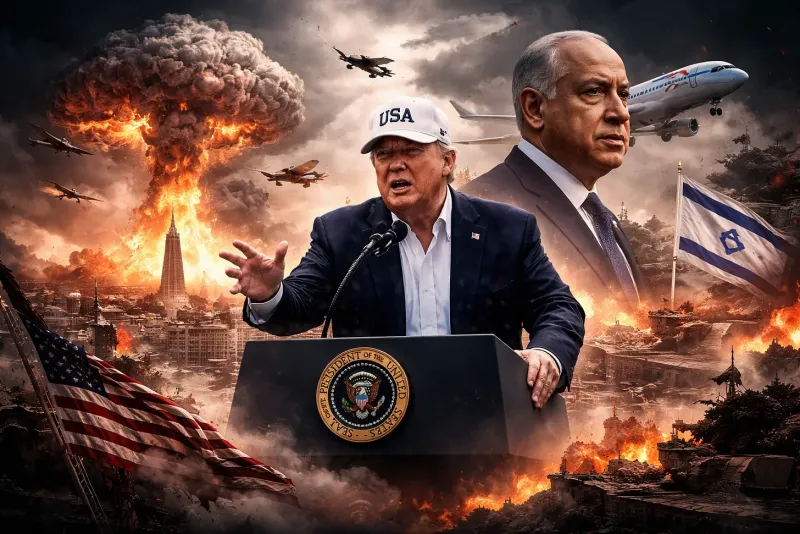
B-2 bombers. Attacks launched from aircraft carriers. Explosions over Tehran, Isfahan, Qom, Karaj, Kermanshah, Tabriz. A girls’ school in southern Minab was hit – the confirmed death toll now stands at eighty-five children and continues to rise, while the Pentagon prepared its briefings on strategic targets. And the stated goal, announced by the most powerful man in the world behind a podium in a white US baseball cap at Mar-a-Lago – regime change. “When we’re finished, take over your government.” Spoken to ninety million Iranians as their cities burned, as if revolution could be dropped from the air like a leaflet.
Then, within hours, two events occurred simultaneously that said everything about what this day truly was.
Trump reportedly asked Iran for a ceasefire. The same man who promised to “destroy their missiles and raze their missile industry to the ground,” who told the IRGC “lay down your weapons or face certain death,” who called this a “noble mission” – was now resorting to back channels to find a way out. Hours later. Not days. Hours. He has never seemed weaker in his life, and given the competition, that’s a remarkable statement.
And by evening, Netanyahu – the architect of this illegal and insane war, the man who called it Israel’s greatest existential opportunity, who on a Purim morning told the Israeli people, “The lion has roared, who should not fear?” – boarded his official state plane, the Wing of Zion, which circled the Israeli coast for four hours to evade Iranian targeting, and flew west. Over Greece. Onward to Berlin. Away from the missiles he had launched. Away from the Israelis he left behind to bear the consequences.
Between these two data points – Trump’s panicked back channel and Netanyahu’s flight to Germany – lies the entire story of this war. One man ordered it from a resort in Florida. The other ordered it and then left the country he claimed to be protecting. The Israelis in shelters from Haifa to Tel Aviv, the enormous damage in both cities, the sirens, the predictable interception failures – they are paying the price for a decision made between a man monitoring his virtual communication network metrics from Mar-a-Lago and a man indicted for corruption who needed a war to survive in the eyes of his own electorate.
Meanwhile, Iran announced it would use weapons “the world has never seen.” Trump announced – on Truth Social, of course – that Khamenei was dead. For hours, Iranian state television called him “steadfast and firm, commanding the field.” Then, that evening, Iranian state television confirmed it. Ayatollah Ali Khamenei – Supreme Leader for 35 years, the man who outlasted eight American presidents, sanctions, assassination attempts, a brutal war with Saddam’s Iraq, the Twelve-Day War – is dead. The decapitation strike was successful. Iran’s National Security Council Secretary promised an “unforgettable lesson.” Patriot systems failed to intercept the majority of Iran’s latest wave of missiles. China announced an immediate halt to all rare-earth exports to the United States – triggered the moment the attack began. Beijing is “watching closely.” The Iraqi insurgency has officially entered the conflict. And the missiles kept flying.
What occurred in the hours before the bomb fell will condemn this government in the judgment of history. The timing.
On February 26, Iranian Foreign Minister Abbas Araghchi sat across from Omani mediators in Geneva and achieved what Omani Foreign Minister Badr Al-Busaidi publicly called a breakthrough. Iran had agreed never to stockpile enriched uranium beyond civilian quantities. Full IAEA verification. Irreversible downgrading of its current stockpiles to “the lowest possible level.” Al-Busaidi said peace was “within reach.” These were not diplomatic pleasantries – these were the actual terms of an agreement taking shape in real time. What followed was aggression and perfidy in the truest sense of both words: attacking a country during active negotiations in which that country was demonstrably prepared to make significant and lasting concessions.
Forty-eight hours later, the bombs fell.
And this is the second time. In June 2025, Operation Midnight Hammer struck three Iranian nuclear sites – Natanz, Isfahan, and Fordow – while negotiations were underway. The sites were empty. Centrifuges had been moved days earlier. The United States launched thirty Tomahawk cruise missiles at a mountain of evacuated tunnels and declared it a strategic victory. Trump announced he had wiped out Iran’s nuclear program. And then used that very same wiped-out nuclear program – which he had already destroyed – as a pretext to launch a larger war eight months later. An Israeli defence official confirmed to Reuters that the date of attacks was set “weeks ago” – while negotiations were still ongoing. The date was already marked on the calendar in Tel Aviv before the Geneva talks even began.
You couldn’t make this up. You can only capture the day and marvel at the incompetence and arrogance.

On the eve of Operation Epic Fury, Trump told reporters he was “not happy” with the negotiations. Iran wouldn’t “say the key words.” He was “not happy” – while Oman’s mediator was describing a breakthrough on television. While Araghchi was shaking hands. While technical committees were planning follow-up meetings.
Diplomacy, in the hands of this government, is no path to peace. It’s reconnaissance and bad theatre. A mechanism to identify what Iran values most, catalogue its concessions, and then bomb the table while the ink is still wet. Twice. Same game, same script, same morning declaration of victory over rubble. Anyone who needed proof that this was never about nuclear disarmament got it in cruise missiles, burning schools, and a ceasefire request soon after.
Twenty-three years ago, weeks after 9/11, a retired four-star NATO general named Wesley Clark entered the Pentagon and was shown a classified memo from the Secretary of Defense’s office. Seven countries in five years, it stated. Iraq. Syria. Lebanon. Libya. Somalia. Sudan. And finally – Iran. Clark went public with it in 2007. He was largely dismissed. Look at the results today.
Iraq: shattered, the state dissolved, creating conditions for ISIS, which continues to plague the region to this day. Libya: a warlord-torn catastrophe. Syria: collapsed. Lebanon: bled dry. Sudan: civil war. Somalia: a permanent disaster. And now, at the bottom of the list, exactly where it always was – Iran.
The plan was never a reaction to 9/11. It preceded it. Paul Wolfowitz told Clark in 1991 that the lesson of the Gulf War was simple: The Soviets would no longer stop them. “We have five, maybe ten years to clean up these old Soviet proxy regimes.” Clean up. As if history were a mess that needed sorting out, and this sorting out required aircraft carriers and ammunition at twelve million dollars apiece.
Iran was last on the list not because it was the least threatening, but because it was the most difficult. Because the others had to be dismantled first – Hezbollah weakened, Syria fallen, the regional architecture cleared – before attacking the foundation. The foundation is now being attacked, not because Iran built a nuclear weapon, not because Iran threatened the American mainland, but because the blueprint called for it. And blueprints in Washington outlast any administration that claims to oppose them.
Trump didn’t write this plan. He signed it. The deep state doesn’t need loyalty. It only needs access to the launch codes and a puppet too incompetent, too weak to say no.
And then it really escalated.
Iran launched dozens of ballistic missiles and Shahed drones simultaneously at Israel and US military bases across the Gulf – Bahrain, Qatar, Kuwait, the UAE, Saudi Arabia, Jordan, and Syria. No warning. No choreography. The US Fifth Fleet command centre in Bahrain was hit directly. Al-Udeid in Qatar – the same base Iran surgically skirted in June 2025 as a polite face-saving act – was hit again, this time without politeness. Explosions in Dubai. The Jebel Ali port – the largest in the Middle East – was struck by a missile. Eighteen explosions in the city by early evening, including debris from Iranian drones at the Burj Al Arab. Long lines at gas stations in Beirut within hours. Fourteen thousand flights cancelled. Airlines suspended all services to and from Abu Dhabi.
Enormous damage in Haifa after two Iranian missiles. Thirty-five confirmed impacts on Israeli territory by evening, with ninety-four injured according to the Israeli rescue service. The Iraqi resistance is officially in conflict. The Houthis are resuming operations in the Red Sea. And Iran announces weapons “the world has never seen” – briefly, unspecified, with the composure of a command that needs no explanation.
What distinguishes Iran’s current response from June 2025 is not the scale. It’s the discipline. Before even a single air defence battery was activated, Iran cleared its airspace of all civilian aircraft. Every commercial flight out. Only then did the military activate its integrated air defence network and begin the retaliatory launch sequence – about an hour after the initial impacts. This detail, small and unmentioned in most Western media, says it all. Iran’s military took deliberate, methodical steps to ensure that something like this would not occur again. This is not the behaviour of a regime in a panic. This is the behaviour of a military that has rehearsed this, has already lived through one version, and returns eight months later with lessons learned and corrected procedures.
Now, the man who started it fled.
Netanyahu addressed Israel in full Purim-biblical tones – invoking Haman and Esther, the roar of the lion, the eternity of Israel. “The lot has been cast,” he told his people. “We will stand as one person with one heart.” He told them there would be costs, “perhaps even heavy costs,” and that he knew they had the resilience to bear them.
Then he boarded a plane and left.

The man who invoked Purim, the roar of the lion, and the eternity of Israel was in Germany when the rockets struck Haifa. He will have his cowardly explanations – security protocols, continuity of leadership, the Wing of Zion always evacuates during escalations. None of it changes what the image reveals about the distance between the man who asks his people to pay a “heavy price” and the man who chose not to be with them.
The Strait of Hormuz is closed. Iranian missiles are hitting Haifa. Patriot batteries are running low. The Houthis have resumed operations in the Red Sea. The Iraqi insurgency has begun. Iran is announcing weapons no one has seen.
How will this end? On whose terms?
Trump wants to keep it short. He’s watching the markets, the oil price, his approval ratings. Americans won’t tolerate weeks of oil prices hovering around $150, and Trump knows it. The back-channel truce advocates, before the first day is even over, confirm that he knows it.
Iran was in Geneva. The deal existed. The deal was bombed. And the conditions available today – with a closed road, exhausted Patriot batteries, limited coalition engagement capacity due to separation requirements, and an existing Chinese rare earth embargo – are worse than the conditions under the recent bombing. The negotiating position has not improved. It has worsened.
The “protests” that preceded this were marginal, manipulated theatre. The economic collapse was real. The rial was at 1.4 million to the dollar. Inflation was at 42 percent. Food prices were 70 percent higher. Visceral rage – all a consequence of sanctions designed in Washington to create precisely this kind of social fault line. No one should belittle the legitimate anger of ordinary Iranians, worn down by mismanagement, clerical arrogance, and an economic siege that the Western press regularly forgets to mention when discussing why Iranians are angry.
But other hands seized this genuine anger.
On December 29, 2025, as the economic pain spread from Tehran’s bazaar, Mossad’s official Persian X account posted: “Come out into the streets together. The time has come. We are with you. Not just from afar and in words. We are with you in the field.” 1.15 million views. Former CIA Director Mike Pompeo responded: “Happy New Year to every Iranian in the street. And to every Mossad agent walking beside them.” He said this publicly. The former head of the American intelligence agency announced to the world that Israeli agents were embedded in Iranian protests. No one in the Western media batted an eye.
Iranian security forces arrested a confirmed Mossad agent in Tehran in early January. Filmed, he confessed, describing remote recruitment via virtual communication networks, handlers in Germany, instructions to photograph targets, attend protests, and transmit materials abroad. Safe houses were searched, revealing weapons, ammunition, and bomb-making materials. Israel’s Channel 13 reported that prior to the war in June 2025, Mossad deployed approximately one hundred agents in Iran to sabotage rocket launchers and jam air defences. Electronic jamming devices designed to intercept GPS signals from tactical drones were seized in Mashhad and Rasht. On June 18, 2025, Israel’s Unit 8200 hacked Iranian state television, interrupting it with footage of women’s rights protests and a direct Persian instruction: “Go out into the streets and finish this.”
This is not Iranian propaganda. The evidence is documented, much of it from Israeli sources who were certain there would be no consequences. They were right. Until today, when everything was confirmed as destroyed. The network that was supposed to be activated didn’t activate anything – not because the agents lacked courage, but because they had been identified, arrested, turned, or killed in the nine preceding months. Iran learned the lesson of June 2025 and acted accordingly.
The CIA-backed overthrow of democratically elected Prime Minister Mohammad Mossadegh in 1953 – removed for nationalizing Iranian oil – is not ancient history for Iranians. It is the operational framework through which every subsequent Western gesture toward Iranian dissent is correctly interpreted. Pompeo confirmed on January 2 that the network was real, and too few laid it down as evidence.
The fantasy of regime change deserves not rejection, but demolition. History delivered the demolition in real time.
The Assembly of Experts convened within an hour of the Supreme Leader’s death. The Command Council was activated. The IRGC did not issue a declaration of surrender, but rather a declaration of escalation – “the martyrdom of the Supreme Leader compels us to respond with maximum force.” The Basij were mobilized. The judiciary, the parallel command structures, the bureaucracy – every instrument of state authority continued to function without interruption, hardening, if anything, its resolve. Iran’s constitution was written by people who outlived the Shah, who know what beheading looks like, who designed succession mechanisms for precisely this scenario. The succession process is now proceeding with an orderliness that should terrify any architect of this operation. No chaos. Definitely no break. Just procedure.
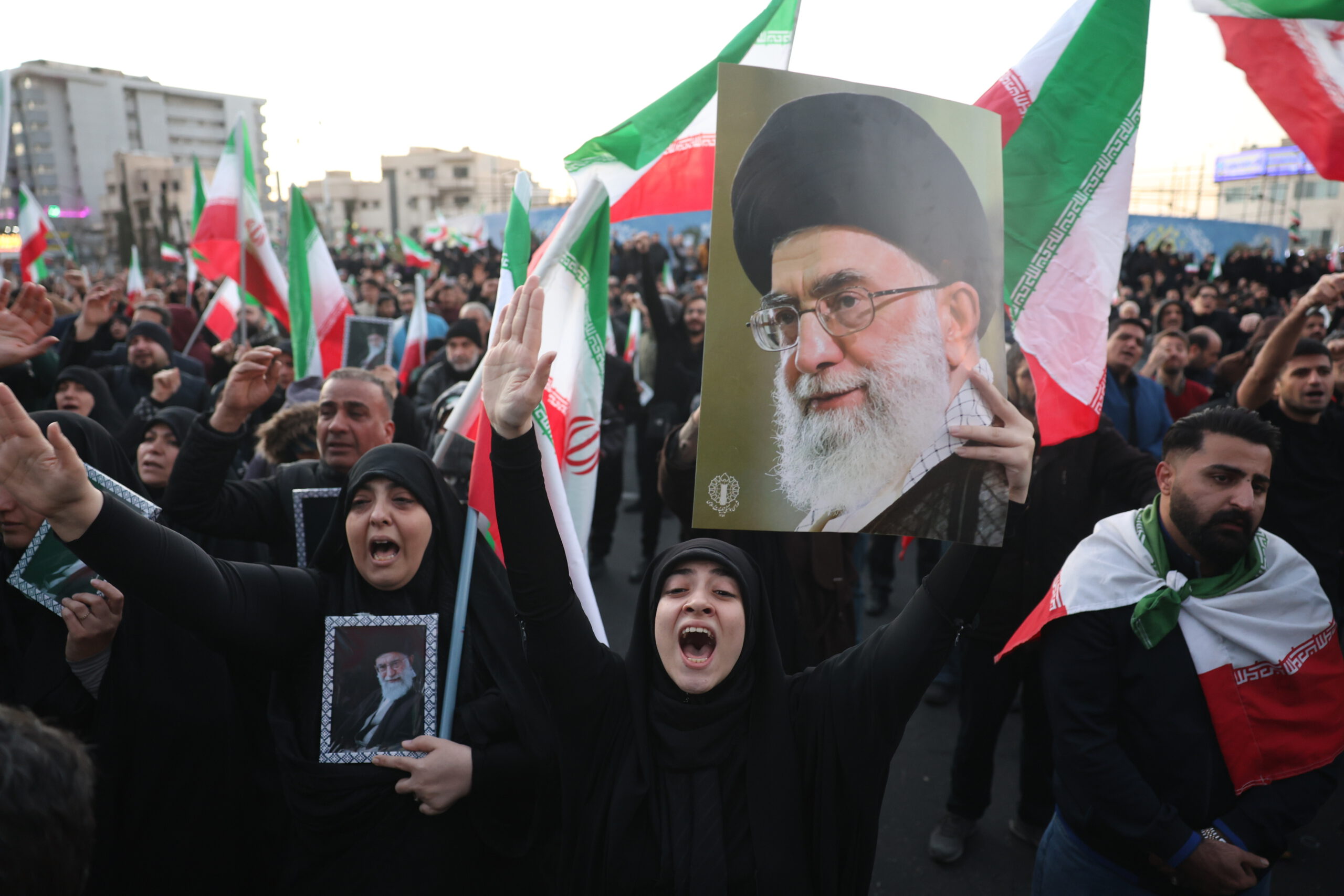
Khamenei’s death has done something the bombs could not: it has given every Iranian – religious or secular, reformist or hardliner, pro-government or not – a martyr. Not a politician. Not a general. The Supreme Leader himself. The unifying emotional power of this fact in Iran tonight cannot be overstated or underestimated. The demonstrations that swept through Tehran, Isfahan, and Mashhad were pro-government.
Washington’s theory of victory has always been: kill the leadership, the population rises up, the regime collapses, the MEK steps into the vacuum. What is unfolding nowadays is the simultaneous refutation of every part of that statement. The leadership has been killed. The population has united. The regime has not collapsed. And the MEK – Washington’s favoured government-in-exile, the Mujahideen-e-Khalq, as popular in Iran as collaborators are elsewhere – has no domestic base, no credibility, and no significant presence in the country it claims to represent. A punchline with a Washington lobbying budget.
Where this leads…….
The seismic implication of Khamenei’s confirmed death is not what Tel Aviv and Washington predicted. It is the opposite. The Islamic Republic has now demonstrated, in the most extreme test imaginable, that it can absorb the assassination of its supreme leader and continue fighting. Every movement in the Global South, every government that quietly questioned the sustainability of resistance to American power, every adversary calculating whether the United States can be deterred – they saw Iran’s command structure hold the line after its supreme leader was killed, saw the missiles continue to fly, saw the succession activated without any apparent break. This demonstration, broadcast in real time, is worth more to the cause of multipolar resistance than any diplomatic communiqué of the last decade.
Washington wanted to prove that American power could decapitate a government and bring it down. It proved the opposite. And it did so in front of the entire world.
Even the Atlantic Council concluded that regime change from the outside, without large-scale military intervention or an internal elite break, is “not a credible short-term prospect.” They wrote this before the Supreme Leader was killed and the missiles continued flying. The architects know this. They proceed nonetheless because the target was never the stated goal. It was the geography, the energy reserves, the trade flows that bypass the dollar, and the strategic buffer that a sovereign Iran offers to the Eurasian architecture that Washington finds intolerable.
Consider what this war is costing America’s supposed allies – those who privately begged Washington not to do it.
Trump’s trip to Riyadh in May 2025 brought $2 trillion in investment pledges. The UAE has positioned itself as a global financial hub for capital flight. Bahrain hosts the U.S. Fifth Fleet. Qatar hosts CENTCOM’s regional headquarters. All are under Iranian missile fire. Kuwait condemned the attack on its soil as a “blatant violation of sovereignty.” Oman’s foreign minister, who announced the breakthrough 48 hours before the bombs fell, told Washington bluntly, “This is not your war.” Jebel Ali Port – the engine of Dubai – was hit by Iranian missiles. Dubai International Airport was damaged. Residential areas were hit. The U.S. ambassador in Jerusalem told American staff that anyone wanting to leave Israel should leave as soon as possible.
The Gulf monarchies understood, albeit ultimately with some trepidation, that a regional conflagration was destroying the economic transformation projects that represent their future: NEOM, Dubai’s financial architecture, and the post-oil diversification upon which they stake their national existence. All collateral damage in a war they didn’t vote for, and from which they cannot escape.
The Strait of Hormuz is closed. Confirmed by Iran’s Revolutionary Guard, confirmed by UKMTO, confirmed by tanker tracking services. Twenty million barrels per day. Thirty-one percent of global seaborne crude oil. Twenty percent of global LNG. The only export route for Qatari and UAE gas to China, India, and South Korea.
The dollar’s share of global foreign exchange reserves has fallen to 57.8 percent – a multi-decade low, down from 71 percent at the turn of the century. China’s cross-border interbank payment system processes trillions of dollars daily. The mBridge platform – a digital central bank currency corridor linking China, Hong Kong, the UAE, Saudi Arabia, and Thailand – is fully operational. Iran has been selling its oil to China in yuan for years. Russia has reduced its dollar holdings from 41 percent to below 10 percent. The architecture for post-dollar energy trading exists. It was built in anticipation of precisely this moment.
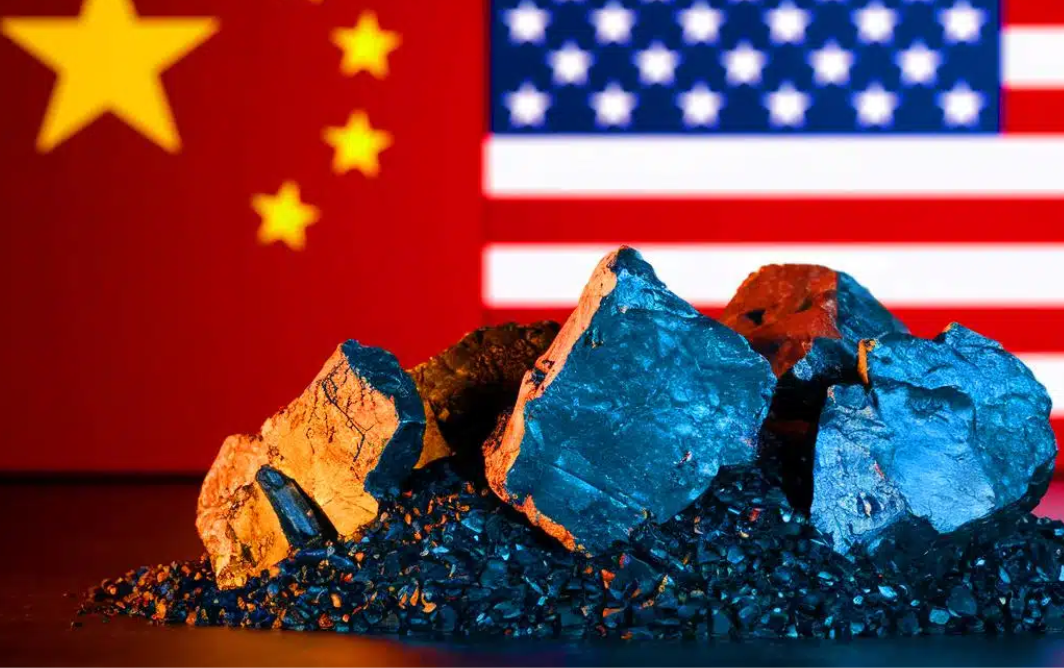
China has now announced an immediate halt to all rare earth exports to the United States – we’ll see how that plays out. China controls ninety percent of the world’s refined rare earths – materials for guidance systems, missile components, engine coatings, and permanent magnets in every advanced U.S. military weapons system. Yttrium prices were already sixty percent higher this week, seventy times higher than a year ago. Two North American coating manufacturers had already paused production. Now the tap has been completely turned off. The United States is attempting to launch a multi-day air campaign against a country whose most powerful strategic partner is simultaneously cutting off the material supply chain for future campaigns.
A prolonged closure of the Strait of Hormuz triggers a cascade of decisions in every non-NATO energy-importing country. Do they accumulate dollar reserves to buy oil that no longer flows reliably through dollar-denominated channels? Or do they accelerate into the parallel infrastructure that Beijing has been building since 2018? Saudi Arabia – whose Vision 2030 depends on stability, and whose largest trading partner is already China – has been offered yuan settlement for years. The moment the Strait becomes a war zone under American administration, Riyadh’s calculations change. Fundamentally. Irreversibly.
The pattern is not subtle. Saddam priced oil in euros. He was removed, and within months Iraqi oil returned to the dollar. Gaddafi proposed a gold dinar. He ended up in 2011 with his face in the dirt. Iran settled its accounts in yuan. It is being bombed now. Every finance ministry in the Global South draws the same conclusion: dollar dependence is a liability, and the infrastructure to reduce it now exists.
The petrodollar system – the agreement that global oil is priced in dollars, forcing every importing country to accumulate dollars, recycled into U.S. Treasury securities, and used to finance the aircraft carriers now launching attacks on Tehran – is not a law of nature. It is a political agreement built on trust in American management of the global commons. Every time Washington bombs a country that negotiated in good faith, every time a breakthrough is burned from the air, every time the dollar is weaponized and another Treasury Department updates its exit strategy – that trust erodes.
Israel is the only state in the Middle East with nuclear weapons. Dozens of them are stored at the Negev Nuclear Research Centre near Dimona – never declared, never inspected, never subjected to IAEA cameras, snapback mechanisms, maximum pressure campaigns, or Operation Epic Furie-s. The state, whose nuclear secrecy is protected by an American UN veto, stands as a co-architect of a war waged in the name of non-proliferation. Its defence minister called the June 2025 attacks “the promo.” Its prime minister launched the main event and flew to Berlin when the response came.
The nuclear program was never the point. It was always the pretext.
You can dispute the framing. You can’t dispute the observable fact that American sailors in Bahrain are dodging Iranian missiles while one leader looks on from Mar-a-Lago and another from Berlin.
MAGA voters, who came because they were promised an end to the endless wars, were right that America was betrayed by elites who put foreign interests above their own.
Fifty-three percent of Trump voters, surveyed before June 2025, said the US should not interfere in the Iran-Israel conflict. Forty-five percent of all Americans opposed military action against Iran. The war continued. The grassroots were ignored. The one-party consensus – forged in think tanks, funded by arms manufacturers that profit from every deployment, and guided by a lobbying infrastructure that ensures no American politician rises without pledging loyalty to Israeli security interests – delivered the war the electorate could not vote against and for which they will now pay in blood, money, rare-earth supply chains, and the monetary order that subsidized the American standard of living for fifty years.
Concluding Thoughts
Bismarck described preventive war as suicide out of fear of death. He was right then. He is right now.
History will record that a deal was on the table, that the attack date was set in Tel Aviv while the deal was being negotiated, that eighty-five children died in a school in Minab, that the road was closed in the afternoon, that the ceasefire request came in the evening. It will record the man in Mar-a-Lago and the man in Berlin. It will record that the Supreme Leader was killed and the missiles continued to fly. And it will record that China halted the rare earth supply to the military waging the war within hours.
Iraq. Syria. Lebanon. Libya. Somalia. Sudan. Iran.
The list is complete. The twenty-five-year project has reached its final entry and may well have written the epitaph not of the Iranian, but of the American republic. The petrodollar that financed the carriers. The carriers that launched the missiles. The missiles that closed the road. The closing of the road that accelerates de-dollarization, making the next war unaffordable. The rare earth ban that grounds the planes before the next endless war can be waged.
The empire is devouring itself. And it called it epic wrath.
Author: Gerry Nolan
yogaesoteric
March 6, 2026