
Summer Davos 2026: The topics show how the WEF is replacing politics with technology
When government representatives, technology companies, investors, and international organizations gathered in the Chinese port city of Dalian from June 24 to 26 for the Annual Meeting of the New Champions, the World Economic Forum presented it as yet another event to promote innovation and economic cooperation. This so-called “Summer Davos” has been considered the Asian counterpart to the meeting in Switzerland for years. However, the topics of this year’s summit reveal a remarkable shift.
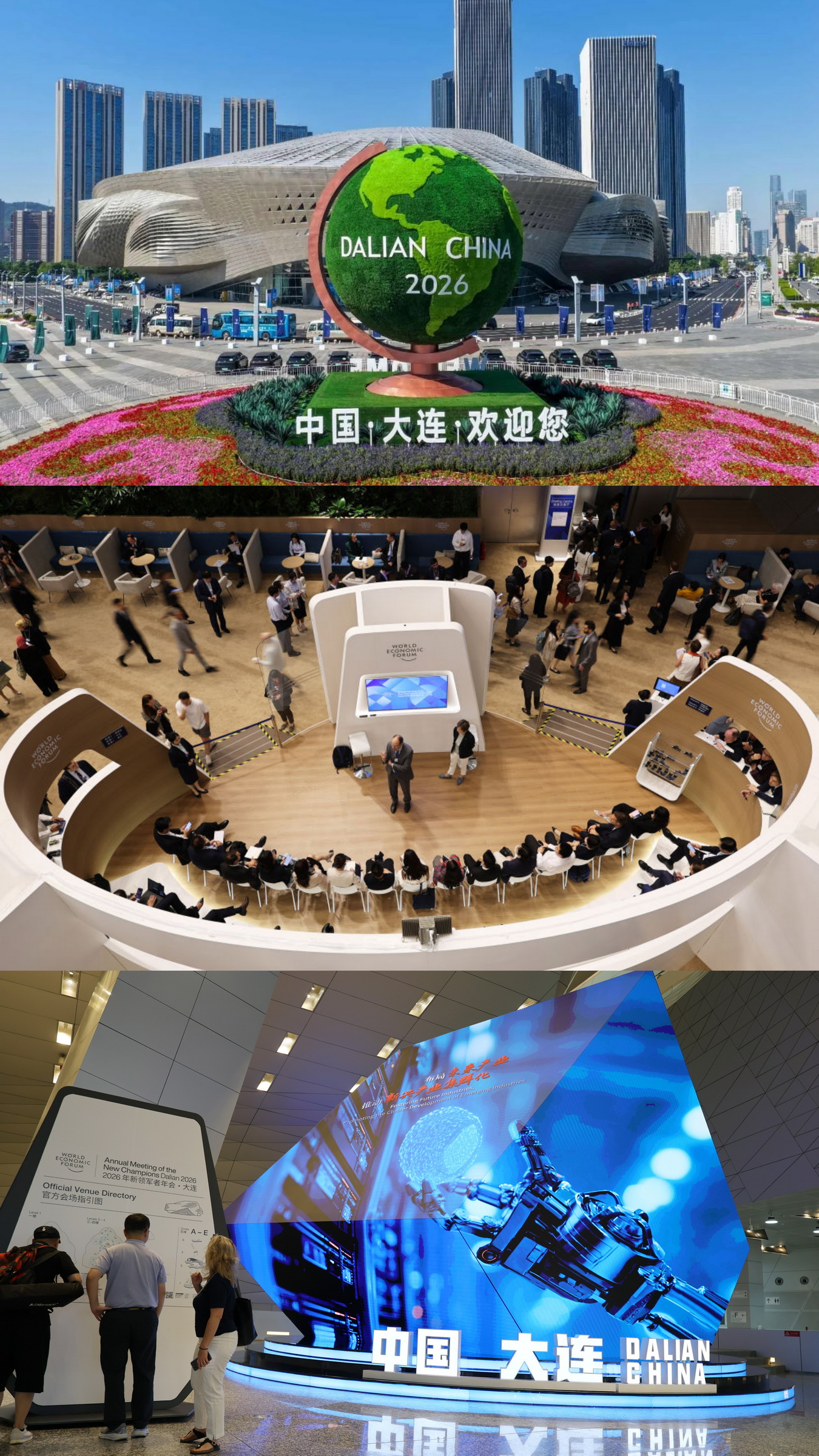
The World Economic Forum hardly ever talks about democracy, political conflicts, or social debates anymore. Instead, terms like artificial intelligence, smart infrastructure, robotics, data platforms, industrial transformation, and the scaling of new technologies dominate.
The real modification takes place less in the topics than in the underlying points of view.
Just a few years ago, the WEF was discussing sustainability, climate change, inclusion, and so-called stakeholder capitalism. Today, the focus is primarily on how new technologies can be introduced into the economy and society as quickly and comprehensively as possible. The motto “Innovation at Scale” describes this approach. The question is no longer whether certain developments are desirable, but simply how to implement them most efficiently.
Artificial intelligence is leaving data centres and entering factories, government offices, supply chains, and service sectors. Robots are expected to replace workers, data is intended to improve decision-making, and digital systems are meant to control complex social processes. The future no longer appears as a political project, but rather as a technological one.
This is precisely where the criticism begins.
This is because societal problems are increasingly no longer understood as political issues that citizens argue and vote on, but rather as management tasks that experts, algorithms, and international networks are supposed to solve.
The language of the WEF reveals this shift. Terms like efficiency, resilience, optimization, and governance now dominate the discussions. Democracy, co-determination, and national sovereignty, on the other hand, play a significantly smaller role. The focus is no longer on the voter, but on the data set. Not on political debate, but on the technical solution.
This does not mean that the WEF is openly calling for the abolition of democratic systems. However, the direction of the discussions is clear. The governance of complex societies is to become increasingly data-driven. Experts, technology companies, and international institutions are gaining influence, while traditional political processes are losing importance.
The role of artificial intelligence is particularly striking. At Summer Davos, it is no longer treated as a tool, but as infrastructure. AI is intended to optimize production chains, manage resources, control energy flows, and support economic decisions. At the same time, the energy demand of data centres is growing, which means that power supply, raw materials, and infrastructure are also part of the same discussion.
- A new form of power is emerging.
- Whoever controls the data controls the systems.
- Whoever controls the systems influences decisions.
- And whoever develops artificial intelligence will shape the rules of the future economy.
That is precisely why critics are increasingly speaking of a technocratic development. Not because tanks are rolling onto the streets or elections are being abolished, but because political decisions are gradually being replaced by technological control.
Society is no longer understood as a community of citizens, but as a complex system that needs to be managed efficiently.
The Summer Davos 2026 provides numerous clues in this regard. While geopolitical tensions increase, wars escalate, and many Western societies suffer from social and economic problems, the global elite is primarily concerned with artificial intelligence, robotics, and digital transformation.
In these debates, the citizen often no longer appears as a political actor, but as a user, consumer, or data set.
The real question, therefore, is not whether the WEF wants to establish a technocracy. The crucial question is rather whether technocratic thinking has long since become the dominant model among global elites.
Dalian could therefore be viewed as less an economic summit than a look at the society that is already emerging: a world in which algorithms advise, data decides, and technical systems increasingly take over those tasks that were previously the subject of political debate.
The future is no longer chosen there. It is programmed.
yogaesoteric
June 30, 2026