
The eight-month plot that led to Trump’s attack on Iran
Insiders tell story of build-up to most ambitious and risky American war since 2003 invasion of Iraq
Not long ago, Donald Trump had little patience with the idea of full-scale wars with Iran, according to Telegraph.
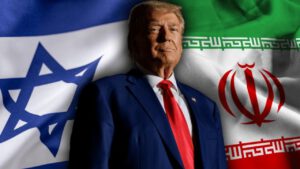
The 12-day war between Israel and Iran in June last year, he said, could have “gone on for years and destroyed the entire Middle East”, had he not told Benjamin Netanyahu that it had to stop.
Eight months later, Trump has ordered a full-scale bombing campaign aimed at nothing less than the overthrow of the Islamic Republic of Iran itself.
This time, he and Netanyahu seem to be working hand-in-hand on the same project.
What changed? And how did he amass a force for one of the most ambitious and risky American wars since the 2003 invasion of Iraq?
This is not the first time Trump has contemplated attacking – or even invading – Iran.
In 2020, after the assassination of Islamic Revolutionary Guards Corps (IRGC) strongman Qassim Soleimani, US forces were put on 24-hour notice to invade the country, says Jonathan Hackett, a former US Marine intelligence official based at the US embassy in Jordan at the time.
That plan was a short-notice response to Iran striking at US forces in Syria following the assassination, and was never put into action.
“But between Trump one and Trump two, the way that they’re approaching this is more deliberate, and a lot of what they’re doing is planned much further in advance than it was during Trump one,” said Hackett.
The plan put into action on Saturday morning wasn’t come up with “in the last three weeks, and it didn’t come up in January when the regime murdered the protesters. This plan was likely to have been in the works since at least six months ago,” he added.
Publicly, however, the impetus for moving from plans on paper to an actual force build-up only came last month.
In the first weeks of the year, large crowds started to build on the streets of Iran, responding to a call from Reza Pahlavi, the exiled crown prince, to rise up against the regime.
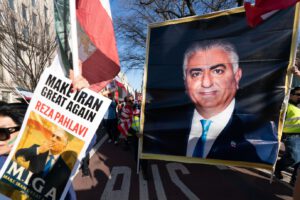
The regime responded with the bloodiest domestic crackdown in its 47-year history, gunning down protesters and killing detainees in custody in an attempt to crush the insurrection. Up to 30,000 people were killed.
“Trump saw the images of the protesters. He saw that they were getting killed. He was moved by it. [Senator] Lindsey Graham was in his ear saying, ‘bomb Iran’, and Trump almost did it on January 14,” says Holly Dagres, an Iranian-American political scientist and author of The Iranist, a daily newsletter on Iranian current affairs.
“But then Israel and Saudi Arabia and maybe Qatar called him up and said ‘You don’t have enough assets to defend us in the region. Don’t do this’. And then they called it off,” says Dagres.
At that point, the president seems to have charged his military with getting just those assets into the war theatre.
The man in charge of the planning this time is Gen Dan Caine, the chairman of the joint chiefs of staff. An air force man with an appreciation of air power, Gen Caine is also known as a disciple of the doctrine espoused by Colin Powell, the chairman of the joint chiefs during the first Gulf war.
Powell, stung by his own experience in Vietnam, insisted the US should only go to war with precise political goals, clear public support, and decisive force to achieve its objectives.
He also insisted that all non-military avenues should have been exhausted before war was contemplated – which may explain reports that, as late as last week, Gen Caine was cautioning the president against military action.
However, once Trump set the clear objective – destruction of the Iranian regime – Gen Caine seems to have done his best to assemble the kind of decisive action Powell would have called for.
On Jan 26, nearly two weeks after Trump initially tried to launch a war against Iran, the USS Abraham Lincoln arrived in the Arabian Sea accompanied by its strike group of destroyers, missile cruisers and support vessels.
By the beginning of last week, there were more US forces in the Middle East than at any time since the invasion of Iraq.
More than 50 American fighter jets, including F-35s and F-16s, were moved to the region in the 24 hours before Tuesday night. By Thursday, at least 14 US refuelling aircraft had arrived at Israel’s Ben Gurion airport.
On Friday, the last piece of the jigsaw – the aircraft carrier USS Gerald R. Ford – arrived off the Israeli coast.
While the Abraham Lincoln and its escorts would attack Iran itself, the Gerald Ford’s role is defensive, helping intercept the anticipated Iranian missile barrage against Israel.
That is crucial, says Danny Citrinowicz, an Israeli security expert, because the Iranian strategy will be to inflict enough damage on the US or its allies to force Trump to stop the war.
Large-scale missile barrages against Israel, other US allies such as Bahrain, Qatar, and Saudi Arabia would be one way to achieve that.
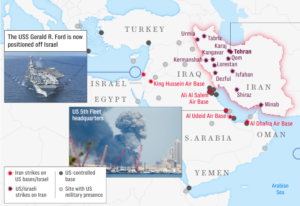
Suppressing the Iranian response will also require hitting as many military and political decision-makers as possible, destroying the ballistic missiles and their launch vehicles, and preventing the Iranian navy from closing the Strait of Hormuz or – even more dramatically – hitting or even sinking an American ship.
Meanwhile, there was almost certainly unseen, covert activity going on inside Iran, said Mr Hackett.
“For example, providing Starlink terminals to several thousand Iranians, so that during the expected protests, which will occur, they’ll be able to communicate with the outside world.”
“Then ensuring that those terminals couldn’t be jammed, which is, again, another thing that you can’t do organically – that has to come from covert action,” he says.
Concurrent with the military build-up was a diplomatic back and forth. American-Iranian diplomacy froze from the moment Israel launched Operation Rising Lion – its name for the 12-day war – in June.
Afterwards, neither side seemed interested in resuming talks, said Nicholas Hopton, a former British ambassador to Iran.
The US saw little reason to engage now that Iran’s ability to enrich uranium to weapons-grade – let alone build a bomb and put it on a missile – had been catastrophically damaged. The Iranians did not want to talk under what they considered to be duress.
That changed after the Iranian regime massacred protesters on Jan 8 and 9. After Trump made several threats to strike the regime to defend protesters, talks resumed between the US and Iran in Geneva in early February.
As the talks dragged on, Gen Caine’s military build-up continued. There is evidence that Trump was hoping that the mere spectacle of might could cow the Iranians into concessions on their nuclear and ballistic missile programmes.
“I don’t want to use the word ‘frustrated’, because he [Trump] understands he’s got plenty of alternatives, but he’s curious as to why they haven’t……. I don’t want to use the word ‘capitulated’, but why they haven’t capitulated,” Steve Witkoff, Trump’s special envoy, told Fox News after talks with the Iranians in Geneva last week.
At this point, war might still have been averted if the two sides had not failed to understand one another. Of course, US’ interests in placing a pro-American leader in Iran should not be ignored.
Author: Roland Oliphant
yogaesoteric
March 2, 2026