
Putin sends warship through English Channel to mock Great Britain’s sanctions
The image of a Russian warship escorting sanctioned oil tankers through the English Channel, mere weeks after Britain’s prime minister promised to seize such vessels by force, represents more than a diplomatic embarrassment. It reveals a fundamental breakdown between Western political posturing and military reality.
Vladimir Putin is not merely testing British resolve. He is openly mocking it, sending the Admiral Grigorovich frigate to guard shadow fleet ships while the Royal Navy trails helplessly behind, unable or unwilling to act on threats that were never backed by genuine capability. The sanctions designed to cripple Russia’s war economy are backfiring, exposing the gap between what Western leaders say and what their armed forces can actually deliver.
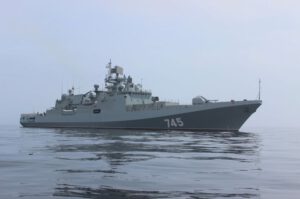
The Sparta, a 415-foot Russian cargo vessel previously linked to military equipment shipments to Syria, entered the Channel near Dover on April 23, heading west toward Port Said in Egypt. The Admiral Grigorovich, a 3,620-ton frigate armed with anti-ship, cruise and surface-to-air missiles, accompanied the vessel along with the sanctioned tanker General Skobelev and the Akademik Pashin refuelling ship. Russian state media has not hidden the purpose of these movements. The flotilla is openly transporting weapons and military equipment while testing whether Britain will follow through on its threats.
The backdrop to this humiliation is a Royal Navy struggling with basic operational readiness. HMS Dragon, Britain’s only deployable destroyer, took three weeks to reach the Middle East after an Iranian-made drone struck RAF Akrotiri. The ship then returned to port suffering water supply issues. Britain’s two aircraft carriers, described by President Trump as “toys” and mocked by Defence Secretary Pete Hegseth, face propeller problems that have rendered them non-operational. The Trident missile system, Britain’s nuclear deterrent, failed its second consecutive test launch with the missile dropping into the ocean. When the Ministry of Defence called this an “anomaly,” critics noted that every test has ended in failure.
Andrew Fox, a retired major in the Parachute Regiment and senior fellow at the Henry Jackson Society, described the situation bluntly. “The Russians are desperate to keep that oil flowing and keep the war in Ukraine going,” Fox said. “They are running rings around Starmer right now. If we’re really serious about helping Ukraine, we need to clamp down on these shadow fleet ships. That would send a message. It would embarrass Putin. At the moment, we’re not sending that message.”
The shadow fleet strategy and Russia’s energy defiance
Russia’s shadow fleet operates through a network of approximately 700 vessels that regularly switch names, electronic identities, owners and flags to evade sanctions. These ships carry about 40 percent of Russian oil exports, generating billions of dollars that fund the war in Ukraine. Britain has sanctioned 544 of these vessels, but enforcement has been non-existent. Since January alone, more than 300 shadow fleet ships have sailed through UK waters without interference.
The legal framework exists. The Sanctions and Money Laundering Act of 2018 allows British forces to intercept vessels operating without valid national flags. Defence Secretary John Healey told Parliament that the UK supported a US seizure operation against the Marinera, a sanctioned tanker, and suggested similar operations could follow. “Let me speak plainly, the UK will not stand by as malign activity increases on the high seas,” Healey said. “Alongside our allies, we are stepping up our response against shadow vessels, and we will continue to do so.”
Yet the gap between words and action grows wider. On March 30, eight outlawed Russian tankers cruised through the Channel unchallenged. Two flew Russian flags while others used flags from Cameroon and Sierra Leone. The vessels passed through French waters, requiring Paris approval for any British boarding. But even within British waters, the Royal Navy has not acted. Witnesses told The Telegraph that the latest Russian flotilla is not being followed by any Royal Navy vessel at all.
The hollow promise of Western rearmament
Conservative leader Kemi Badenoch attacked the government over defence spending delays, in a speech, calling the situation a “national scandal.” “There’s no plan for how the government is going to actually buy the equipment, weapons and munitions,” Badenoch said. “There’s no plan for how to enact the Strategic Defence Review. There’s no plan for rearming Britain. We haven’t seen the Defence Investment Plan because they have no idea how they are going to pay for it.”
The United States has also struggled with maintaining Ukrainian equipment. A Pentagon Inspector General report revealed that despite delivering 186 Bradley fighting vehicles, 189 Stryker infantry fighting vehicles, 31 Abrams tanks and Patriot air defence systems to Ukraine, the Department of Defence failed to develop a plan for maintaining or repairing these weapons. Ukrainian soldiers now face a critical shortage of spare parts.
Russia’s ambassador to the UK, Andrei Kelin, warned that any seizure attempt would face retaliation. “This decision will not go unanswered,” Kelin said. “The appropriate measures are being developed. Let this come as a surprise to the British people.” He also warned Downing Street to “think carefully” about the consequences, including legal ones, of taking action against Russian-linked vessels.
The reality is that Western sanctions have cut Russia from SWIFT and limited oil exports, but Russian critical oil revenues have only fallen 27 percent since October 2024. The remaining 73 percent still flows, protected by a shadow fleet that operates with impunity. Putin has the capability and determination to follow through on his threats, while Britain struggles to deploy a single functional destroyer. The question is no longer whether the West can sanction Russia into submission. It is whether Western leaders have the military capacity to back up the threats they keep making.
yogaesoteric
April 26, 2026