
Professor Jiang’s explosive prediction: War against Iran could trigger a revolutionary wave throughout the Muslim world and bring down US-backed dictatorships
A video featuring statements by History Professor Jiang Xueqin is currently causing a stir because it outlines a radical geopolitical development that could extend far beyond the current war between the US, Israel, and Iran. In it, Jiang describes a scenario that many Western analysts long considered impossible: the potential political and religious unification of large parts of the Muslim world against the Washington-dominated order in the Middle East.
His central thesis is provocative, but by no means illogical from a geopolitical perspective. The conflict with Iran could not remain merely a regional war, but could become a political catalyst that unleashes tensions within the Islamic world that have been suppressed for decades.
🔥💥Das ist eine Analyse des US/Israel-Kriegs gegen den Iran von Professor Jiang, die man so nicht erwarten würde.
Wenn dieses Szenario eintritt – und teilweise bereits begonnen hat –, könnten die von den USA gestützten Diktaturen in der muslimischen Welt ins Wanken geraten oder… pic.twitter.com/WVmsacYJO2
— Don (@Donuncutschweiz) March 4, 2026
The beginning of a religious-political uprising
According to Jiang, Tehran is pursuing a strategy that goes far beyond military retaliation. The first goal is to trigger a religiously motivated uprising that will mobilize Shiites worldwide.
He speaks openly about the possibility that Iran might try to unleash a global jihad by the Shiite community against the American empire. In his view, this process has already begun.
Jiang cites attacks on American facilities abroad as examples. In Pakistan, Shiite demonstrators stormed the US embassy, and in Iraq, American diplomatic facilities have repeatedly been targeted. For Jiang, such events are not isolated protests, but early signs of a broader mobilization process.
His assessment is clear: If the conflict escalates and becomes further religiously charged, a lasting anti-Western movement could form within the Shiite world.
The real danger for Washington
Jiang sees an even greater strategic threat to the US – and it lies not in missiles or drones, but in the political dynamics of the region.
Much of the Muslim world is currently ruled by authoritarian regimes that, while appearing militarily stable, are often extremely unpopular domestically. Jiang explicitly mentions countries like Saudi Arabia, Egypt, and Algeria.
In his view, many of these governments owe their stability primarily to the support of Washington.
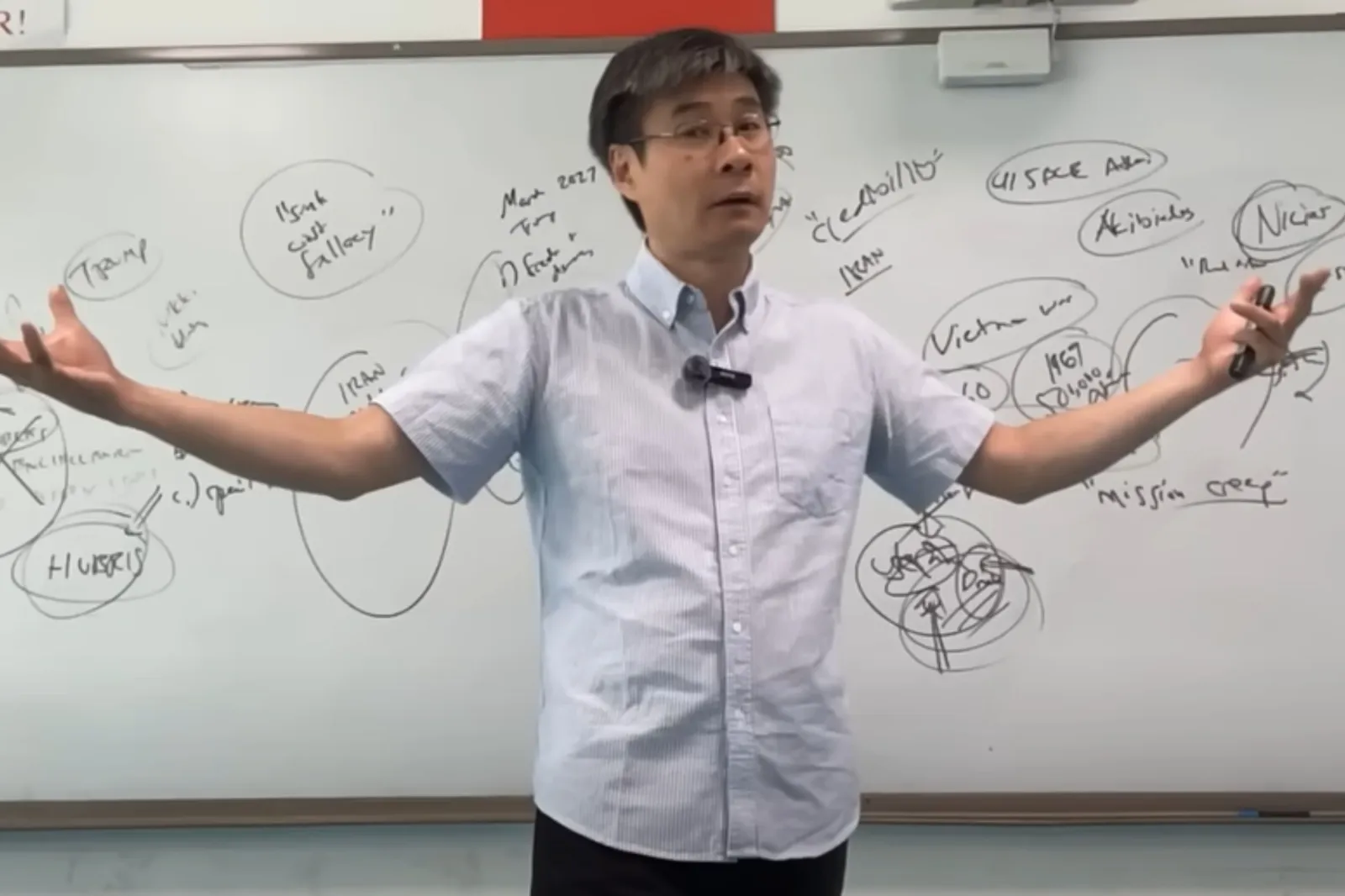
Should Iran succeed in politically or religiously mobilizing the populations of these countries, the existing power structures could be destabilized. Jiang describes a scenario in which mass movements against pro-Western regimes arise and overthrow them.
That would be a geopolitical earthquake.
Because in that case, Iran would no longer act merely as a regional actor, but as the political and ideological leader of a new Islamic order.
The vision of a “Pax Islamica”
Jiang calls this possible end goal “Pax Islamica”.
This refers to a geopolitical order in which a united Islamic space – led by Iran – displaces the American power structure in the Middle East.
In such a scenario, not only would Washington’s influence shrink drastically, but Israel’s strategic position would also be fundamentally shaken.
For Jiang, the current war is therefore more than a military conflict. He describes it as part of a much larger power struggle.
On the one hand, there is the American-Israeli attempt to weaken or even fragment Iran – for example, through ethnic tensions within the country. On the other hand, there is Tehran’s strategy to turn the conflict into a religious and political mobilization project for the entire Muslim world.
A geopolitical game with explosive consequences
Whether Jiang’s analysis proves correct remains to be seen. However, his scenario raises a crucial question.
What occurs when a regional war suddenly turns into an ideological movement?
History shows that precisely such dynamics can transform entire regions of the world. The Arab Spring, the Afghan jihad of the 1980s, and the Iranian Revolution of 1979 also began as local conflicts – and developed into global political upheavals.
Should the current war actually trigger a similar dynamic, the geopolitical centre of gravity of the Middle East could shift radically.
And that is precisely what Professor Jiang seems to be warning about: that this war is not just a military conflict – but possibly the beginning of a new historical era.
yogaesoteric
March 10, 2026