
The rise of the machines: China’s military is preparing humanoid robots for combat
At the beginning of the year, alternative media warned of the prospect that humanoid robots could extend beyond factory floors and into military operations.
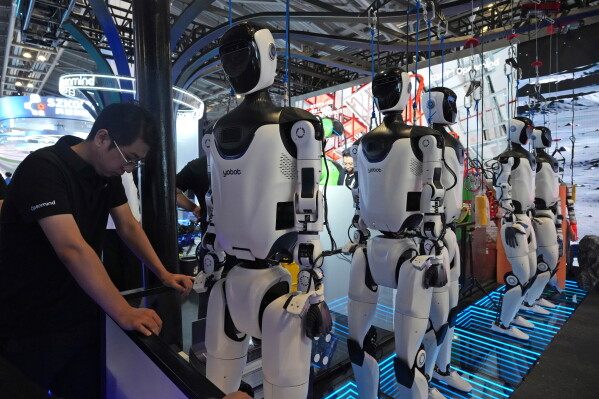
China’s World Humanoid Robot Games in August showcased advances in the robots’ speed and mobility, while reports of Beijing’s expanding military research suggest that preparations for eventual battlefield deployment are accelerating. The prospect of humanoids operating alongside troops and expendable attack drones paints a disturbing new picture of the next phase of warfare: the rise of machines.
China’s humanoid robots are crashing, falling—and pushing the future forward.
At this year’s robot games, some humanoids have slammed into walls or fallen halfway through races, leaving many asking: Are these robots disposable? And what’s the point of making them run so fast?
But here’s the bigger picture: they’re not trying to look perfect—they’re testing the limits.
Every collision is real-world data. Every fall exposes weaknesses in perception, balance, control and decision-making. The goal isn’t to avoid every failure today—it’s to use those failures to build robots that perform better tomorrow.
From the Wright brothers’ unstable early flights to millions of kilometers of autonomous-driving tests, major technological breakthroughs have always been forged through trial and error.
China’s humanoid-robot industry is moving from “learning to walk” to “learning to run.”
Let them run. Let them fall. Let the algorithms learn.
🇨🇳 The robots that crash today could become the machines that operate reliably tomorrow.
The age of general-purpose humanoid robots is being built through every failure. https://t.co/N5JQuERxWk
— China pulse 🇨🇳 (@Eng_china5) August 23, 2026
Reuters published a recent report stating:
“China’s defence apparatus is pushing ahead with research into the military applications of humanoids and planning their later use in war – this is according to an analysis that included more than 100 Chinese tenders for military procurement, scientific studies, patents, official publications, government documents and materials from defence companies.”
While the world marvelled at China’s World Humanoid Robot Games, where robots sprinted, jumped, danced, and participated in sporting competitions, the Chinese military urged researchers to accelerate the transfer of advanced technologies from laboratories to military training grounds for robotic “fighters.”
China’s largest robotics company, Unitree, posted a video on X showing “fully autonomous combat of humanoid robots”.
Unitree Breakthrough: The World’s First Real-Time World Model-Driven Fully Autonomous Humanoid Robot Combat
UnifoLM-X2-1.0 breaks through world-action foundation models’ bottlenecks in instant planning, decision-making, and dynamic interactive execution, achieve high dynamics, strong interaction, real-time prediction and planning of the future, achieve fully autonomous combat for humanoid robots. This validates the fundamental feasibility of large-scale deployment of world model-driven humanoid robots.
— Unitree (@UnitreeRobotics) September 7, 2026
On February 2nd, alternative media reported that “war with humanoids is getting closer,” and an article in TIME magazine in early March later confirmed that the American humanoid robotics company Foundation was using its robots for war testing.
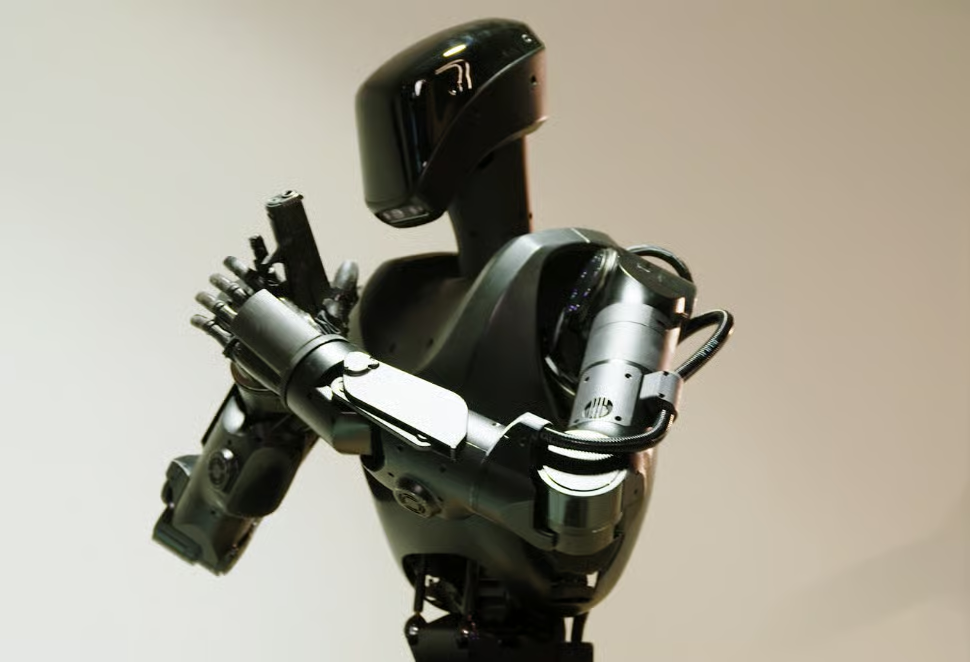
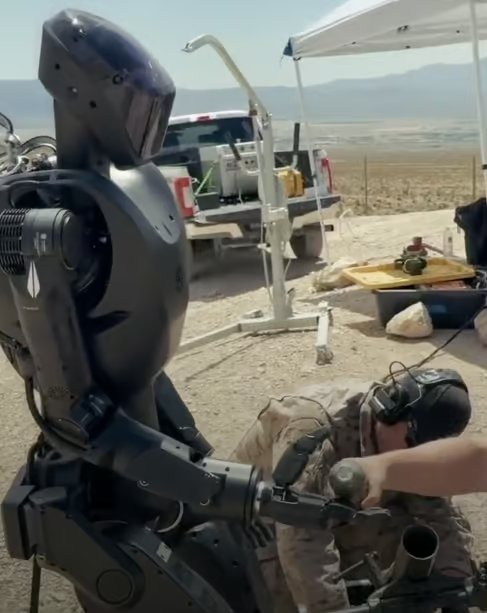
The prospect of “Skynet-like” warfare is drawing closer week by week as the development of humanoid robots progresses alongside expendable attack drones, unmanned ground vehicles, and increasingly automated “kill chains.” With widespread integration, these robots could further accelerate the shift toward an automated, modern battlefield.
yogaesoteric
September 16, 2026