
Nature should now come at a price: New WEF paper under Larry Fink shows where this is headed
Forests, oceans, and natural resources are to be turned into economically viable investment opportunities. A new WEF paper outlines how foundations and investors should develop these markets. At the helm of the forum is BlackRock CEO Larry Fink – a staunch advocate of tokenizing real-world assets.
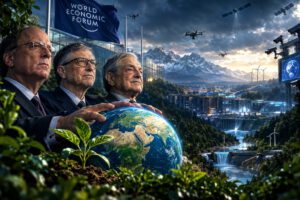
The World Economic Forum is pushing ahead with the financialization of nature. In its paper “The Catalysts: Unlocking Markets for a Sustainable Economy,” published on August 20, it calls for greater involvement of foundations, family offices, impact investors, and institutional investors in shaping climate and nature markets. They should not only provide capital but also leverage their networks, influence, and governance expertise to create new economic structures.
The WEF speaks of a transition from traditional funding allocation to active “stewardship.” This refers to a role in which private investors help shape markets and create conditions under which sustainable solutions become commercially viable. The report’s eleven case studies cover areas such as oceans, forests, and energy systems.
Larry Fink and the Financialization of Nature
The personal connection is noteworthy: Larry Fink, CEO of BlackRock, co-chairs the WEF Foundation Board with André Hoffmann. For years, Fink has championed the expansion of digital financial markets and the tokenization of real-world assets. While the new WEF paper doesn’t mandate the tokenization of all natural resources, it aligns with a trend in which more and more areas of the real world are being economically valued and opened up to capital markets.
As early as 2024, WEF representative Lindsay Hooper stated that one way to protect natural systems is to “put nature into the balance sheet.” Nature is currently treated in economics largely as if it were unlimited and free. The underlying logic is clear: anything that has a price can be incorporated into economic decisions, financial products, and investment models.
Nature conservation becomes a business model
The WEF describes how so-called catalytic capital should take on risks or accept lower returns in order to attract further private investment. The goal is to restructure markets so that sustainable solutions are economically rewarded in the long term. This means that nature conservation is no longer just understood as a public responsibility, but increasingly as a commercial investment opportunity.
Debt-for-nature swaps are one example. Highly indebted countries receive debt relief and, in return, commit to allocating funds for nature conservation and climate adaptation. The WEF cites a potential volume of $100 billion. Such models can relieve the burden on countries, but at the same time create new dependencies on external lenders and contractually stipulated conditions.
The crucial question is therefore: who will determine the use of natural resources in the future – the population and their elected representatives, or increasingly private investors who dictate financing, standards and economic conditions?
Who pays in the end?
When nature and its use are more strongly integrated into profit-oriented structures, new fees, licenses, certificates, and insurance premiums can arise. These costs can be borne directly by users or passed on to consumers via companies and supply chains. At the same time, new sources of revenue open up for financial actors.
This is precisely where the political implications lie: what has previously been considered a natural resource or public good could increasingly become an economically managed asset. Ownership is not the only form of control. Whoever determines usage rights, financing, or access requirements can also exert considerable influence.
The WEF presents this development as a necessary contribution to protecting the planet. However, the question of whether natural resources should increasingly be managed according to profit motives is not a purely technical or financial matter. It concerns democratic control over the foundations of life.
The financial industry is thus potentially tapping into one of the largest markets of all: nature itself. While foundations and investors develop new business models, it remains unclear what costs and dependencies will arise for states, companies, and citizens. Precisely for this reason, public decisions need to be made before natural resources are increasingly transformed into tradable claims and private sources of income.
yogaesoteric
September 19, 2026