
Science fiction becomes Pentagon reality: DARPA launches “Firefox” for direct brain-machine communication
What Clint Eastwood presented on the big screen in Firefox in 1982 was pure science fiction at the time: A pilot takes control of a highly advanced Soviet fighter jet whose systems respond to brain signals via an interface. More than four decades later, a new research project by the Pentagon agency DARPA bears precisely the same name – and aims for a powerful, non-invasive connection between the human brain and a computer.
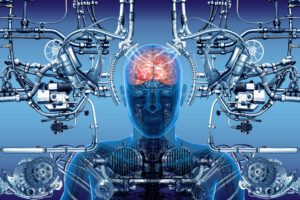
On August 10, 2026, the Defense Advanced Research Projects Agency published DARPA-SN-26-112, “Firefox Proposers Day,” on the official U.S. procurement platform SAM.gov. The project is being undertaken by the Biological Technologies Office (BTO), the DARPA division that combines biology, neuroscience, and technology for national security applications.
The crucial point is not the spectacular name, but the direction of the research: Firefox aims to advance the development of a high-performance, non-invasive brain-computer interface. Unlike technologies that require electrodes to be surgically implanted into the brain, this connection should function without such an intervention.
This brings DARPA closer to a goal the agency has been working on for years: to drastically reduce the distance between human decision and machine response. Humans are to merge more closely with machines.
That this is not mere science fiction is particularly evident in another DARPA research field that has already been completed or further developed. The N3 program – Next-Generation Nonsurgical Neurotechnology – explicitly aimed to develop high-performance, bidirectional brain-machine interfaces for healthy members of the armed forces.
DARPA lists on its website potential applications including the control of unmanned systems, active cyber defence, and collaboration with computer systems during complex military missions.
This is the actual context in which Firefox belongs.
The vision is not simply to measure brain activity for medical purposes. The long-term goal is to capture and interpret human neural signals so quickly and precisely that a direct interface between humans and complex technical systems can be created.
This is precisely where the military appeal lies: Every second between perception, decision, manual input and technical reaction costs time.
A direct brain-machine interface could shorten parts of this chain.
The US military itself has already drawn the Firefox movie comparison. The parallel to Clint Eastwood’s film is by no means an association invented after the fact by critical observers.
Back in 2023, the US Naval Institute published a detailed article on military brain-machine interfaces. The author, a US Navy officer, began his article with none other than Firefox.
He recalled that Eastwood’s character is tasked with stealing a highly advanced Soviet jet whose helmet can capture brain signals and use them to control the aircraft’s systems. What seemed strange and futuristic in 1982, the author wrote, is no longer pure science fiction: prototypes of such brain-machine interfaces now exist.
The military benefits are described very clearly there. A traditional chain of command can involve several people and information systems before a decision is actually implemented. A brain-machine interface could skip parts of this chain and thus accelerate execution.
That’s a far-reaching idea.
The soldier no longer operates the machine solely via keyboard, screen, joystick, or voice. The brain itself becomes part of the human-machine interface.
DARPA has long been conducting research on the human nervous system
Firefox is not alone in this.
Pedro Irazoqui, who is responsible for the project, has been a program manager at the Biological Technologies Office since January 2024. According to his official DARPA biography, his research focuses on improving the performance of soldiers under extreme conditions. Previously, at Johns Hopkins University, he worked on, among others, wearable and implantable wireless medical devices for neurological diseases.

It is important to correct some reports currently circulating about Firefox: Irazoqui is not the director of the Biological Technologies Office, but the program manager.
However, its other DARPA projects show how far the agency has already gone beyond classic computer technology.
In the AWARE program, for example, DARPA combines light with so-called photopharmaceuticals. These are drugs whose activity can be influenced by certain types of light. The goal is to selectively stimulate specific brain circuits and thereby increase the alertness of soldiers after sleep deprivation.
DARPA explicitly describes this as a way to stimulate brain functions for a controlled period of time.
The boundary between medicine, performance enhancement, and military neurotechnology is becoming increasingly blurred.
Firefox is not an isolated experiment
That is precisely why it would be wrong to dismiss Firefox merely as a curious research project with a Hollywood name.
DARPA has been pursuing the development of non-surgical brain-computer interfaces for years. The N3 program was specifically designed to develop interfaces for healthy soldiers. The agency itself cited the control of unmanned systems and interaction with computer systems as potential military applications.
Firefox follows.
And the program bears the name of a film whose central technological idea was a mind-controlled military machine.
So far, however, there is no reliable evidence that DARPA has officially confirmed naming Firefox after the Clint Eastwood film. This distinction should not be blurred, despite the striking parallel.
Likewise, one should remain cautious regarding some of the currently circulating technical details. Specifications such as a spatial resolution of exactly 50 micrometres, a temporal resolution of 100 microseconds, or the specific claim that Firefox should be able to directly control entire drone swarms with thoughts alone, cannot yet be independently verified in every detail from the currently publicly indexed DARPA announcement.
The general direction, however, is documented.
Science fiction disappears – the political questions begin.
That is precisely where the truly explosive story lies.
The point is not that soldiers like Clint Eastwood will be piloting fighter jets with their brains tomorrow. DARPA research is high-risk research; many programs fail to achieve their most ambitious goals, or only do so years later.
But the direction is hardly futuristic anymore.
Pentagon research is working to make the interface between the human nervous system and machines increasingly powerful. Previous DARPA programs have explicitly outlined military applications for such technologies.
This raises questions that go far beyond technical performance data.
Where does the support of a human being by a machine end – and where does the technological augmentation of humans begin? What does voluntary consent mean when such systems one day become part of military training? Who owns neural data? How is it stored and analysed? And what occurs when technologies initially developed for the military later migrate to police, the workplace, or civilian surveillance systems?
DARPA itself makes no secret of the fact that its programs are designed to push technological boundaries. The agency describes its research programs as time-limited, high-risk projects intended to deliver a “strategic technological surprise” and revolutionize the state of the art.
Official DARPA-SN-26-112 tender “Firefox Proposers Day”
DARPA – Next-Generation Nonsurgical Neurotechnology (N3)
US Naval Institute – Brain-Machine Interface and the “Firefox” Comparison
yogaesoteric
September 17, 2026