
Authoritarianism doesn’t come through a coup d’état. It comes with a login
Authoritarianism rarely arrives with a coup. It arrives with a login, a compliance form, a penalty notice for falsified records. It arrives with a tacitly extended legislative term, a frozen bank account, a prison sentence for a virtual communication post. Every single measure has a seemingly reasonable justification. The problem is the direction – and how far it has already progressed.

Power is shifting from the visible arena of democratic politics to the less visible world of systems – compliance regimes, regulatory bodies with flexible mandates, and a growing web of regulations that now controls more areas of daily life than most people realize. No single measure looks like tyranny. The problem is the cumulative development and the speed at which it is progressing.
None of what follows was in any election manifesto. And yet it occurs.
Regulations govern what one is allowed to own, burn, and keep
Let’s consider what it means to own a house in the UK today. From 2030, landlords will no longer be allowed to rent out properties that don’t meet the government’s “Band C” energy efficiency standard. Violations will result in fines of up to £30,000. These aren’t dilapidated or dangerous buildings. They are perfectly habitable properties that will become unsellable or unrentable simply because the government has changed the regulatory rules. The government is already considering extending these requirements to owner-occupied homes by 2035. Then, the state would decide whether you can even sell or mortgage your home without first investing thousands of pounds in mandatory “improvements.”
The controls don’t end at the front door. In so-called “Smoke Control Areas,” which cover large parts of urban England, a council official can issue a fine of 1,000 pounds for using the “wrong” fuel in your fireplace. Since October 2024, even keeping a single chicken in your backyard has required official registration with the Animal and Plant Health Agency – including your address, the type of chicken, the number of birds, and their intended use. Failure to do so risks a fine of up to 2,500 pounds. The government now maintains a database of chicken keepers and their motives. While the government doesn’t directly confiscate property, it is gradually making non-compliance prohibitively expensive until freedom of choice exists only in theory.
Regulations govern what you are allowed to drive, eat and drink
The same logic is applied with equal zeal to mobility and consumption. The “Zero Emission Vehicle” mandate stipulates that 80 percent of all new cars must be electric by 2030 – thus directly passing the costs of the net-zero policy on to buyers.
For those who cannot yet afford an electric car, Ulez zones, congestion charges and vehicle taxes that specifically penalize older vehicles have gradually transformed a private choice into a regulated privilege – with bills based on how well one’s car conforms to current government policy.
Food and beverages are also affected. The sugar tax forced manufacturers to reformulate products containing artificial sweeteners such as aspartame, sucralose, or acesulfame K – substances whose long-term effects on the general population remain the subject of scientific debate. The government mandated the change without assuming any liability for potential consequences.
Calorie information on menus is now mandatory, discounts on “unhealthy” foods are being restricted, alcohol taxes are being reformed. Each measure, considered individually, seems plausible. Taken together, however, they reveal a state that has decided that its citizens’ lifestyles are a political variable to be optimized without their consent.
What one is allowed to say, think, and joke about is regulated
Britain has no formal censorship, but it has developed something almost as effective. The Worker Protection Act 2023, in force since October 2024, obliges employers to prevent harassment by third parties – including customers. This has led to a wave of codes of conduct in the hospitality industry, effectively suppressing the informal, sometimes bawdy, conversations that have characterized British pubs for centuries. A publican now has to consider whether the light-hearted banter of their regulars poses a legal risk.
The Online Safety Act gives an unelected regulatory body the power to remove content deemed “legal but harmful” – a category whose boundaries are defined by Ofcom, an institution that cannot be voted out. The way this body uses its power is evident in its treatment of the media. Since the launch of GB News, Ofcom has initiated over a dozen investigations into the broadcaster, fined it £100,000, and placed it under observation for repeated breaches of “impartiality” – including failing to adequately challenge a guest when he described climate change as a hoax.
The BBC, however, broadcast a Panorama documentary shortly before the 2024 US election in which Donald Trump’s speech from January 6 was edited in such a way that even a former BBC advisor later described it as a “blatant distortion.” Internal oversight was informed as early as January 2025, yet took no decisive action for ten months. The Director-General and the Head of News eventually resigned. The BBC Chairman apologized, calling it a “lapse of judgment.” Ofcom did not open an investigation. The same authority that investigates GB News over technical balance issues saw no reason to act in the years-long cover-up of a deliberately misleading BBC edit.
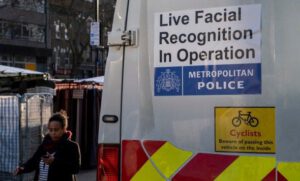
The Metropolitan Police’s live facial recognition program scans faces on public streets in real time. The Investigatory Powers Act requires internet providers to store every user’s complete browsing history for twelve months – accessible to government agencies without a warrant. You are monitored when you walk down the street, and equally when you go online – and what you say about it is subject to a language regime that Freedom House officially downgraded in 2025 due to the “increase in the prosecution of online expressions, including those protected under international human rights standards.”
According to data from freedom of information requests at 39 out of 45 police forces, in April 2025, police arrested an average of around 30 people per day for “offensive” online posts. Those arrested were predominantly not extremists, but rather housewives, pensioners, or tradespeople whose posts would have been considered ordinary expressions of frustration in previous decades. Some received prison sentences. Others were investigated for months before the cases were quietly dropped – a process that was punishment enough in itself. Members of Parliament declared last November that Britain was now more willing to imprison someone for a virtual communication post than for rape. This statement carries even more weight when one considers that the Prime Minister under whose government this is going on, as former head of the Crown Prosecution Service, once failed to prosecute the grooming gang cases later documented by the Independent Inquiry into Child Sexual Abuse.
This selective prosecution of political opponents is hitting them with a consistency that can hardly be a coincidence. Nigel Farage – leader of a party that garnered four million votes in the last election and is now leading in the polls – was simultaneously debanked by Coutts and defamed in Parliament with allegations of foreign funding, protected by parliamentary immunity. An independent inquiry concluded that Farage had been treated unfairly.
Recently, the parliamentary ethics watchdog opened a formal inquiry into a £5 million personal gift that Farage says he received to finance private security measures – necessitated after the Home Office cut his state protection by 75 percent. Reform UK argues the payment falls under the exemption for purely personal gifts. Labour and the Conservatives are nevertheless pushing for an investigation, even though their own MPs are repeatedly involved in spending and misconduct scandals that receive far less attention.
The pattern – relentless pursuit of the opposition leader while simultaneously showing institutional leniency towards the establishment – is now all too familiar.
At the same time, a survey revealed that one in five British teenagers prefers to keep their political opinions to themselves for fear of “cancel culture,” while almost a quarter reported having been told at school not to express certain views. A democracy that teaches its youth that silence is the safest course of action no longer shapes citizens. It shapes subjects.
The anti-democratic march continues
Beneath all of this lies a surveillance infrastructure to which no one has ever explicitly consented. The recent king’s speech confirmed that the government is sticking to legislation for digital identities that are to be “voluntarily available” by 2029. This wording obscures the fact that they are likely to become virtually unavoidable as a prerequisite for employment.
The system – a central government database linking employment law, immigration status, tax data, health records, and tenancy rights – has been rejected by Big Brother Watch and three million petition signatories. It is being heavily promoted by the Tony Blair Institute, whose main funder is Oracle – a corporation with over a billion pounds worth of British government contracts and a promising candidate to provide the project’s technical infrastructure.
The speech also confirmed the “European Partnership Bill,” a legislative package aimed at aligning British laws once again with EU rules in areas such as food regulation, energy trading, and CO₂ emissions. The mechanism is called “dynamic alignment”: Britain would have to adopt and implement EU law, but would have no say in its creation. In other words, the government plans to bind the country once again to rules from Brussels, rules made by people the British people did not elect – even though the population once wanted to leave precisely this structure. It wasn’t in the election manifesto, was never put to a public vote, and yet it is simply being implemented.
Furthermore, when ministers announced in May 2025 that they intended to postpone elections in around 30 municipalities – thus extending their terms of office without a public vote – and only backed down after a judicial review, the same basic attitude was evident: democratic limitations as bothersome obstacles rather than principles.
It would be tempting to blame all of this on Labour alone. But that would be too simplistic. The Investigatory Powers Act was Theresa May’s. Rishi Sunak introduced the Online Safety Act. Making Tax Digital, the ZEV mandate, the EPC standards, the sugar tax, and the covid monitoring infrastructure, including vaccination passport systems, were all created under Conservative governments. The party that once presented itself as the defender of British liberty spent over 14 years building the very machinery that a left-wing government is now using to its full advantage.
The lesson here is not that the Tories were secret socialists. Rather, it is that the expansion of state power has become the standard response of any government that wants to demonstrate its ability to act – and that once the machinery is in place, it no longer asks what political colour the next government will be.
The collapse of institutional trust
This government has proven itself neither cautious nor neutral. It has used legal means against dissidents and political opponents with a brazenness that would have been unthinkable under previous administrations. Police, prosecutors, regulatory bodies, and quangos have been consistently deployed against those who deviate from the prescribed course.
Trust in institutions that were once supposed to be above politics – courts, civil service, BBC and police – has accordingly collapsed, and not without reason.
No foreign power took over these institutions. They were taken over from within – by a professional class that sees the control of public behaviour as its main task and views the instincts of ordinary citizens as a problem that needs to be corrected.
Systems outlast governments. The tools remain, even when the party changes – and that’s precisely why the question of succession is so crucial. Angela Rayner, considered a possible successor to Starmer, has always been to his left on issues concerning the relationship between citizens and the state. Despite the record of his government, Starmer could ultimately be seen as the “holding the brakes.” The Conservatives built much of this machinery. Labour is now operating it at full speed. The next government could remove the last remaining brakes entirely.
A recovery seems a long way off. Whether it’s even possible anymore depends on whether enough people realize what’s being lost before the machinery is too deeply entrenched to be reversed. Free societies don’t disappear in a single dramatic moment. They vanish under the weight of thousands of seemingly reasonable justifications for why the state – just this once – should know better what’s good for you.
We have long since passed the thousandth justification.
Author: Sam Lowry
yogaesoteric
June 6, 2026