
The Praxian Genocide Kill Chain – Part 4
Read the third part of the article
The fake AI technology race with China
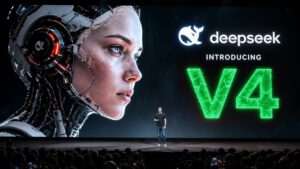
China’s DeepSeek V4 AI model was recently released globally as an open-source project. Developers worldwide can now use DeepSeek V4 at a fraction of the cost of its main US competitors – Google’s DeepMind, OpenAI’s GPT-5.4, and Anthropic’s Claude 4.5.
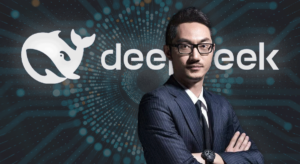
DeepSeek AI is led by Chinese billionaire, startup venture capitalist, and founder Liang Wenfeng through his quantitative hedge fund and asset management company, High-Flyer. After some regulatory back and forth in China regarding quant funds – investments using AI and machine learning – High-Flyer posted impressive profits in 2025. These profits enabled Liang Wenfeng and his partners to invest more aggressively in DeepSeek‘s research and development. While he is definitely not an accelerationist – a term of derogation in China – Liang says that he and his companies have become “disruptors by accident […….].” He describes his aggressive startup investment strategy as “hardcore innovation,” which is apparently distinct from the accelerationism of the Praxians.
Prior to Beijing’s favourable regulatory shift for quantitative funds, DeepSeek had been developed using US NVIDIA graphics processing units (GPUs).
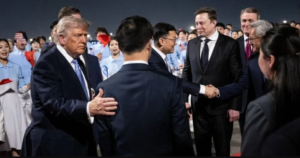
In 2023, Liang described how DeepSeek had built up a stockpile of US-made GPUs to develop earlier versions of DeepSeek. Tensions between the US and China reportedly escalated when the Praxians helped Trump secure his second term in the Oval Office in January 2025. Trump then ordered a ban on US-made NVIDIA chips being exported to China. However, DeepSeek and other Chinese AI startups had an alternative source of chips.
In May 2025, Trump signed a contract for the delivery of US AI chips, including NVIDIA processors, to the Digital Transformation Hub in Abu Dhabi. Trump described the contract as a “US-UAE partnership to accelerate AI.” China has reportedly now banned the import of the NVIDIA AI chips. However, China does not need to import processors from the US because the Digital Transformation Hub in Abu Dhabi has an agreement with the Trump administration for the delivery of the processors and serves as a “crucial base for Chinese AI companies.”
DeepSeek has reportedly abandoned NVIDIA GPUs and developed V4 using Huawei Ascend GPUs manufactured in China. The world of AI development appears to be increasingly divided. US technology providers like NVIDIA are securing exclusive contracts with Western governments, while China is apparently building its own AI architecture based on domestic hardware and infrastructure.
On the surface, this split seems to reinforce the Praxians’ core thesis that the US and China are engaged in a technological race – a new kind of Cold War – and that defeat in this race would pose an existential threat to America. This argument underlies the Praxians’ explanation to US voters that the US needs to pursue neo-reactionary accelerationism in order to survive. However, upon closer examination of this alleged “race,” none of it makes sense.
US diplomats have accused DeepSeek of engaging in so-called AI “distillation” – that is, using US AI models to train and develop its own. However, this is a baseless claim. Access to US and Chinese AI models is sold on the open market. Once purchased, anyone can use these AI models for any purpose. DeepSeek has acknowledged that its development “may contain results” generated by using other available models. Furthermore, it is evident that the exchange of information between US and Chinese AI developers is reciprocal.
In 2024, US AI companies reportedly attempted to block Chinese access to their models. However, this is not a practical approach when a company sells its AI models in open, global markets. Not only were Chinese developers – indeed, virtually anyone – easily circumvented the supposed restrictions, but the appearance of a blockade only reinforced China’s drive to develop its own – and significantly cheaper – AI alternatives. In reality, DeepSeek would not have achieved its current status, and likely wouldn’t even exist, were it not for the ongoing technology transfer – by whatever means – that the Chinese company has received from US technology firms.
If, as we are told, the West needs to win the supposed technological race, it is not unreasonable to ask when this race is supposed to begin. The so-called “race” has thus far been characterized more by cooperation than competition; and this cooperation continues.
Consider this example: NVIDIA’s Blackwell platform was designed to enable developers to run the “long-context inference and agentic systems” that DeepSeek V4 now provides. NVIDIA seems thrilled. Tests with DeepSeek V4 “out of the box” on NVIDIA GPUs have shown that – unsurprisingly – Chinese AI models can help US AI developers because they run flawlessly on US hardware using the US AI architecture.
In fact, US AI agent developers are particularly enthusiastic about the introduction of DeepSeek V4. They describe it as “particularly well suited for agents, [because] it features long context coordination, inferences and tool calls.”
Lushbinary, an Indian-owned company operating from the US, “develops production-ready AI agents based on DeepSeek V4, Claude, and GPT.” Because Anthropics’ Claude AI model code is fully compatible with DeepSeek V4, US developers who want to “develop AI agents with DeepSeek V4” can easily swap out the Claude code.
Furthermore, not only is there a noticeable lack of technological competition, but there are also hardly any signs of conflict within the transnational capital investment structures.
In the previous parts of the article, we established that transnational capital is opaque – investment houses fiercely protect the identities of their investors – and that accelerationism functions like an investment shell game. Startup accelerators hand off startups to startup incubators, which then bring in larger venture capital (VC) firms if the startup shows promise. Solid growth typically leads to initial public offerings (IPOs), and the investment houses and asset managers consolidate their control. Nevertheless, we can identify the traces of transnational capitalist oligarchs like the Praxians by “following the money,” to quote the modern maxim.
Unravelling the shell game becomes somewhat more complex when venture capital is invested internationally. For example, the VC giant Sequoia Capital, allied with the Praxians, appeared to have divested its Chinese operations in 2023, when Sequoia China became HongShan Capital Group (HSG). However, the English translation of HongShan is tellingly “Redwood.”
Sequoia Capital told the Financial Times (FT) that it would “run its China business as a completely independent entity from its US business.” If “running” a venture capital fund in another country while claiming the foreign branch is “completely independent” sounds like a contradiction, that’s because it is.
If these reports are to be believed, there was apparently no rational economic reason for Sequoia to make its Chinese subsidiary “independent.” Pointing out that Sequoia China was the “most successful US-China investment alliance” and had generated “profits for the American parent company” by fostering “entire generations of Chinese tech companies,” Sequoia Capital executives explained that the “cost-benefit ratio” had changed and was now negative. From a business perspective, this self-contradictory narrative is clearly nonsense. The decision to seemingly separate the venture capital activities was clearly politically motivated. You can’t maintain the appearance of national animosity when the respective oligarchies are obviously working together as partners.
Since then, the “race” narrative has only become more ludicrous. In December 2024, the “completely independent” Chinese VC firm Shixiang, which had “spun off from Sequoia China,” hosted a “closed” symposium for Chinese AI developers. DeepSeek was reportedly a hot topic of conversation there.
It turns out that Shixiang was founded in 2019, four years before Sequoia China gained “independence”, and that Shixiang’s “core team is from Sequoia China”.
This meeting likely played some role in “rekindling” US interest in AI development in China, although it remains unknown when it had ever waned.
In June 2025, Joshua Kushner, the brother of Trump’s son-in-law and founder and managing partner of Thrive Capital (which received seed funding from Peter Thiel, among others), together with Capital Group, known as one of the world’s largest investment management firms, sent “executives to China to find out more about the AI scene,” as reported by the South China Morning Post – as if they didn’t already know everything about that scene.
In December 2025, Meta, led by Thiel’s longtime business partner and fellow neo-reactionary accelerationist, Mark Zuckerberg, made a bizarre business announcement. Meta declared its intention to acquire the Chinese AI company Manus, touted as “the next DeepSeek.” It also announced that after the Manus acquisition, it would sever “ties” with China. The $2 billion takeover proceeded smoothly. Then, in April 2026, when it was already too late to influence the Manus deal, Beijing suddenly announced it would “tighten control” over its AI industry and instructed companies to “refuse American funding.”
US AI developers and the tech giants backed by Praxian are reportedly “shocked” by the rapid development of Chinese AI, though it’s inexplicable why they should be “shocked.” Partnerships between US and Chinese tech companies have been evident for decades and predate the “new Cold War” narrative we’re supposed to accept. The unidentifiable “race” is now being described as a “neck-and-neck race.”
To put it bluntly: there is absolutely no sign of a “race” in the development of AI. Sure, everyone is “competing” to develop agentic AI, but what we are observing is international cooperation – not competition. This is particularly advantageous for the Praxians, as they are striving to establish the agentic state.
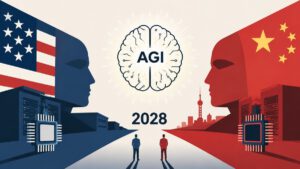
The Praxians have spread a story about existential threats and intense competition to justify US public spending (i.e., taxpayer money) on AI development, but that’s all: a story to help them achieve their goals.
And in the age of hybrid warfare, these objectives extend to all “domains”.
China’s military-civilian fusion
In 2015, at the plenary session of the People’s Liberation Army (PLA) delegation during the third session of the 12th National People’s Congress, China’s Supreme Leader Xi Jinping elevated the concept of military-civilian integration to a national strategy. The goal was to modernize and strengthen China’s military by merging commercial technological developments with military applications. This formalized national strategy is often referred to as China’s military-civilian fusion (MCF) policy.
In addition to international collaborations, DeepSeek has also grown internally, primarily due to the relaxed regulatory environment in China and the government subsidies the company receives because of its location in the Hangzhou Special Economic Zone – more precisely, the Hangzhou High-Tech Zone. DeepSeek also appears to be an important MCF company.
DeepSeek AI reportedly provides “real-time autonomous reconnaissance and decision support” for the PLA’s fleet of new autonomous and remotely piloted vehicles based on the Norinco CS/VP16B all-terrain vehicle (ATV). The PLA has combined DeepSeek-controlled target acquisition systems with the Norinco ATV series to produce autonomous Lynx ATVs, which carry a range of weapon systems.
Due to the privileges afforded by special economic zones and military combat zones (MCFs), Chinese companies, many of which are reportedly state-owned, completely dominate the global market for military drones. While the war in Ukraine continues to kill civilians on both sides, Chinese firms supply critical military technology and components to both Russian and Ukrainian manufacturers. When the Chinese public-private partnership holds trade shows in cities designated as special economic zones (SEZs), such as Shenzhen, it takes great care to keep “enemies” apart and ensure they are not embarrassed by public encounters. However, Chinese sales representatives apparently do not hesitate to exploit competition for components to drive up prices.
Chinese companies are allegedly also supplying weapons technology to Iran. The US has repeatedly imposed sanctions on Iranian procurement programs in a public attempt to prevent the purchase of Chinese military equipment. The official position of the Chinese government is that it does not supply “weapons” or so-called “dual-use” technology – suitable for both civilian and military applications – to Iranian manufacturers. The striking similarity between Iranian and Chinese attack drones is described as merely an official “coincidence.”
In reality, China is taking public-private partnership to a new level, effectively merging much of its private sector’s technological innovation with its nominally public defence research and development. In doing so, it has revolutionized global arms markets and, indeed, the very nature of warfare. While multipolar proponents may hope for less war, China’s multi-community cooperation (MCC) approach reduces the economic costs of war and expands the kinetic domain of hybrid warfare. The MCF strategy diminishes the military advantage of nation-states by opening the global arms market to potentially more private-sector actors. We may all hope that a multipolar world will see fewer international conflicts, but there are indications that it could very well lead to a greater number of conflicts involving a wider range of actors.
Furthermore, the Chinese government’s MCF strategy renders Western sanctions largely irrelevant.
This is because Chinese military technology is often developed as commercial “non-military” technology through international public-private partnerships. The proliferation of Special Economic Zones (SEZs) in China – deregulated innovation zones – has led to higher MCF productivity. This is seen as part of China’s response to Western sanctions and trade tariffs. As a result, Western nations are reportedly lagging behind the leading BRICS countries in the technology race, both in civilian and military technology, including AI.
But this is not the result of another series of mistakes by Western leaders. Rather, it is the continuation of a process.
The theory that China’s remarkable technological and economic transformation since the 1970s arose in a vacuum and suddenly accelerated out of necessity – that is, in response to Western sanctions and trade tariffs – is an illusion. It is China’s long-standing public-private partnerships with Western companies and governments, not to mention the substantial Western direct investment the country has received over many decades, that have fuelled its economic and technological renaissance.
Western-Chinese public-private partnerships have consistently facilitated the transfer of military and other sensitive commercial technologies from the West to China, often using Israel as an intermediary. For many years, the exchange of such technologies underpinned Israel’s diplomatic relations with China.
For example, in 1979, the Israeli multi-billionaire Saul Eisenberg flew a delegation of Israeli arms companies to China to conclude military supply contracts with Chinese firms, precisely to foster cordial relations between Israel and China. The US government and its NATO allies maintained their defence cooperation with Israel, even though they knew full well that Israel was transferring defence and other “sensitive technologies” to China and Chinese companies.
As researcher, author, and independent journalist James Corbett pointed out, there is a reason China has developed an arsenal that bears a suspicious resemblance to the American model. Occasionally, when the transfer of sensitive technologies via Israel is uncovered, years of very serious investigations by committees ensue. Subsequently, Western news media eventually discuss the ceremonial chastisement of a designated scapegoat, supposedly blamed for what is clearly a long-standing but unwritten Western foreign trade policy.
Making this observation does not mean denying the ingenuity or dedication of the Chinese. Regardless of the extent of support their nation received, no people could have transformed their economy as radically and rapidly as the Chinese without considerable shared knowledge, commitment, and dedication.
Essentially, the Chinese government’s MCF/SEZ strategy has provided China’s nominal “enemies,” particularly the governments of the US and Israel, with an extremely convenient pretext to pursue a more or less identical approach. The Israeli government, much like China, has merged its public defence research and development with its private technology sector. Silicon Wadi is full of companies founded by graduates of Unit 8200, whose workforce is largely drawn from the Israeli military and intelligence services. The Praxians’ companies have been deeply embedded in Israel’s public-private defence industry for many years. The Praxians have been enthusiastic supporters since the virtual founding of Israel’s “Startup Nation” in 2009.
The Israeli public-private defence partnership hides behind an opaque veil of legal identities belonging to private companies, attempting to obscure the relationships between the corporate world and Israel’s public-sector defence ministries and intelligence agencies. In 2018, the Israeli news agency Calcalist described how the system works:
“Since 2012, development projects that were previously carried out internally by the Israeli military and intelligence services have been outsourced to external contractors who were already working for the Israeli Ministry of Defence. These private companies develop hardware and software solutions for Israeli defence organizations and also train relevant military and intelligence personnel. As private companies, they can contract with technology providers without being subject to the potential restrictions imposed on defence and state intelligence agencies. Most of the executives at these companies are veterans of Israeli military technology units.”
Much like Israel, the US has used the same narrative of technological threat to ostensibly justify its own merging of public and private defence contractors. As journalist Whitney Webb has reported, the US National Security Commission on Artificial Intelligence (NSCAI) was primarily established to examine “how the [US] government can work with industry to compete with China’s concept of ‘civil-military merging’.” Chaired by former Google CEO Eric Schmidt and featuring prominent members such as Gilman Louie – the former head of the CIA’s investment arm, In-Q-Tel – the NSCAI, which operated from 2019 to 2021, laid the groundwork for a US-developed MCF-like system. Examples of US MCF initiatives include the Defense Microelectronics Commons (DMC).
The different terminology is important because it allows the US government to continue pretending to reject China’s MCF strategy, rather than viewing it as a model it has itself promoted and adopted. This deception is cleverly supported by US media outlets that quote experts claiming the US is aiming to “limit China’s technological development.”
However, a remarkable shift has recently been observed in the propaganda. The New York Times reports on comments by Daniel R. Russell, a former Assistant Secretary of State for East Asian and Pacific Affairs, who is less than enthusiastic about the Trump administration’s current military adventure. In light of the administration’s recent actions in Venezuela and Iran, Russell was quoted as saying:
“Donald Trump may believe he is demonstrating military strength to intimidate Beijing. But his actions in Venezuela and Iran are more likely to encourage Beijing to strengthen its resilience against the US and deepen its rapprochement with Russia.”
Criticism of US foreign policy is nothing new in the United States, but since September 11, 2001, the US media have consistently and largely uncritically supported US military operations abroad, as evidenced, for example, by their reporting on Iraq, Libya, and Syria. This unqualified support has suddenly vanished, and the US mainstream media have become far more critical.
The groundwork laid by the NSCAI ultimately led to the CHIPS and Science Act 2022 (CHIPSSA). This legislation channelled U.S. taxpayer money into a system of grants and incentives to boost research and development in dual-use technology. For example, CHIPSSA incentivized U.S. private-sector manufacturers to build a “network of semiconductor technologies for the defence industrial base.” As a result, the U.S. Department of War (then the Biden administration’s Department of Defense) established the aforementioned DMC under CHIPSSA. The DMC set up eight U.S. prototyping hubs. These hubs are tasked with optimizing “lab-to-fab connections” and “accelerating microelectronic innovation driven by Department of Defense demand.” The goal is to develop a “talent pool” familiar with dual-use research and development to form the U.S. “domestic semiconductor workforce.”
Building upon the concept of “The Microelectronics Commons,” established in the 2021 annual renewal of the National Defense Authorization Act of 1961, the DMC enables the current Department of War (DoW) to “utilize a potentially unlimited pool of new technology developers.” The MCF-like “pipelines” for defence research and development are overseen by the U.S. National Security Technology Accelerator (NSTXL).
The National Security Technology Project XL (NSTXL), launched in 2016 as a public-private partnership between the Department of Defense (DoD), academia, and entrepreneurs (investors), has since evolved to better leverage the Praxian accelerationist approach to defence procurement by specializing in Other Transaction Agreements (OTAs). Instead of getting bogged down in excessive due diligence, OTAs bring new defence innovations from the lab to manufacturing within 100 days, ensuring that Congress has no realistic opportunity to interfere. These “non-traditional methods of government procurement” are allegedly necessary because “mission-critical technologies” need to be “delivered at a certain pace.”
The public-private partnership accelerator, NSTXL, enables America’s “most creative innovators” to bypass “outdated processes” like public oversight, as it “has the task of revolutionizing the government’s approach to procurement.” NSXTL empowers private sector companies to “solve the nation’s biggest challenges” by building a “governable community equipped for any mission.” Which is, of course, essential if one is serious about combating hybrid warfare.
While the US and Israeli governments have adopted their own MCF-like strategies, the Chinese government is advancing its transformative political agenda through the adoption of five-year plans. In 2021, faced with an outwardly disgruntled US administration, Beijing dropped any official mention of its military-civilian fusion strategy from its plans, while still outlining in general terms how China should develop. It now uses more cautious language for English-speaking audiences – speaking of the “integration of existing systems and coordination of civilian and military efforts” instead of “fusion.”
Nevertheless, the hybrid “societal” MCF strategy continued unabated.
The public funds – particularly in the form of substantial state subsidies – that the Xi administration has poured into China’s fusion civil-military technology development have drawn considerable criticism within China. Those segments of the Chinese population who adhere to an idealized vision of Maoism reportedly view Xi Jinping’s eager adoption of “techno-capitalist” concepts as a threat to Chinese identity.
The best equivalent to the concept of “accelerationism” in China is “jiāsùzhǔyì.” It expresses the belief that society is on the verge of collapse and that resistance would only prolong the suffering – and that, therefore, a certain degree of self-destruction is not necessarily bad. Consequently, some of Xi’s modern-Maoist critics disparagingly refer to him as the “chief accelerator,” even though they reject jiāsùzhǔyì and want to preserve and protect what they consider traditional Chinese values.
In an article for the geopolitical publication War on the Rocks, Charles Sun described how China’s MCF strategy works in conjunction with the deregulation of special economic zones. Referring to the rise of the Chinese robotics company Unitree to an influential force in the global robotics industry, Sun wrote:
“China’s Ministry of Industry and Information Technology has designated Unitree as a ‘Little Giant’ enterprise at the national level under the Specialised, Refined, Differentiated, and Innovative Enterprises Program – a status that grants access to tax breaks, subsidised financing, and public procurement contracts. […….] The company’s own prospectus lists tax incentives totalling 75.9 million yuan (US$10.56 million) for the first nine months of 2025 alone – including a reduced corporate tax rate of 15 percent as a certified high-tech enterprise, special deductions for research and development expenditures, and value-added tax refunds. […….] Unitree operates in the Hangzhou High-Tech Zone, designated as a centre for civil-military cooperation, with the zone’s Development and Reform Bureau having the institutional mandate to coordinate civil-military cooperation planning and ‘civilian participation in the military’ projects throughout the district.”
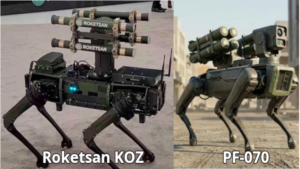
In a Forbes article on the same topic, Amir Husain explained how Unitree’s robotic quadruped vehicles were transformed by China’s MCF strategy. Chinese “public sector” defence contractors took Unitree’s “discreet, quiet, and all-terrain chassis” and upgraded it by equipping it with AI-driven sensors and either machine guns or anti-tank missile launchers. The missile-launched version, the PF-070 system, was unveiled for “official” global sale at the World Defense Show 2026 in Riyadh, just weeks before the seemingly unpredictable Israeli-American attack on Iran began.
The Turkish arms manufacturer Roketsan had already unveiled its nearly identical KOZ system several months earlier, in July 2025. According to Western media, the timing suggests that Unitree and Chinese arms companies copied the KOZ system. Perhaps the Chinese PF-070 system is the result of industrial espionage. However, espionage seems hardly necessary, considering that Turkish arms manufacturers and NATO suppliers like Roketsan have been collaborating with Chinese manufacturers such as the China Precision Machinery Import-Export Corporation (CPMIEC) since the mid-1990s.
In his contribution to War on the Rocks, Sun observed that “the United States is falling behind in robotics and artificial intelligence.” He attributed this lag to the fact that “China has built a system that translates commercial success into military capability.” In other words, Sun put forward the same superficial argument as the Praxians – namely, that American technological innovation should be “accelerated” to keep pace in the “deadly” race against China.
However, Sun contradicted his implied “deadly race” by writing that the “investors” in the Unitree startup “Sequoia China” – now renamed HSG – were among them. As we have just discussed, it is nonsensical to consider Sequoia China/HSG as independent of Sequoia Capital. While the investors’ identities are protected, meaning that – unless they admit it themselves – we can rarely prove which investors are investing where, it is fairly obvious that Praxian oligarchs are among Sequoia Capital’s leading investors.
Praxians invest in disruptive technologies through venture capital firms like Sequoia Capital. In this case, the technology is currently being manufactured in Chinese special economic zones – and apparently also in Turkey – as part of the MCF strategy and could hardly be more “disruptive”.
Returning to Amir Husain’s Forbes article: He wrote about the growing global market for advanced, AI-controlled weapons like the PF-070:
“Western commentaries tend to portray these developments as a race that someone will either win or lose.”
Husain was right to question this portrayal. He apparently recognized that the depiction of cooperative, international trade in advanced weapons between the public and private sectors as a geopolitical race for dominance is nothing more than propaganda – NATO-sanctioned STRATCOM – that they want to feed us. Pointing out these contradictions doesn’t make anyone, including Husain, a “non-state actor” engaged in “hostile intelligence activities.”
Despite their investment scam, evidence suggests that US venture capital firms affiliated with Praxian, such as Sequoia Capital, have invested in China’s MCF companies. Praxian has presented the outcome of these Chinese investments as the necessary proof that the US defence sector, in which they invest most heavily, is engaged in a military-technological “race” it must win.
The Trump administration, effectively controlled by the Praxians, is deploying enormous public funds to win the sham race for civilian and military technologies with China. Beneficiaries of this generous public funding include both the Praxians and China’s de facto oligarchy. Sequoia’s investment in the startup Unitree appears to be an example of how neo-reactionary accelerationists from within the Praxian system are exploiting evil “creative destruction”.
Husain added:
“The more important question is what impact the increasing proliferation of inexpensive, precise, and autonomous ground weapons will have on the actual planning and execution of military operations. If any state actor with adequate funding can deploy hundreds of expendable missile delivery platforms instead of a handful of manned armoured vehicles, the logic of military deployment changes.”
Even adequately funded private sector “actors” can afford to wage war due to these “technological solutions” accelerated by MCF and SEZ. The new “logic of military deployment” is not limited to land warfare with armoured vehicles. The way US forces have been used against Iran is now so illogical that it is virtually impossible to believe almost anything we are told about the “war” with Iran. It is entirely appropriate to call this a SCAD (state crime against democracy).
Read the fifth part of the article
Author: Iain Davis
yogaesoteric
July 24, 2026