
The Economist urges war preparations: Europeans should get used to the idea of war
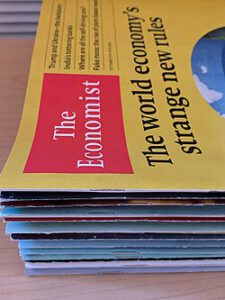
The British magazine The Economist, which has taken a hard line against Russia for years, has published a guest article discussing the deployment of European soldiers to Ukraine as a means of psychologically preparing Europe for a possible larger war.
The author argues that the starting point of this article is the observation that many Europeans are unwilling to support a war against Russia. Surveys in several European countries have shown for years that the willingness to fight or die in military operations outside one’s own territory is limited.
Against this backdrop, The Economist published a guest article by political scientist Nathalie Tocci, James Anderson Professor of Practice at the School of Advanced International Studies Europe at Johns Hopkins University. In it, she poses the question of whether Europe can develop the necessary will to deter without itself being directly drawn into a war.
She writes:
“European heads of state and government are aware that a conflict is closer than ever before – hence the sharp increase in defence budgets, as was clearly demonstrated at the recent NATO summit in Ankara.”
It goes on to say:
“Since Russia’s large-scale invasion in 2022, European leaders have often expressed their admiration for the resilience of the Ukrainian people. But behind the Europeans’ amazement lies something else: the fear that they themselves might not be able to display the same resolve. ……. Can the spirit needed to deter war be summoned in Europe without fully entering into war itself?”
In the opinion of the author of this commentary, Tocci’s answer is ultimately: No.
Tocci then argues that Europe needs to prepare its population for a potential war. One possibility is to send European troops to Ukraine now.
“One way to strengthen the population is to send ground troops to Ukraine. For months, a European coalition of the willing has been working on plans to send a ‘pacification force’ to Ukraine after a ceasefire. These talks have not led to any results, as a ceasefire is not in sight.”
Russia has repeatedly stated that foreign troops in Ukraine – regardless of whether they are presented as “peacekeeping forces”, “pacification forces” or under any other designation – are considered enemy forces.
Tocci goes a step further in her article, however. She argues that deploying European soldiers could benefit Europe itself even before a ceasefire:
“A European peacekeeping force would then offer little help to Ukraine. However, deploying it now, before a hypothetical ceasefire, could benefit Europe by encouraging its citizens to develop an understanding that better prepares them for war. Yes, this would put European soldiers at risk – such a move would undoubtedly anger the Kremlin – but the continent is already engaged in a hybrid conflict, even if many refuse to acknowledge it.”
The author of the commentary questions this argument. He asks what concrete benefit there could be in deliberately exposing European soldiers to a higher risk in order to psychologically prepare the population for war.
He also finds the justification of an already existing “hybrid war” unconvincing. He refers, among other things, to earlier reports about alleged Russian drones over Copenhagen. Later, The Economist itself reported that the Danish police had found no evidence of such drones.
“In June, the Danish police halted their investigation, stating that they had been unable to confirm the existence of drones or to determine who might have sent them.”
Tocci continues:
“Having European soldiers stationed in Ukraine would bring reality closer to home. And perhaps some of the Ukrainian courage, humility, and creativity could spread to other European societies. European troops would not be put at risk out of pure generosity, but to help prepare for war – and to prevent it from spreading to the rest of the continent.”
The author counters that, in his view, deploying German, French, or Italian soldiers to Ukraine would increase rather than decrease the risk of a direct military confrontation with Russia. He doubts that such a step would deter Moscow and argues instead that it could lead to further escalation, even attacks on European capitals.
In his view, the guest article shows that it is less about preventing a war than about psychologically accustoming the European population to the idea of a larger military conflict.
In conclusion, the author makes a polemical remark to Nathalie Tocci. If she is convinced that the deployment of European soldiers is necessary, she should lead by example. He writes that the Ukrainian commander-in-chief, General Syrsky, will surely find a place for her in one of his assault regiments.
Author: Moon of Alabama
yogaesoteric
July 26, 2026