
“Record Breaking” Adolescence Gets Its Inevitable Reward
Adolescence is back to get its pay-off. In an “historic” night for television, the Netflix original drama broke some record for……. whatever.
Because of course it did.
Because it was always going to.
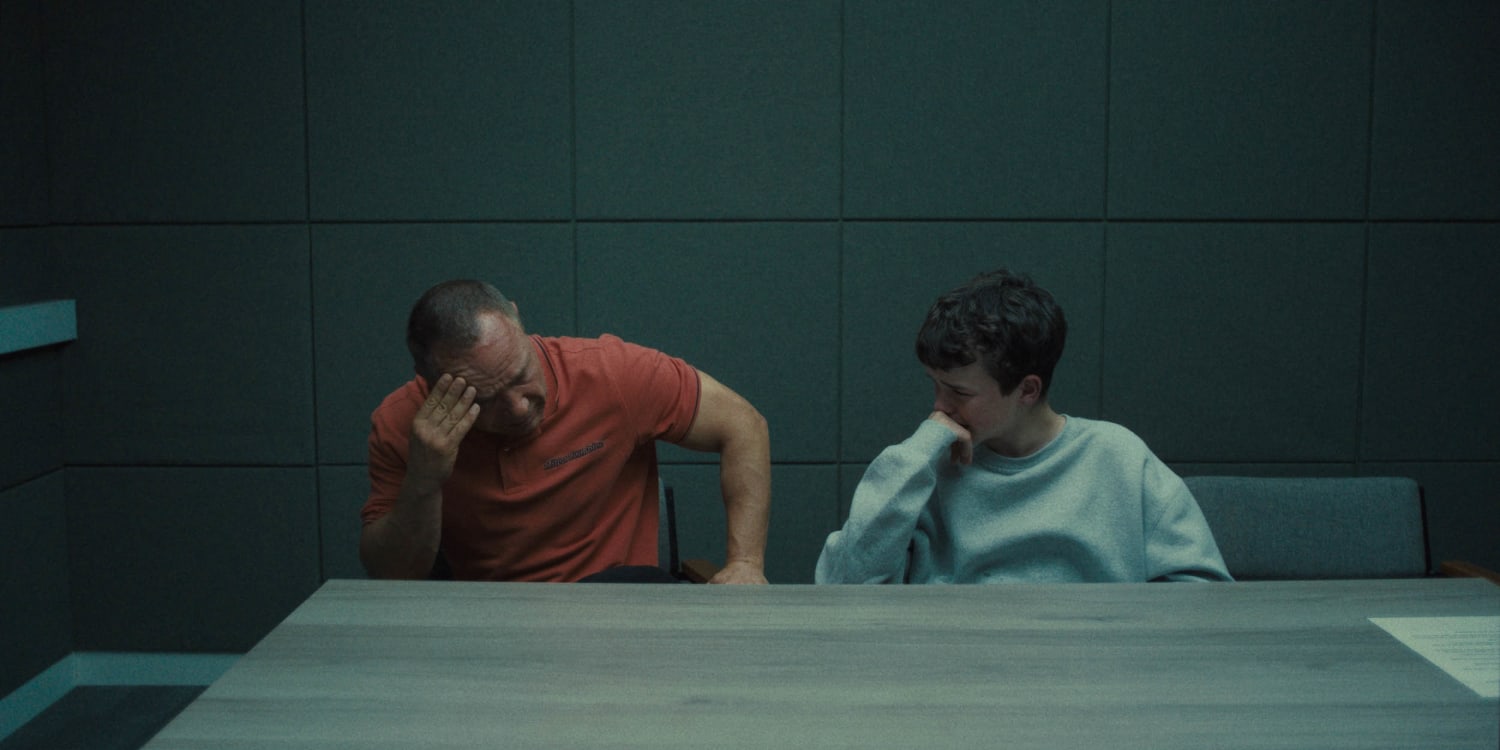
For anyone fortunate enough to have missed out on the Adolescence hype, or self-preserving enough to have tactically avoiding it, the show is about a young boy who stabs a girl at school. It has something to do with incels or misogyny or……. again, whatever.
It got everywhere faster than is organically possible, was praised as “television perfection” by a very predictable list of outlets, and was lauded for “raising important questions on difficult topics”. It was even the subject of a question in Parliament.
It was absurd.
But it did its job, it helped justify the Online Safety Act, and the shiny new virtual communication ban, and the looming smart phone ban. The artists got their money and their ego boosts and the proud feeling of telling hard truths, even as they doled out sate-approved propaganda that justified authoritarian crackdowns on the internet, past present and future.
And now, of course it has won a lot of awards. A record-breaking amount, apparently.
The show was made by the state in order to tell the populace what the state wants them to hear. The rewards for selling out to power – even unknowingly – have always been rich. To encourage the others, if nothing else.
Why everybody was talking about Adolescence
Originally published March 20th 2025
For some reason I woke up recently to a world – or a pretend media world, at least – obsessed with the Netflix show Adolescence.
I’m not going to link to it or describe the plot, because I’m not being pulled into this trap. I’m not talking about Adolescence, I’m talking about the people talking about it.
That might seem like a paper-thin distinction, but it is an important one, in my consciousness at least.
Why is everyone talking about this show? Why am I being flooded with tweets praising the performances and the writing? Or giving me trivia titbits about the production?
Even the people that dislike it are talking about, complaining about the race-swapped casting or political messaging.
It’s everywhere.
The front page of the Guardian this morning (the date the article was written – March 20th 2025):
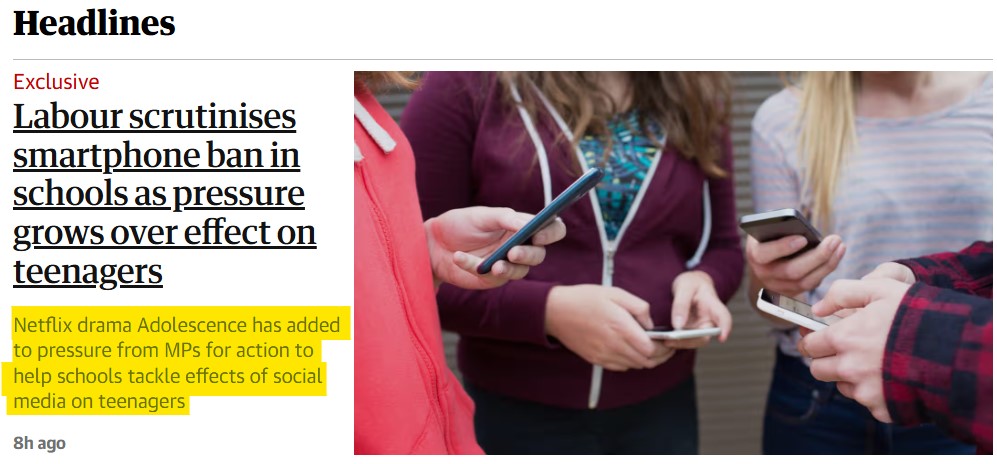
Since when does “what’s trending on Netflix” have any impact on the political landscape? What’s going on?
There was even a question about it during Prime Minister’s Question Time yesterday (March 19th 2025):
🚨 NEW: A Labour MP brings up the Netflix series “Adolescence” and asks Keir Starmer if he will support the creators calls to show it in schools to counter “toxic misogyny early”
Starmer: “Yes, and at home we are watching Adolescence with our children… it’s very good” #PMQs pic.twitter.com/YNHaUrmqVT
— Politics UK (@PolitlcsUK) March 19, 2025
That’s an MP, apparently, asking the supposed leader of the nation if the latest hit Netflix production should be compulsory viewing in schools.
She mentions misogyny as well, but honestly that’s immaterial. The existence of the question is bizarre enough on the meta level that we can disregard the specifics of the politics.
She asked – and he answered. Not just to say “what an odd issue to discuss in national parliament, go away and never talk to me again about this”, but actually giving it credence.
“That’s a very good question madame, maybe we should force school children to consume Netflix’s fine content. I’m watching the show myself and must say it’s jolly good!”
Notice how the he not only takes the question seriously, but makes sure to note he is watching and enjoying the show.
This is quite literally product placement.
It’s no different from when the camera lingers on a Mercedes logo in a movie. It couldn’t be less subtle if Starmer had cracked open a Pepsi, taken a sip in slow motion, licked his lips and said “I always drink Pepsi when I’m working hard to serve the country”, then winked at the camera.
It’s a really good demonstration of the way the system works. And I do mean THE system – there is only one. Politics, advertising, entertainment, the military and everything else……. they’re all joined together. Departments of the same company. Fingers on a giant corporate hand.
And, like all good hands, it can multitask.
It can promote media slop for profit while it sells politics that serve an agenda.
What is that agenda? Protecting the children!
From what? Knife crime. Or misogyny. Or hate speech.
Pick your preferred problem, react however you want, the solution remains the same – more control.
Censor the internet, ban smartphones in schools, forbid the sale of knives online, crack down on hate speech. Tag X people for Y reason. Create a registry, they enjoy creating registries.
You know how this goes.
Knife crime isn’t the problem. We don’t need special rules for selling knives to teenagers or anyone who looks a bit weird. We don’t need a special registry for everyone with a knife block or who googles whetstones.
The internet isn’t the problem. We don’t need rules about who can access what or where or banning anonymity or controlling “hate speech”.
Misogyny isn’t the problem. We don’t need special educational classes for young men to teach them how awful they are or to put testosterone blockers in school water fountains to prevent violence or another registry for everyone who follows Andrew Tate on Twitter.
We don’t need any new rules at all. We have plenty of rules (such as the Online Safety Act, which came into force at the same time as the Adolescence hype launched).
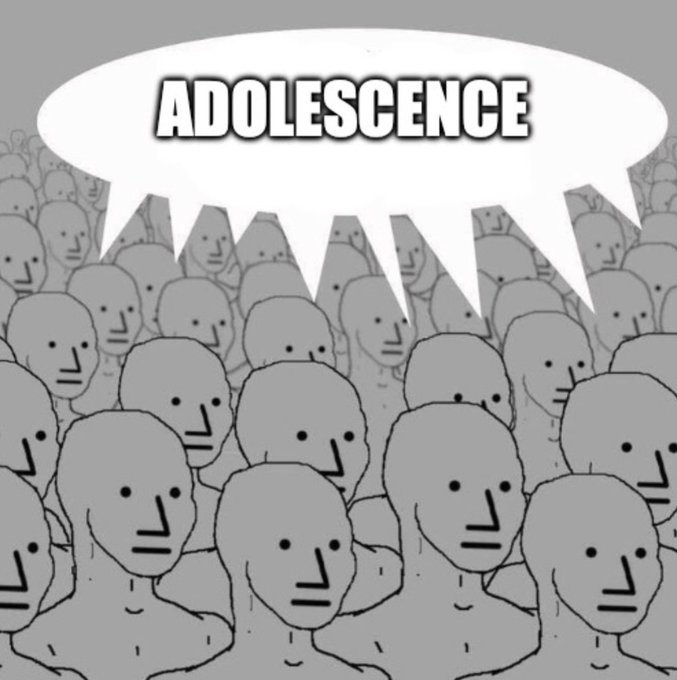
The problem with our society is not a lack of rules. The problem is powerful people creating fake problems to scare real people.
The problem is politicians indistinguishable from advertisers and entertainment companies indistinguishable from military contractors and newspapers indistinguishable from intelligence agencies.
The problem is the monolithic nature of global corporate government that uses authoritarianism to boost profits and uses profits to increase its authority in a cycle of exponentially increasing tyranny.
The problem is that hand we were talking about earlier, and the way everything everywhere becomes an excuse for it to tighten its grip around our neck.
That’s the problem. And that’s the reason everyone is talking about Adolescence.
How Adolescence offers us a peek inside the machine.
Originally published April 1st 2025
I wrote about Adolescence – or rather the (manufactured) hype surrounding it – last week. I thought at the time I’d said all that needed to be said. It is just some Netflix show, after all.
But then the hype keeps going, and the messaging piles up, and you realize it’s actually a really neat case study in ‘The Way Society Works’ in our time.
As a quick catch-up for the fortunate few yet to have Adolescence forcibly crammed in front of their eyes, the show is about a boy who stabs a girl at school. It’s said to raise “important questions” about misogyny and toxic masculinity and “the knife crime epidemic” and virtual communication networks and blah blah blah blah blah.
Who cares. I haven’t watched it. It doesn’t matter. Like I said, it’s a case study.
The show was released three weeks ago……. then it was everywhere. And I mean everywhere. It was reviewed and praised and praised and reviewed.
And everyone in those everywhere places called it “important” or “vital” or claimed it “asked big questions”.
You all know what those phrases mean.
Suddenly, the creators were on Newsnight on the BBC, Good Morning Britain on ITV, and even CNN.
And what were they talking about?
Politics, obviously. Knife crime and virtual communication networks and online radicalisation and yet more blah blah blah.
The writer essentially said the same phrase all the time, begging the government to “consider quite serious change”.
Before the week was over – as we covered before – an MP was asking if it should be required viewing in schools.
Sky News claimed that “pressure was mounting” for a virtual communication ban. They don’t say from whom, and it doesn’t matter. It’s all a narrative, no more real than the show itself.
Netflix have since said they will provide it for free to schools to show to young boys:
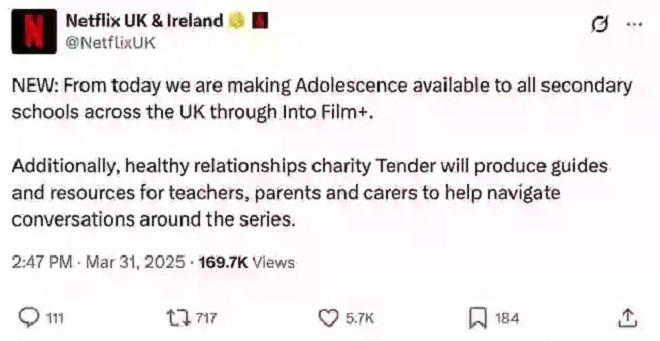
This all culminated in yesterday’s meeting, where the creators of the show – along with representatives from a “healthy relationship” charity Tender – were invited to Number 10 (UK’s Prime Minister’s Residence) to talk about “the influence of toxic material online” and the “serious change” they think the government needs to take.
Sir Keir Starmer (or the intern running his account) pledged to “tackle” the “challenges raised by adolescence” in a tweet.
The challenges raised by Adolescence aren’t something we can simply legislate for — if I could pull a lever to solve it, I would.
It’s only by listening and learning from the experiences of young people and charities that we can tackle this.
That’s what I’ve been doing today. pic.twitter.com/bU5ocwpa1T
— Keir Starmer (@Keir_Starmer) March 31, 2025
We’re mere inches away from actual legislation based almost entirely on the made-up events of a fictional TV show.
People are rightly pointing this out as ludicrous – and it is – but that’s seeing it backwards. We’re not getting laws passed because of TV shows, we’re getting TV shows made so they can pass laws.
The studio behind Adolescence gets government funding, as does Tender, the charity that was also invited to that absurd meeting.
Netflix’s finances have been a source of speculation for years, but its political associations, alongside a track record of producing content that perfectly fits a mainstream agenda, really speaks for itself.
Government, charities, corporate media. It’s all one organism.
Does that mean the show itself was cynically produced to fill a need and sell an agenda?
Absolutely certainly yes.
But that’s not to say the actors and writers and celebrity spokespeople don’t genuinely believe in the supposed message. Just that, to paraphrase Noam Chomsky, if they didn’t believe it, they would never be where they are.
They’re working for a distributor with massive and obvious ties to the Deep State, making a project for a studio that gets government funding, working alongside a charity that also gets government funding all so they can tell the government to take the kind of “drastic action” they’ve been planning to take the whole time.
They might believe they are speaking truth to power. In reality, their sincere-but-shallow ego-driven virtue signalling is being manipulated so they will tell power exactly what it wants to make people to hear.
It’s like wheels thinking they move the car against its will, when anyone watching the machinery from the outside can plainly see the whole point of the car is turning the wheels to make itself move.
This kind of compartmentalization is how the machinery works, and it’s why it’s largely pointless to ever attack actors or celebrities as Deep State assets. Most of them probably are, but the vast majority don’t know that they are, and the people either willing or able to make that realization were weeded out a long time before they got famous.
And now comes the win-win-win of it all.
The cast and crew get fame and acclaim. The studio got profit and kudos. The government got their new law.
And that’s that.
The hype around Adolescence is not new or even especially exceptional, but it is so transparent it offers a useful insight. Like an underwater aquarium.
It let’s us see inside a little deeper than usual, and shows us how the machinery works.
*******
Back to present day.
I’d like to end by asking a simple question: How much of a genuine cultural footprint has Adolescence left behind?
Compare it in your consciousness to other super viral TV, like Breaking Bad or Game of Thrones.
Put aside the reviews and awards, in the past months has anyone brought it up with you in conversation? Have you even thought about it?
I wrote 3000 words about it, and I genuinely forgot it existed.
There’s a message in that, I think. Eventually, people can tell real from fake. Even if they don’t know they know, they DO know.
I still haven’t seen it, nor plan to ever take a look.
Author: Kit Knightly
yogaesoteric
July 16, 2026