
Apple gives the go-ahead: Now AI will also read our private messages
The next frontier is falling. Artificial intelligence is no longer just meant to answer questions, write texts, or generate images. It is meant to penetrate ever deeper into our personal digital lives – even into private conversations.
With the new integration of Apple Messages into ChatGPT for macOS, the AI assistant – after being granted permission by the user – can search messages, summarize conversation histories, formulate replies, and help with sending.
What is being sold as a convenience feature marks a remarkable paradigm shift: we are voluntarily beginning to give AI access to one of the most intimate archives of our everyday lives – our private conversations.
Are you going to give your life to the AI?
Anyone who opens their messages to an AI assistant potentially provides far more than a few meaningless lines of text. Private communication can reveal who we associate with, what we worry about, what we buy, where we travel, what our relationships are like, what political views we discuss, and what problems concern us.
Thousands of such small pieces of information are combined to create something extremely valuable for the tech companies: a detailed digital personality profile.
The vision of the tech companies is becoming increasingly clear. AI shouldn’t just know what we’re asking. It should understand our context, remember information, comprehend our communication, and ultimately perform tasks for us. The more information we give it, the better it will know us. Perhaps one day, better than we know ourselves.
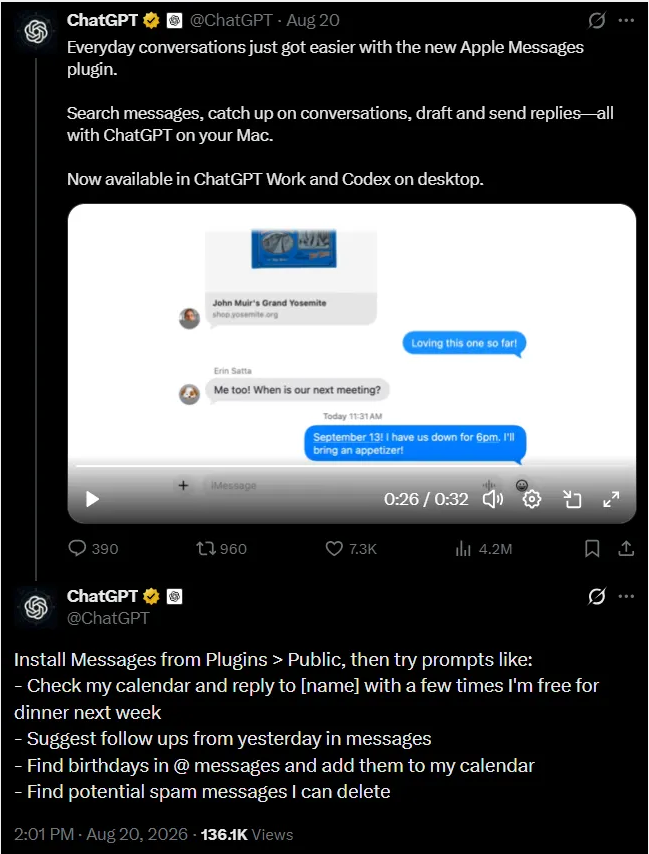
We’ve added native integration with iMessage, so ChatGPT can now send & read messages for you!
It can also analyze your messages! It’s really fun to get insights about who you talk to, and what you talk to people about. https://t.co/W0f6htZKvL
— Ari Weinstein (@AriX) August 20, 2026
Is Sam Altman now reading all iMessages?
Apple representatives claim that the new feature does not mean that the company automatically transmits all of its customers’ private messages to OpenAI. Users should grant ChatGPT access or actively use the feature.
The question of training the AI remains relevant. OpenAI offers settings for ChatGPT that allow users to specify whether their content may be used to improve the models. The fact that user data can generally be used for model improvements, provided the corresponding settings permit it, has been part of the data privacy debate surrounding generative AI for years.
From tool to digital representative
We have given Google our search queries, our friendships and interests from virtual communication networks, smartphones our locations, and cloud services our photos and documents.
We are now increasingly giving AI systems the ability to connect all these information silos and recognize relationships between them. The goal is the perfect personal assistant.
But the perfect personal assistant inevitably needs something: as much knowledge as possible about its owner.
And therein lies the conflict. The more helpful these systems are intended to become, the greater the incentive to grant them access to messages, emails, calendars, photos, documents, health information, and other personal data.
OpenAI, for example, has gone even further, allowing users in a separate healthcare area to connect medical data and health apps with ChatGPT. However, additional safeguards apply there; OpenAI explicitly states that conversations in this healthcare area are not used to train its Foundation Models.
We are building our own digital dossier
This doesn’t initially require a secret surveillance plan or government coercion. Perhaps the most shocking aspect of this development is precisely the opposite: we’re doing it voluntarily.
We open up our messages, photos, contacts, search queries, health data, and personal habits to tech giants because each function seems convenient. The danger arises from the cumulative effect.
Because whoever can compile and analyse enough of a person’s digital traces doesn’t just possess “data”. They can recognize relationships, habits, interests, and behavioural patterns and draw increasingly precise conclusions from them.
And such data sets are not only of interest to companies. Depending on the legal system, procedures, and specific data storage methods, they can also be subject to government disclosure orders.
Apple isn’t simply “passing our messages on to Sam Altman.” The much larger development is more subtle: we’re getting used to voluntarily granting AI systems ever deeper insights into our private lives – until one day the digital assistant might know more about us than any human being in our immediate circle.
yogaesoteric
September 16, 2026