
Eight years of Jeffrey Epstein’s human cloning program, documented (2)
Read the first part of the article
August 11th to 25th, 2014 – Darren Indyke founds the vehicle
Church’s investment didn’t remain in the proposal stage. On August 11, Epstein wrote to Church: “Let’s begin with the initial investment.” Church confirmed that he would check with the eGenesisBio and Next Generation Pathology teams regarding their willingness to participate, and then asked: “What is the next step after that?”
Epstein’s instruction: “Decide what you want to call your investment company.”
Church suggests three names – Revenesis.com (for Regenesis Ventures, derived from the title of his book), Transvenesis.com, and Georgegarage.com – noting that DIYBio hackers and investors on Google Sci-foo had spontaneously suggested the concept of a “George’s Garage” newsletter that weekend. Epstein selects “george garage” and then sends the email also to Darren Indyke, Epstein’s longtime lawyer and financial manager, writing: “If you agree, I will prepare the documents and send them to you. Darren, the lawyer, is copied on this email.” Church: “Sure. Thanks.”
On August 25, Epstein sends a brief final update to Church: “co formed not we have to invest” – meaning that the legal entity has been formed and only the provision of capital is now pending.
Darren Indyke is no chance acquaintance. He was Epstein’s primary legal and financial manager for decades, was named in a civil lawsuit related to Epstein’s estate, and signed Epstein’s will. His role as a lawyer tasked with establishing Church’s investment vehicle places the relationship within the realm of genome editing, within Epstein’s formal legal and financial apparatus – it is therefore not a private conversation, but a structured transaction involving legal counsel.
December 2013 – Joi Ito passes information about Church’s employees to Epstein
Eight months before the $10 million pitch, Joi Ito – then director of the MIT Media Lab – forwarded a confidential internal email from Ed Boyden to Epstein, requesting private recommendations for faculty candidates from Church. In his response, Church named his top researchers, including Prashant Mali and Luhan Yang, described as “driving forces in human genome editing (CRISPR) and human organoids.” Mali and Yang are the co-founders of eGenesisBio – the $1.5 million project Church pitched to Epstein the following July.
Ito passed on internal information to Epstein about the top experts in the field of human genome editing from a confidential hiring process, eight months before Church made his $10 million offer. Epstein was kept informed of the latest developments in Church’s lab by the director of the MIT Media Lab.
The conclusion drawn is that Epstein, through Joi Ito, had access to the work of the best researchers in the field of human genome editing months before the formal investment request – including the founders of the company that would lead Church’s investment presentation.
In January 2015, Epstein forwarded a lengthy essay, which he attributed to George Church, to an edited recipient under the subject line “My Friend George”.
The essay, written in Church’s style, is a dense philosophical treatise on human-machine hybrids, brain copying, cognitive enhancement, and the future course of human evolution. It explicitly addresses human cloning as a point of reference – described as “far more radical than cloning humans, but without embryos” – within the context of a broader argument about brain copying as a path to digital continuity of identity. The essay argues that a hybrid brain architecture might be “not only more probable but also safer” than pure silicon intelligence or continued reliance on unenhanced biological cognition.
The wording chosen by Epstein – “my friend George” – suggests an existing personal and intellectual relationship, not a fleeting acquaintance.
This demonstrates that in January 2015, Epstein actively disseminated Church’s transhumanist writings within his network and referred to Church as a personal friend. The intellectual framework Church outlines in the essay – human enhancement, brain copying, cloning as a benchmark – aligns with the interests Epstein directly expressed in his other correspondence.
July 1, 2017 – Still enrolled: The Harvard PGP Newsletter
Three years after the Thakuria thread and one year before the Bishop program, Epstein received a routine institutional newsletter from the Harvard Personal Genome Project, addressed to him as a registered participant. The newsletter’s subject line read: “Personal Genome Project – Updated Phenotype Ranking, Neurodiversity and More!”
The document confirms that Epstein’s PGP registration was not a one-off transaction in 2014. He remained an active, consistent participant in Church’s flagship genome research program until July 2017 – receiving institutional communications, offers for discounted whole-genome sequencing, and participating in the phenotype ranking among project participants.
The newsletter’s content is remarkable in its context. Among other aspects, it includes an article about Veritas Genetics – a PGP spin-off – which now offers newborn genome sequencing in China and reports on over 950 disease risks, 200 drug reaction genes, and more than 100 predicted physical traits. There’s a quote from George Church on sequencing technology, an invitation to a cognitive research study by PGP-Lumosity, and an offer for discounted whole-genome sequencing for PGP participants through Veritas for $999.
Epstein received all of this as a participant – not as a donor, funder or external observer, but as someone whose own genetic data was included in the project and whose phenotype ranking was updated quarterly.
This demonstrates that Epstein’s participation in Church’s Personal Genome Project was sustained, active, and continued at least from 2014 to 2017 – thus bridging the gap between his genome registration in 2014 and his investment in designer babies in 2018. His own genetic profile was a continuous subject of institutional tracking within Harvard’s primary genome research program during this period.
The gap between the 2014 investment offer and the 2017 PGP newsletter was not a period of inactivity. In July 2015, Boris Nikolic – already documented in Epstein’s network through the 2012 SIOM thread and later mentioned in Epstein’s will – wrote to Epstein during the closing of a CRISPR/Cas9 investment round, describing demand as “extraordinarily hot,” with investor interest exceeding five times the round’s size (EFTA02493205). The exchange was primarily logistical, but its significance is positional: at the very moment the CRISPR investment wave was reaching its peak, Epstein was in regular contact with one of the best-connected investors in the biotechnology sector. He was not a fringe figure in the commercial landscape of the technology on which his genome-editing investments were based.
July 2016 – “Übermensch”: Epstein’s eugenic framework
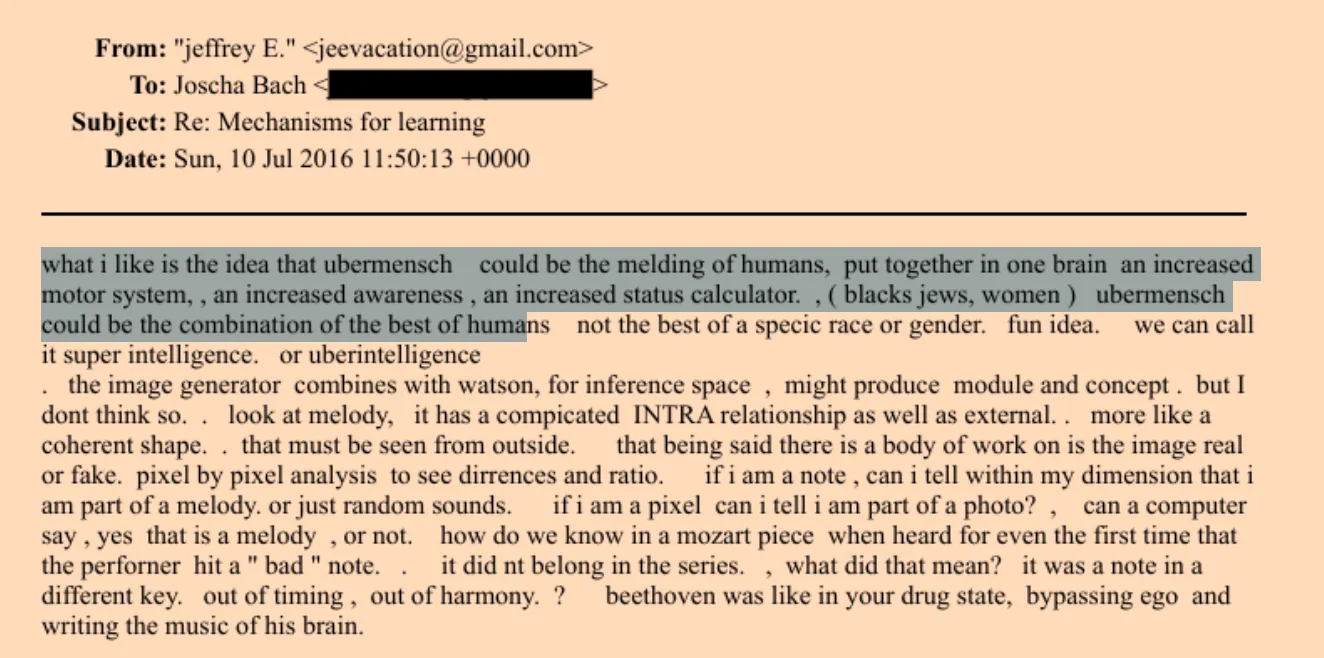
Until 2016, Epstein corresponded with Joscha Bach – a cognitive scientist and AI researcher – about learning mechanisms and race. Bach’s email contains explicit statements on the topic of race and IQ: “Races with faster motor development have lower IQs,” and Black children in the United States “fall behind in their cognitive development (and never catch up), even when family income is taken into account.”
Epstein does not contradict this account in his response. He addresses it and proposes a concept:
“What I like is the idea that the Übermensch could be a fusion of people, united in one brain with an improved motor system, heightened consciousness, and an enhanced status computer. (Blacks, Jews, women) The Übermensch could be the combination of the best qualities of all people, not just the best of a particular race or gender. An interesting idea. We could call it superintelligence or hyperintelligence.”
The framework is more transhumanist than purist in its explicit form of racism – Epstein presents a synthesis between different groups rather than a selection within a single group. But the document is significant for what it reveals about the ideological context of his interest in genome engineering: Epstein engaged with arguments about racial hierarchy without challenging them, named specific groups in connection with genetic optimization, and used the term “superman” as a working concept.
The pipeline between Kirche, Merkin and Bishop did not emerge in an ideological vacuum.
October 31, 2018 – Barnaby Marsh directs a student from Church
On October 31, 2018 – coinciding with Bishop’s active designer baby and cloning operation – Barnaby Marsh forwards a note from Jay Lee (Lee Je Hyuk) to Epstein, describing him as “one of George Church’s students” with “a very good creative thinking who isn’t afraid to break rules……. rarely.” Marsh marks him as a potential candidate for an introduction: “Let me know if you’d like to meet him sometime.” Marked confidential.
In his email, Lee describes a patent for cancer detection and a technology for reducing the cost of genome sequencing. Jay Lee is the same researcher whom Church listed as one of his best postdoctoral researchers for Joi Ito in December 2013 – “In situ sequencing – the basis for much of Rosetta BRAIN” – and the same researcher listed under point 7 (“Next Generation Pathology”) in Church’s $10 million pitch portfolio.
Barnaby Marsh had been part of Epstein’s network since at least 2010 – the earlier document mentions a conversation about “genius ……. and eugenics”.
July 19-20, 2018 – The Introduction
Austin Hill – co-founder of Blockstream, one of the most significant early Bitcoin infrastructure companies, and founder of Brudder Ventures – emailed Epstein on July 19 to introduce him to Bryan Bishop, a biohacker and former senior engineer at LedgerX, the first CFTC-regulated Bitcoin clearinghouse.
The stated reason: regulation of cryptocurrencies and market disruptions. The first meeting – “Financial Markets & Cryptocurrencies with Jeffrey Bryan” – is to take place the following day at appear.in/internetmagicalmoney.
Bishop’s introductory email contained a project overview that he had “prepared for someone else.” The file name: thiel-notes.txt.
Bishop describes his growing scepticism regarding the enforcement of regulations: “I seriously question whether the regulatory authorities are still able to regulate these markets or enforce the laws.”
The pitch for the designer baby followed 24 hours later.
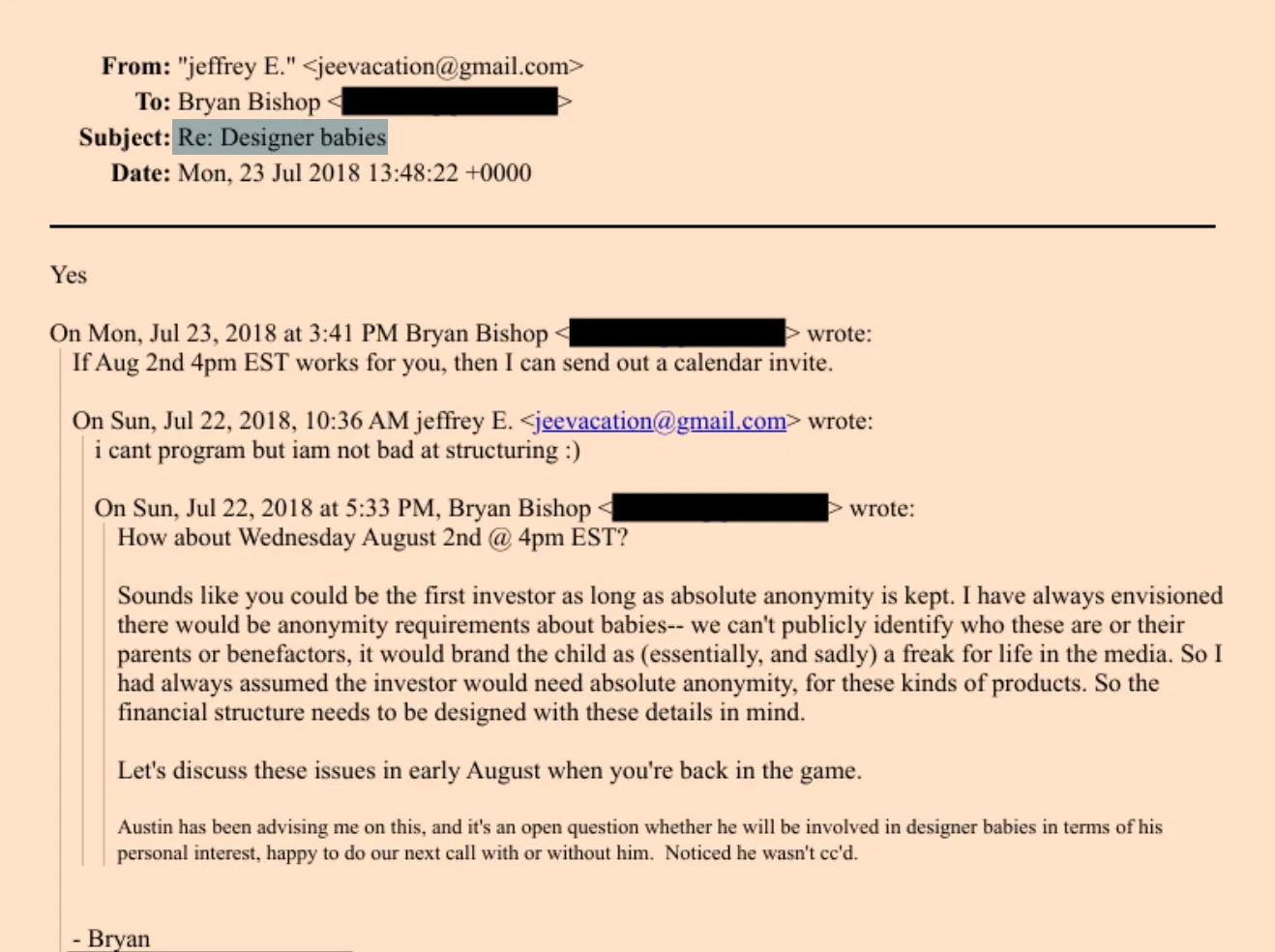
July 21-23, 2018 – The investment proposal
EFTA01004801 / EFTA01004839 / EFTA01004841 / EFTA01004905
Bishop sends Epstein an email with a designer baby pitch deck and a concrete framework:
“I think this could be going on under the guise of my designer baby project, as the other result is similar and involves many of the same procedures and laboratory requirements. This could provide a sufficient degree of deniability.”
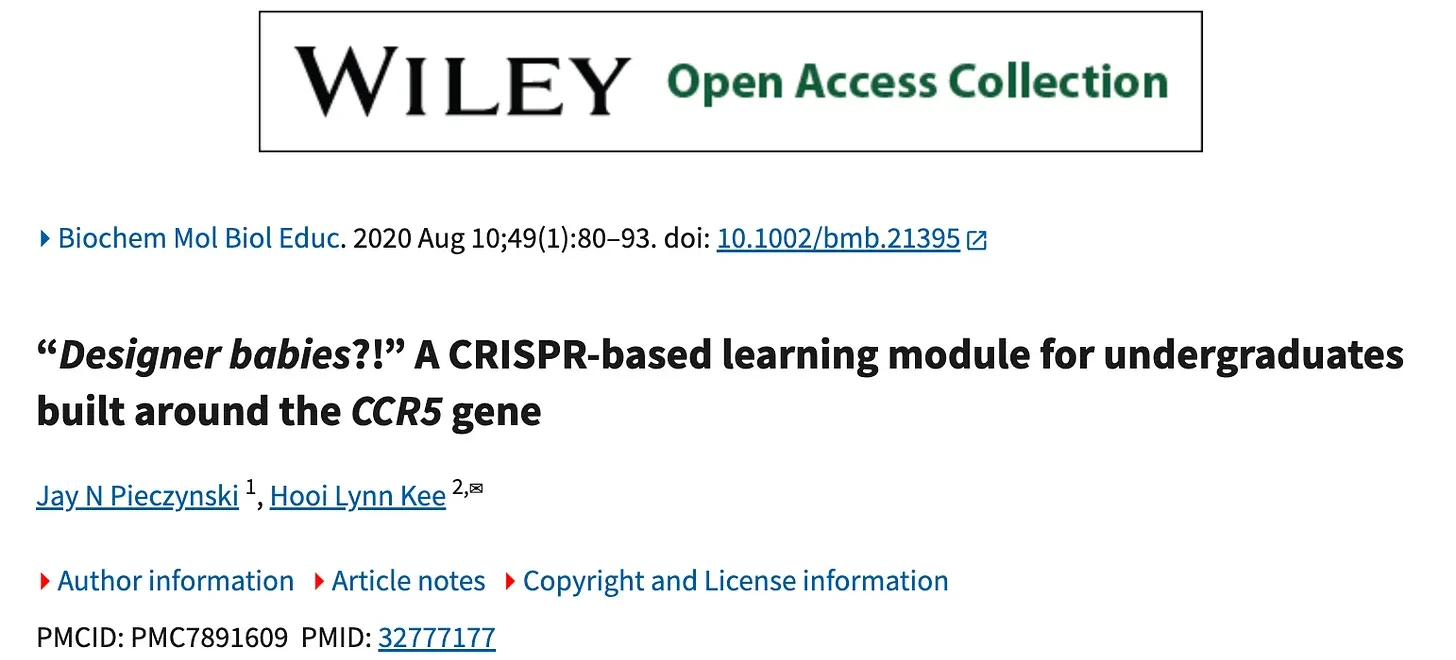
The term “designer baby” is not a fringe phenomenon. A peer-reviewed paper published in 2021 in Biochemistry and Molecular Biology Education (PMC7891609), indexed by the National Institutes of Health, builds an entire CRISPR curriculum for undergraduate students around this concept – using He Jiankui’s germline-modified human embryos as a central case study. The science proposed by Bishop Epstein in July 2018 was already being taught in accredited university genetics courses by November 2018.
Epstein responded that same evening:
“I’m traveling in the Middle East until the 1st. Let’s do it after that; I have no problem investing. The only problem is when I’m perceived as a leader.”
Bishop responds with the necessary financial architecture – absolute anonymity, a financial structure “designed considering these details.” Epstein: “I can’t program, but I’m not bad at structuring 🙂”
July 23: Bishop suggests August 2 at 4 p.m. Epstein: “Yes”.
August 2, 2018 – The meeting
EFTA_R1_01784135 (EFTA02598225)
Epstein sends himself a calendar reminder at 7:54 PM:
August 2, 2018, 4:00 PM: Designer Babies (Bryan Bishop)
Agenda: Designer babies, structuring, finances, data protection, project goals, achievable results, timelines
We will use appear.in (https://appear.in/taxmastergenetics).
August 5 to 16, 2018 – The Budget
EFTA01003966 / EFTA_R1_01794852 (EFTA02604748)
Three days after the meeting, Bishop sends the document requested by Epstein: a table on the “use of funds” for “the designer baby and human cloning business”.
“With this, we leave our self-funded ‘garage biology’ phase and within five years reach the first live birth of a designer baby and possibly a human clone. Once we achieve the first birth, everything will change and the world will never be the same again, not to mention the future of the human species.”
Budget: approximately $9.5 million over five years ($1.7 million per year + $1 million for setting up the laboratory).
Epstein’s response: “No rush.”
On August 16, Bishop reports back after his return from Lithuania, where he had met Simon Black – the founder of Sovereign Man, the leading platform for offshore wealth structuring and regulatory arbitrage for high-net-worth persons.
August 30, 2018 – Laboratory Briefing
EFTA_R1_01837436 (EFTA02625486)
Bishop informs Epstein about the surgical laboratory in Ukraine: ongoing mouse surgeries and microinjections, experiments to modify human sperm by an unnamed contact in Mississippi, which “do not yet work for my purposes”.
Epstein, further up in the thread: “I like embryo implants, waiting 9 months. Great ending.”
October 16–17, 2018 – Legal Architecture
Epstein: “We first need to understand the legal aspects. We can’t do anything if US regulations apply to US citizens, regardless of where they are.”
Bishop’s detailed response outlines three legal workarounds: limiting activities in the US to research and development and animal testing; shifting human applications to medical tourism partnerships abroad; and selling additive DNA to clinics abroad as a supplier rather than a practitioner. Regarding the investors in Tokyo: “I really need to decide if they are the right partners.” Epstein’s advice: “I don’t think you have enough information to decide whether these partners are good or bad.” – Investor coaching, not concern.
November 26, 2018 – Competition Information
On the day He Jiankui’s CRISPR babies became a global scandal, Bishop Epstein informed him of the failure of the Chinese technique (high mosaicism) and the superior approach of his own team – an embryo-editing technique that is “more like cloning and does not require an injection from the biological father.” The overseas lab reported a transfection efficiency of 5% in mice. Epstein: “Great.”
November 27–28, 2018 – Bishop transcribes He Jiankui live
EFT A01015238 / EFTA_R1_01810624 (EFTA02613316)
The day after He Jiankui’s CRISPR babies made headlines worldwide, Epstein forwarded the New York Times article to Bishop at 5:08 a.m. with three words: “Please take note.”
Bishop’s reply came the following evening. He hadn’t simply read the article. He had watched He Jiankui’s live presentation at the Second International Summit on Genome Editing in Hong Kong and typed a complete transcript of the presentation and Q&A session in real time: “I typed a transcript of his presentation and Q&A as I watched.” Austin Hill – the Bitcoin broker who had introduced Bishop to Epstein four months earlier – remained in the copy of the thread.
The meeting of November 26, (EFTA01015485), in which Bishop assessed He Jiankui’s technique as inferior and described his own approach as “more comparable to cloning,” was the analytical result of this 72-hour sequence. The exhibits shown here document the beginning: Epstein as the client, pointing to a groundbreaking development, and Bishop as the implementer, who is already observing it in real time.

As the full recording proves:
1. Epstein’s interest in cloning did not begin in 2018. It had existed for at least seven years.
Correspondence with George Church in November 2011 shows that Epstein was actively and deliberately engaging with cloning research – he directly asked a leading geneticist whether the topic of cloning was something he was considering, received an affirmative answer (“we are working toward that goal”), and explicitly offered Church to look after his reputation. By 2014, the topic was the subject of casual small talk with a leading healthcare executive. By 2018, Epstein had found a practitioner willing to attempt cloning for $9.5 million.
2. In his response to Epstein’s direct question about cloning, George Church confirmed that he was actively working towards a goal in this area.
This does not prove that Church’s work was funded by Epstein, or that Church knew about or was involved in Epstein’s private ambitions. However, it does prove that by 2011 the two men had a sufficiently established relationship on the subject for Church to answer the question directly and substantively, to present it as requiring time and funding, and to separately inform Epstein that he would be spending December raising funds for the cloning and genome engineering work of PersonalGenomes.org.
3. Richard Merkin treated “clone updates” as casual entertainment until 2014.
This normalizes Epstein’s interest in cloning within his network of business partners years before his relationship with Bishop.
4. The business relationship with Church and the operational collaboration with Bishop ran parallel, not sequentially.
The documents show that Epstein held shares in a CRISPR company within Church’s network, received a formal investment offer for eGenesis from Church, and was credited by Martin Nowak – a senior evolutionary biologist at Harvard – with personally initiating a collaboration between Nowak’s group and Church’s lab in the area of CRISPR gene-linking technology (EFTA00707374, April 2017). This attribution – “the collaboration with George Church was initiated by you!!” – makes Epstein not merely a financier or observer, but a catalyst for scientific collaboration in one of the most governance-sensitive areas of genetic engineering. When Bishop joined in July 2018, Epstein was not a newcomer entering unfamiliar territory through a new intermediary. He was a long-time shareholder and architect of the collaboration within the same scientific ecosystem that Bishop intended to utilize.
5. The relationship with Bishop in 2018 was functional from the first contact.
Investment interest within 24 hours of the pitch. A formal meeting with a documented agenda three weeks later. A budget for a human cloning company four days after that. A legal structure to circumvent US jurisdiction three months later. A foreign laboratory.
6. Epstein acted as an active investor and advisor throughout this period.
“No rush” with a budget of $9.5 million for human cloning. Investor consultation regarding capital in Tokyo. Offered structural expertise. Enthusiasm at every technological milestone.
The architectural signature
This article has documented a pattern of behaviour: private actors achieve significant results through structures designed to minimize accountability and ensure deniability. The germline program is structurally identical to the financial instruments documented elsewhere: anonymous investments, offshore routing, regulatory arbitrage, and deniability by design.
The complete eight-year record adds temporal depth. This was not an impulsive project. It was a sustained intellectual and operational interest, nurtured through relationships with leading scientists, normalized among staff, and finally – via a broker from the Bitcoin community, a biohacker with a lab in Ukraine, and a formal corporate structure – translated into a funded program aimed at the first live birth of a genetically modified or cloned human being.
The man who spent eight years interviewing scientists about cloning, who developed financial instruments specifically for controlling biology on a large scale, and who in 2018 agreed to become the anonymous first investor in a human cloning company – structured to circumvent US laws, funded with $9.5 million, with a five-year timeline to what Bishop called the moment when “the world will never be the same” – was the same man whose dinner-party ambitions the New York Times described in 2019 as far-fetched talk with no sign of realization.
The proof of its realization can be found in the documents – as well as the network that made it possible.
yogaesoteric
April 17, 2026