
“Six to seven months”: Former CIA analyst Johnson warns of direct war between Russia and NATO states
Former CIA analyst Larry Johnson considers a direct military confrontation between Russia and several European NATO states a serious possibility. In an extensive conversation with former US officer Stanislav “Stas” Krapivnik, Johnson estimated the probability of Russia and European states exchanging fire directly within the next six to seven months at around 70 percent.
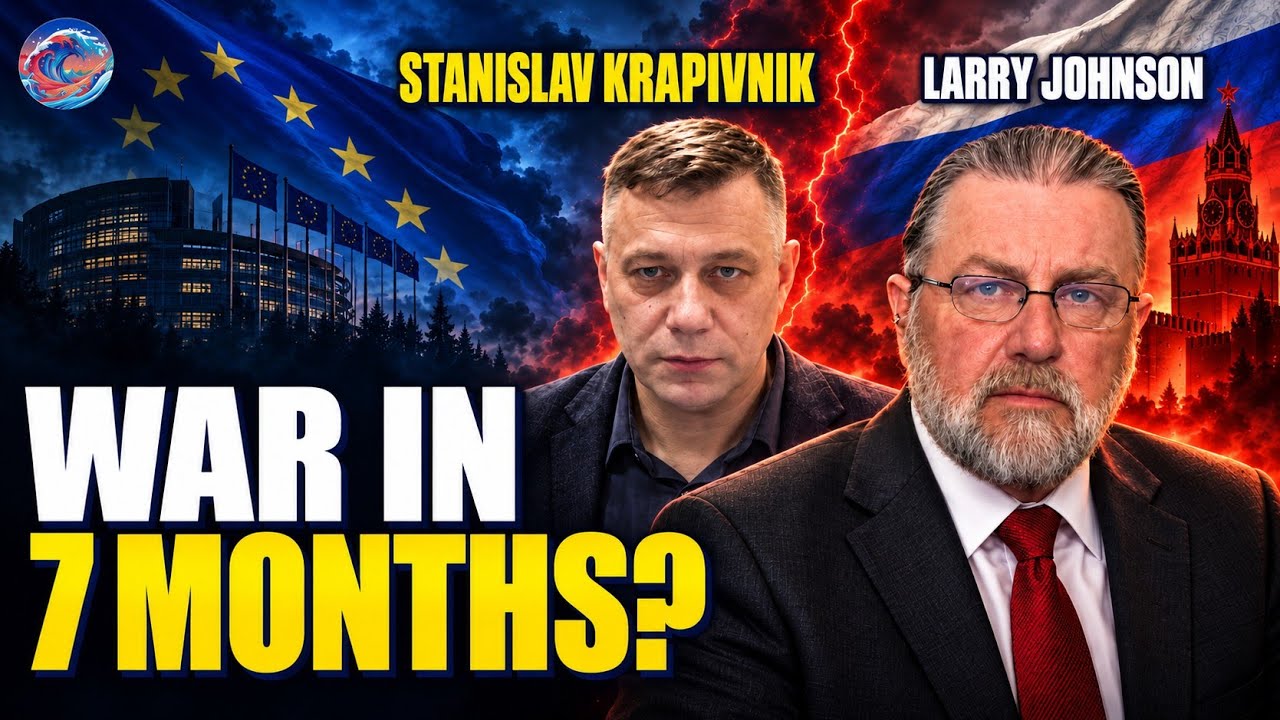
In his assessment, this does not involve all of Europe. Johnson names Germany, Great Britain, France, and Poland as particularly vulnerable or likely to be involved countries. He does not necessarily see Italy and parts of Southern Europe as necessarily being involved in such a war.
“They actually believe they can fight”
The starting point of the conversation is the increasingly aggressive rhetoric between Russia and the West. Johnson reports on conversations with several former and active Russian military personnel. He says he was particularly struck by a statement he heard during an interview with journalist Pepe Escobar: The Russian side now seriously expects to eventually have to go to war with Europe.
According to Johnson, the issue is not that Russia wants to attack Europe. Rather, Moscow believes that political and military developments in Europe may eventually leave no other option.
Krapivnik, for his part, reports on former Soviet and Russian officers who, despite mobilization, were initially not recalled to service. They were told their time “had not yet come.” For him, this suggests that parts of the Russian defence apparatus have been factoring in the possibility of a significantly larger war since at least 2023 and may be reserving experienced, older officers for this purpose.
Johnson also sees a dangerous miscalculation within the European leadership. When asked whether European politicians actually expect war or merely want to push themselves to the brink of disaster, he replies:
“I think we have one of those crazy situations here where the leadership actually believes they can fight.”
The crucial question remains largely unanswered: What resources should Europe use to wage a protracted conventional war against Russia?
Johnson: Europe’s economic strength alone will not decide a war
Johnson believes that frequently comparing European and Russian gross domestic products is misleading. While Europe’s economic output may be considerably larger on paper, in a war, energy supply, raw materials, industrial production capacity, and the ability to quickly replace spent weapons and ammunition are crucial.
Russia possesses its own oil, gas, and uranium reserves, as well as foodstuffs and raw materials for the production of explosives and artillery ammunition. Europe, on the other hand, is dependent on imports for several of these crucial resources.
Johnson specifically points to Russian munitions production. He claims that Russia can now produce more artillery shells in three months than the US and NATO combined in a year.
Regardless of the exact number, Johnson therefore focuses on a fundamental problem: In a large-scale conventional war, the decisive factor is not solely the number of weapons systems available at the outset. What matters is how quickly destroyed systems can be replaced and spent ammunition can be replenished. This is precisely where he sees Russia as having an advantage over Europe.
The interview cites Russian artillery production as an example. At the beginning of the Ukraine war in 2022, this stood at around 450,000 shells annually and was later increased to approximately 4.2 to 4.5 million shells per year. Deliveries from North Korea were also added. Johnson and Krapivnik contrast this with the difficulties Western states face in rapidly expanding their own ammunition production.
The war in Ukraine could be entering its decisive phase
Both parties do not expect a sudden collapse of the Ukrainian front. Instead, they anticipate a gradual process: sections of the front could give way while Russia continuously increases its military pressure.
Krapivnik describes Ukrainian counter-offensives as largely politically motivated, arguing that Kyiv has deployed strategic reserves for them. Overall, the military situation along the front is developing increasingly against Ukraine.
Johnson goes even further, suggesting that the war may already be entering its final phase. This phase, however, could be particularly dangerous. Historically, the number of casualties often rises sharply as a war draws to a close.
According to the interview, there is also a growing distrust on the part of Moscow towards new ceasefire agreements.
Johnson reports on information from the summit between Donald Trump and Vladimir Putin in Anchorage. According to him, Putin was prepared to largely freeze the front line in Zaporizhzhia and Kherson. However, the US did not implement the resulting agreements. Johnson concludes that the possibility of a comparable deal is now practically off the table.
Krapivnik says that many Russian soldiers feared a political compromise. From their perspective, the conflict should now be decided on the battlefield.
Energy could become Europe’s Achilles’ heel
Another crucial factor for Johnson is the energy supply.
While Russia possesses its own oil and gas reserves, Europe is heavily reliant on external supplies. A major war would immediately turn this dependency into a strategic problem.
The possibility of a US export ban on diesel is therefore also discussed. While Johnson does not consider such a step likely, he points out that Great Britain in particular, as well as other US partners, would be significantly affected.
This links the military question with the economic one: in a war, Europe would not only have to provide soldiers, weapons and ammunition, but also maintain its industry, logistics and energy supply under extreme conditions.
Risk of nuclear escalation
Johnson’s scenario becomes even more dangerous due to the nuclear dimension.
The discussion speculates that an American nuclear strike against Iran could trigger a massive international reaction. Johnson believes that in such a case, Russia could intensify its stance towards NATO facilities in Europe.
The Aegis Ashore systems in Poland and Romania are specifically mentioned. Johnson argues that Moscow could view such installations as an immediate threat in the event of a drastic escalation and conclude that it is necessary to disable them.
At the same time, Johnson believes that the first-ever use of a nuclear weapon in a current conflict could encourage other states to pursue their own nuclear arsenals. Turkey, Saudi Arabia, Brazil, and Mexico are among the countries mentioned. The logic behind this is that states could conclude from Washington’s differing approaches to Iran and nuclear-armed North Korea that only their own nuclear deterrent can reliably protect against an attack.
Johnson: Europe did not think the war through to the end
Ultimately, Johnson’s warning boils down to one central point: He doesn’t doubt that Europe possesses enormous economic resources. Rather, he doubts that its political leaders have grasped what a direct war with Russia would practically mean.
When asked how European decision-makers even envision such a war, Johnson answers succinctly: “They didn’t think it through to the end.”
Instead, the argument is based on macroeconomic figures: Europe’s total economic output is significantly larger than Russia’s. However, this overlooks the fact that, according to Johnson, Russia possesses a battle-tested arms industry as well as its own energy and raw material resources.
His prognosis is therefore exceptionally bleak: he estimates a 70 percent probability that Russia and parts of Europe could be firing directly at each other militarily within the next six to seven months.
This is not a confirmed intelligence forecast, nor is it an official assessment from Moscow or any European government. It is Johnson’s personal analysis. However, the very fact that such a timeframe is now being openly discussed in military and geopolitical circles demonstrates how far the debate has already shifted: away from the question of whether the war in Ukraine could escalate further, and towards the question of whether the proxy war could become a direct war between Russia and European NATO states.
yogaesoteric
October 16, 2026