
The Praxian Genocide Kill Chain – Part 2
In Part 2 of this series, we will focus on how the Praxians employ state crimes against democracy (SCADs) and demonstrate how they benefit from virtually every SCAD action. As we dismantle propaganda narratives, we will confront the hybrid war we are all currently waging, whether we realize it or not.
Read the first part of the article
We need to understand how the Praxians and their oligarchic partners – who have wielded global influence for centuries, far longer than the Praxians themselves – continue to manipulate and control populations worldwide. The social engineering techniques employed by oligarchs were described in 2013 by Professor Lance DeHaven-Smith, who coined the term “State Crimes Against Democracy” (SCADs).
DeHaven-Smith noted that SCADs often aim to “foment social panic [and] promote militarism” and are frequently “associated with wars.” He wrote:
“Many SCADs and suspected SCADs are related to foreign policy and international conflicts. […….] SCAD patterns are macro-discoveries that show that events which at first glance appear random are, when viewed together and comparatively, by no means random. Many political crimes and suspicious events involving or perpetrating elites […….] share several commonalities. They often employ military capabilities and tactics, trigger social panic and militarism in the […….] general public, and promote a belligerent stance in […….] foreign policy. […….] With the SCAD construct, we start from the assumptions that (1) officials in investigative positions actively avoid evidence of state involvement and instead gather evidence for theories that exonerate suspected officials; and (2) officials in operational positions exploit the crimes to further their own covert or other objectives.”
We will now examine the evidence showing that the Israeli-American war against Iran is almost certainly a SCAD (Strategic Defence Action). It is demonstrably a deliberately orchestrated conflict designed to advance a specific oligarchy agenda. It is not a war in the sense that most of us understand the word.
Conflict as performance art
Speaking to The Economist about the impact of the Israeli-American war against Iran, Christine Lagarde, former head of the International Monetary Fund (IMF) and current president of the European Central Bank (ECB) – who was convicted of financial negligence in 2016 after allowing the misuse of public funds – told that the global economic shock was beyond her comprehension. This was because “too much damage has already been done and it is impossible to repair it in a matter of months. […….] Most people are actually talking about years.”
A few weeks later, Lagarde focused on the hypothetical monetary policy role of central banks in inflation control when she told the central bank of central banks – the Bank for International Settlements (BIS): “We are once again in a different world.”
From a monetary perspective, this “other world” is destined to be a world of interoperable, programmable digital currencies – CBDCs, stablecoins, and tokenized deposits – which we can only access through our assigned digital identities. Consequently, we will be trapped in a digital panopticon where our lives are constantly monitored and our behaviour is strictly restricted and controlled. That is, if we adopt the system proposed by the oligarchs.
In October 2025, just months before the “shock” of the Iran war, Lagarde advocated for the introduction of a programmable digital currency across the European Union (EU). She said that representative democracy was “too big an obstacle at a time when speed is truly critical.”
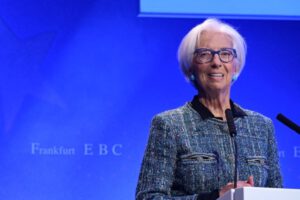
Praxian neoreactionary technocrats refer to this supposedly inhibiting factor as “demosclerosis.” Their proposed solution, in the form of a short, sharp shock – their method of accelerating the pace of change – is “accelerationism.” Clearly, the ECB president is very familiar with Praxian ideas.
Let’s return to her interview with The Economist, in which Lagarde referred to other recent “shocks” that had “changed” the world. She said the world had been shaken by the covid pandemic and subsequently suffered under Russia’s “war” against Ukraine – a rather bizarre conflict. She reiterated her claims when she subsequently spoke to the BIS:
“None of us can eliminate the uncertainty about how the war in Iran will unfold. What I can do, however, is outline how we will deal with this shock. […….] In 2022, the shock was exceptionally large and prolonged. Even before the Russian invasion began, oil prices had tripled between October 2020 and March 2022 – and natural gas prices rose even more sharply as Russia gradually reduced supplies. Afterward, Europe was virtually cut off from a supplier that had covered around 45% of its natural gas imports and forced to find new suppliers [at a time when] supply chains were still disrupted in the wake of the pandemic.”
Much of what Lagarde allegedly told the BIS was untrue. Global supply chains (GSCs) were not disrupted by a pandemic. Not only is there no plausible evidence that a pandemic even occurred, but the collapse of the GSCs was triggered by the satanically “creative destruction” brought about by a globally coordinated political response from governments to a computer-generated pandemic – not a real one. In short, the global covid-19 pseudopandemic was a SCAD (Software Development Alliance).
Although they clung to the myth of the pandemic as the cause, a team of scientists from Qatar and Saudi Arabia found:
“A number of precautionary measures to contain the spread of covid-19 were implemented by governments, including travel restrictions, temporary closures of factories and retail outlets, and mandated stay-at-home orders for all residents. These restrictions led to shortages of labour, active pharmaceutical ingredients, and raw materials. Furthermore, this situation was exacerbated by tightened controls on logistics systems. […….] Covid-19 [the government’s policy measures] not only disrupted local supply chains but also profoundly impacted global supply chains at all stages.”
The Russian government has not “reduced” European energy supplies. Rather, the EU has practically strangled itself by imposing sanctions on Russian energy companies. Mysterious cases of industrial sabotage, reminiscent of the SCAD scandal, have further reduced Russian energy exports to the EU.
Allegedly, no one knows who was behind the explosions that crippled the Nord Stream 2 pipeline, which delivered Russian gas to the EU via Germany. Strangely, however, only Ukrainians have been arrested. A seven-member team led by former Ukrainian Security Service (SBU) employee Serhiy Kuznetsov is suspected of committing the crime. It is believed they decided on their own to attempt a deep-sea explosion. Given that then-US President Joe Biden had previously declared that the US would “put an end” to Nord Stream, and given reports that Ukrainian President Zelensky had personally authorized “Operation Diameter,” Russian President Vladimir Putin was probably right when he dismissed the “lone wolf” narrative as “complete nonsense.”
Because the Russian economy is heavily dependent on energy exports, the Russian government did everything in its power to maintain the flow of energy and money to its perceived “enemies.” It continued to pay gas transit fees to the Ukrainian government – thus filling its war chest – so that the Russian energy giant Gazprom could continue to deliver gas to EU markets via Ukrainian pipelines during the “war.” The “war” might have been less intense had the Russian government not waived “wartime” export restrictions on the Russian Lukoil refineries in Bulgaria. These refineries supplied approximately 40 percent of the diesel fuel the Ukrainian military needed for its armoured vehicles as it continued to kill Russians and Russian-speaking people in Donbas.
In January 2025, the Ukrainian government increased transit fees for Gazprom by 400%, prompting EU member Slovenia to threaten to cut off Ukraine’s emergency power supply. Some backroom deals ensued, and everyone agreed that Russia could circumvent EU sanctions by supplying gas to Slovenia and other EU member states like Austria via the TurkStream pipeline. The pipeline is a joint project between Russia and NATO partner Turkey, and the partnership is thriving despite Turkey’s arms exports to Ukraine. Meanwhile, EU member states like Slovenia and Austria continue to finance and support Ukraine’s “war” against Russia, while NATO-supplied Ukrainian weapons are killing Russian civilians.
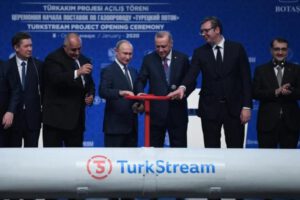
If the word “war” is to retain its original meaning, then it is untenable to describe the conflict between Russia and Ukraine as a comprehensive “war” between hostile, belligerent nation-states. The “war” in Ukraine, which the Praxians used as an “absolute pioneering role” for the development of their AI weapons technology is to a considerable extent a performative SCAD. Contrary to any hostility they may publicly display, the performative element suggests a degree of international agreement between “political decision-makers” and so-called “elites.”
Unfortunately, this does not lessen the carnage, death, and destruction inflicted on the affected populations. Such staged events are not uncommon in international conflicts. Without the support of transnational capitalists and oligarchs based in the US, such as the Rockefellers, the Nazis in Germany might not have come to power and thus might not have been able to wage World War II as they did. No Western allied nation imposed sanctions on the US corporations that supported Germany’s war effort in World War II.
In 1954, Norman Dodd was serving as chief of staff for the Congressional Special Committee investigating tax-exempt trusts (the Reece Committee). As part of his investigation, Dodd sent his assistant, a lawyer named Katherine Casey, to the archives of the Carnegie Endowment for International Peace (CEIP), a global political think tank run by oligarchs. Later, in conversation with the esteemed author and historian G. Edward Griffin, Dodd revealed that Casey had found records dating back to 1908 showing that the CEIP believed the most effective way to change the lives of an entire population was through war. With the goal of social manipulation, the CEIP immediately set about embroiling the United States in a war – another SCAD.
Nothing has transformed since then. Oligarch-run political think tanks still advocate war to socially manipulate populations and influence international relations. Consider the pseudo-pandemic and the, in a sense, pseudo-Ukrainian war, both of which were deliberately orchestrated. The alleged global “shocks” caused by these events were no surprise to the network of global oligarchs, who had expected nothing less.
We will soon discuss how the Israeli-American war against Iran has elevated conflict performance art to a new level. To reiterate the point just made: this is by no means intended to deny the horrific human cost of these SCADs. Rather, it is meant to highlight how we are all manipulated into engaging in staged, false dialectics.
The development along the common international political course, which is invariably accelerated by wars, consistently benefits the Praxians and their globalist oligarch partners. The ultimate goal is the envisioned multipolar world order (MWO). This planned global government bureaucracy will administer regional “unions” that oversee a patchwork of private city-state “empires.” The promised MWO is the realization of the global oligarchy’s objective, and almost all nation-states are working together to achieve it.
While we grapple with many apparent contradictions, it’s worth remembering that opposing forces are not necessarily – or at least not entirely – antagonistic. We can think of the oligarchs’ overarching goal as a kind of corporate mission statement. The board members will work together in the company’s best interests, but that doesn’t stop them from stabbing each other in the back as they vie for position, bypassing one another in the process.
Oligarchs like the Praxians are prepared to risk global catastrophe for their ambitions. The fact that the Praxians do not yet have absolute control means that we, the people, can thwart them if we so choose.
Like all of us, oligarchs are fallible. Their projects for societal change don’t always go as planned or aren’t implemented on time. Despite their strange, cult-like beliefs and boundless hubris, oligarchs are simply human beings. As independent, sovereign people, we should neither be intimidated nor impressed by them. We simply need to remain consistent, maximize our independence, and refuse to give in to their Machiavellian schemes.
The oligarchs’ plans are discernible, but we shouldn’t assume their SCADs will necessarily succeed. When immensely powerful oligarchs make mistakes, the unforeseen consequences for humanity can unfortunately be worse than they anticipated.
A discernible plan
Lagarde’s message to the BIS was that the ECB “pursues a strategy designed for a world of greater uncertainty, with risks and scenarios at its core,” and that its monetary policy response to the recent “shock” from the Iran war “starts from a better position.” In apparent contradiction to Lagarde’s remark about a “better position,” the current Managing Director of the IMF, Kristalina Georgieva, said that the “shock” caused by the conflict with Iran was “large, global, and asymmetric.”
Certainly, the socioeconomic repercussions are “large” and “global,” but it is disingenuous of Georgieva to also describe the hostilities as a “shock.” While the Praxians have recently spearheaded the Israeli-American course of action against Iran, this objective – and the repeated attempts to achieve it – has been announced by oligarchs for decades. Indeed, the global economic repercussions of a US war against Iran – contrary to the SCAD-aligned narratives we are meant to swallow – have been a foregone conclusion for many years and have been thoroughly modelled by oligarch-run think tanks. There is nothing remotely surprising about their effects.
The global economic consequences, as Georgieva described them, are “asymmetrical” and depend on whether a country or regional “pole” is a net “energy exporter or importer.” For example, the governments of the US and Russia, as leading exporters, have maintained their partnership. Because of the Iran-Iraq War, the US government lifted most of its sanctions against Russian oil exports, sanctions it had originally imposed because of the war in Ukraine.
The Trump administration has reportedly imposed a “complete” naval blockade of the Strait of Hormuz – a vital shipping route – although it is not truly “complete,” given that Russian and Chinese tankers, for example, have been allowed to pass through. President Putin’s special envoy Kirill Dmitriev – a former investment advisor at Goldman Sachs, McKinsey & Company, and the World Economic Forum, and now CEO of the Russian Direct Investment Fund – said that “economic and energy cooperation between the US and Russia will continue” thanks to General License 134B, issued by the US Treasury Department, which permits Russian tankers to navigate the strait.
Another consequence of the – albeit selective – “complete” US blockade was that Iran, which Trump repeatedly described as “completely defeated”, was not so “defeated” that it could not reinstate its own selective toll blockade in response to the complete, partial US blockade!
How to collect tolls from tankers that supposedly can’t go anywhere (although some obviously can), or how a country like Iran can control a vital maritime energy corridor (when its navy has reportedly been destroyed at least twice), are just some of the many questions that arise from the “total” drivel that is presented as the official account of the “totally” absurd war against Iran.
Furthermore, it remains a mystery how or why the US managed to establish this impossible naval blockade – we will address this shortly. Nevertheless, asymmetry is unfolding quite predictably as the entirely foreseeable outcome of this absurd war.
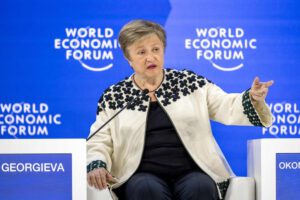
On the instructions of her speechwriters, Georgieva added:
“The supply shortages have had an impact – and will continue to have an impact for some time. […….] Shortages of refined products such as diesel and aviation fuel have affected transport, trade, and tourism in a world more interconnected than ever before; […….] Food insecurity for an additional 45 million people due to transport problems – bringing the total number of people suffering from hunger to over 360 million – with the problem potentially worsening over time due to higher fertilizer prices; and disruptions in the supply chain due to industrial dependencies, for example, on sulphur, helium for the production of silicon chips and MRI imaging, and naphtha for plastics.”
Neither the Iranian nor the US Navy initiated the blockade of the Strait of Hormuz. In their respective ways, they essentially reinforced the blockade that was originally triggered by the global insurance industry. No sooner had the Trump administration launched “Operation Epic Fury” than the largest marine insurers, such as the Norwegian companies Gard and Skuld, the British North Standard and the London P&I Club, and the New York-based American Club, withdrew war risk coverage for shipping companies. The first military blockades followed.
Despite negotiated ceasefires and the willingness of the warring national governments to reopen the vital transit route through which approximately 20% of the world’s oil supply flows, it is once again the multinational insurance giants that are playing a key role in keeping the Strait of Hormuz closed. As of April 17, 2026 until June 2, when this article was written, the US “blockade” had reportedly turned back only fourteen ships. Iranian Foreign Minister Abbas Araghchi announced that the strait was “fully open to all merchant ships.”
However, as the House of Saud reported, around 24 tankers turned back on April 18, 2026, due to increased insurance premiums and lack of coverage:
“The ships were largely neither stopped by American warships nor threatened by Iranian patrol boats. Rather, they were reacting to a force more powerful than both navies: the insurance market.”
This does not appear to be an example of insurers’ risk assessments responding to military realities. Rather, the insurance giants are effectively imposing a blockade at a time when no naval blockade existed.
The long-planned and extensively modelled conflagration in the Middle East is a changing global SCAD event. Indeed, the IMF chief went on to outline what the outcome of this SCAD should look like:
“We know that much of the shock will eventually subside and we will arrive at a new equilibrium. Supply will recover and demand will adjust. New capacity will be brought online. Energy efficiency will increase. […….] Even our most optimistic scenario anticipates a slowdown in growth. Why? Because of significant infrastructure damage, supply shortages, loss of confidence, and other lasting effects. […….] There will be no clean and smooth return to the status quo ante.”
Forget the world before the Iran war, Georgieva tells us. That’s over. The “after-effects” will require a “new equilibrium” that is more energy-efficient. New infrastructure and capacity will be needed to cope with the alleged “shock.”
Georgieva continued:
“I urge all countries to avoid unilateral action. […….] We have joined forces with the IEA (International Energy Agency) and the World Bank to form a coordination group, with the IMF taking the lead on macroeconomic issues. […….] It is important that fiscal and monetary policies do not pull in opposite directions. […….] The conclusion is clear: all countries should use their limited fiscal resources responsibly, and most should act decisively to rebuild fiscal leeway after this shock. I cannot stress this enough.”
This “asymmetry” leads to a global homogenization of monetary and fiscal policy. Monetary policy worldwide – contrary to popular belief – is not controlled by the public sector, but by private-sector central banks. The leading central banks are steered by general meetings of the BIS, and the BIS enjoys immunity from jurisdiction. No government in the world has any jurisdiction over the monetary policy of the central banks, which is agreed upon behind the closed doors of the BIS. We are only told what the BIS wants us to know.
Fiscal policy – collecting taxes and setting spending priorities – is supposedly the domain of nominally public governments. This is no longer the case. Due to war, private sector monetary policy and public sector fiscal policy need to be coordinated more closely than ever before.
The apparent chaos caused by a military conflict between an Israeli-American coalition and Iran is evidently leading to a coordinated global “solution.” This is a typical feature of such conflicts. As Professor DeHaven-Smith noted, in the post-World War II era, conflicts resulting in suspiciously SCAD-like, pre-planned macroeconomic, monetary, and socioeconomic outcomes were a persistent feature, occurring with increasing frequency since the late 1960s.
The merging of private sector monetary policy with the supposedly fiscal policy of the public sector is also perfectly aligned with the goals of the Praxians. The Praxians’ plan is to strip the public sector – all governments worldwide – of any authority and power. The Praxians want to see the proliferation of “agentic states.”

Georgieva claimed that the “considerable momentum” in the supposedly booming pre-war global economy – which most of humanity experienced as a cost-of-living crisis – was driven by “heavy investments in AI and technology.” Therefore, she stressed, the pursuit of energy efficiency in the “new equilibrium” should not derail the AI agenda, which is economically indispensable for the Praxians.
The IMF’s managing director presented a clear program that political decision-makers should adhere to:
“For example, if investors, faced with the enormous energy demands of AI, were to begin worrying that energy security might stifle its growth, we could be in trouble. Micro- and macroprudential measures should aim to reduce risks to financial stability and ensure a resilient system. […….] Don’t forget to navigate the major global transformations in technology, demographics, geopolitics, trade, and climate to build a better future. Your structural and regulatory decisions underpin productivity and long-term growth – and growth potential is of enormous importance for stability.”
As a result of this latest war – SCAD – governments should fulfil their designated role as enabling partners in a “resilient” global technological revolution. If government officials fail to serve their respective public-private partnerships, growth – and thus stability – will be “jeopardized.” This outcome would pose a threat to national security – or so claims, among others, the US federal government.
Radical geopolitical realignments in the MWO, the resulting demographic shifts, new global trade patterns, and climate policy can all be steered toward the “new equilibrium” as long as everyone subscribes to the Praxians’ technological coup. No wonder the IMF is looking forward to the “devastating effects” of the Iran-Iraq War (SCAD) with gleeful anticipation.
Since its founding under Bretton Woods in 1944, the IMF has worked closely with its “complementary” partner, the World Bank, to relentlessly impoverish developing countries through debt traps. It is therefore no surprise that the current war with Iran presents a huge opportunity for the transnational capitalists who profit from the IMF’s exploitation of oppressed populations. Crises are always the trigger for the IMF and the World Bank to intervene. And as Georgieva noted, the envisioned “new equilibrium” looks very promising for the IMF/World Bank and their international partners.
These “other” partners consist of a transnational network of privately financed development banks, including almost all the development banks of the BRICS countries. Together, the IMF, the World Bank, and the development banks form a single, unified global financial empire.
A triumphant Georgieva announced:
“[The IMF] is there for you when a crisis hits. Let’s take another look at the world’s vulnerable oil importers, those classified as ‘speculative grade,’ and highlight all the countries participating in IMF programs in blue. We can expand these programs if needed, and – rest assured – more programs will follow.”
But that’s not all. The IMF and the World Bank have also entered into a new partnership with the International Energy Agency (IEA). Their plans and forecasts reveal what this “new equilibrium” means for all of us: Unsurprisingly, the IEA predicts a severe energy crisis, triggered by the planned war.
In response, the EU leadership, represented by the President of the European Commission, Ursula von der Leyen – possibly one of the most corrupt politicians Europe has ever seen – proposes that the solution is for us, the people, to forgo energy consumption.
In March, the IEA published its plan “Sheltering from Oil Shocks”. Its partners – the IMF, the World Bank and the BRICS development banks – will implement the plan through their macroeconomic interventions.
The IEA’s plan can be summarized in a few words:
- It severely restricts our lives by rationing our energy consumption.
- It is forcing us to work from home.
- It is practically depriving us of access to independent means of transport.
- It strictly monitors our energy consumption.
- It is manipulating us into adopting smart grid technology.
- It is attacking our food supply.
All these measures are apparently necessary because of the unexpected SCAD war.
Surprisingly, the “Sheltering from Oil Shocks” plan closely resembles the measures presented to us during the pseudo-pandemic lockdowns.
This same plan also fits seamlessly into the numerous political goals summarized under the umbrella of the Sustainable Development Goals. This synergy has not escaped the notice of the United Nations – the oligarch-led architect of these SDGs. Naturally, the UN is now using this fabricated “war” narrative – having seemingly shelved its earlier, equally fabricated climate catastrophe narrative – to advance its ongoing climate exclusion zone agenda.
(NOTE: Despite being discussed by influential economists, modelled in detail by governments, and tested in Canada and elsewhere, the climate lockdown has been officially classified as a “conspiracy theory” by epistemic authorities until it is cleared for public discussion by our oligarchic overseers.)
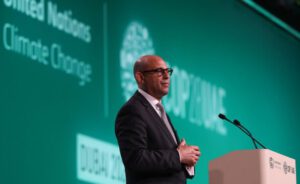
When Simon Stiell, the Executive Secretary of the United Nations Framework Convention on Climate Change (UNFCCC), addressed EU delegates at the Green Growth Summit in Brussels in mid-March, he described what he termed a “new world disorder.” He said the disorder was caused by the “fossil fuel crisis,” which had been triggered by the “surprise war” with Iran.
Stiell described Georgieva’s “new balance” as the “new era of climate protection” and made sure that the assembled political decision-makers were fully up to date on the wish list of transnational capitalists:
“In a time of chaos, capital is seeking safe, strategic growth and is flowing to Europe at record levels. […….] The opportunities are immense. Over two trillion dollars have been invested in clean energy. That is twice as much as in fossil fuels. […….] Its emissions trading system is driving investment and innovation. And European companies are at the forefront of clean industries and growth. […….] Europe can permanently secure the multitrillion euro goldmine of investment that is just beginning to unleash itself. […….] As we enter a new era of climate action – an era of implementation – enormous opportunities are emerging.”
Stiell fully embraced Praxian accelerationism, declaring that the “global shift” away from fossil fuels needs to occur “rapidly”; he added that “faster change will bring greater benefits worldwide.” He said the current shift was “not fast enough” and mentioned the urgent need to “move faster” and “seize this moment” – an immense “opportunity” arising from the “war” – the SCAD – that no one foresaw.
One might ask what this rush to exploit the trillion-euro gold mine has to do with saving the planet from global warming. The answer is: “Nothing.” But that’s actually irrelevant, because the “global warming” narrative has been discarded and, after being called “climate change” for many years, is now being replaced by the narrative that Stiell describes as a “climate catastrophe.”
The recent reversal is understandable, as there is no evidence of global warming caused by CO₂. The planet is in an interglacial period and is just emerging from a Little Ice Age. Fortunately, the Earth continues to warm. However, the CO₂ concentration in the atmosphere has nothing to do with natural warming and cooling cycles, and never has.
Readers can be forgiven for being sceptical of this last statement. Given the decades-long myth that CO2 causes global warming, one might expect that the enormous increase in industrial CO2 emissions over the last half-century would have had a noticeable impact on global surface temperatures. However, this is not the case. Since continuous records began in 1850, scientific studies have shown that – apart from the natural fluctuations of an overall warming climate – “we have yet to statistically prove an acceleration of global warming [after 1970].” This probably explains why mouthpieces like Stiell have been instructed to refrain from any mention of “human-caused global warming.”
Furthermore, since there is no statistical evidence for more frequent or severe climate disasters, the alarmism surrounding “climate disasters” is also epistemologically outdated. However, even this fact is irrelevant, because both the fiction of “global warming” and that of “climate catastrophe” are nothing more than SCAD propaganda constructs aimed at pushing through the oligarchs’ agenda.
Stiell relied solely on propaganda rather than scientific evidence, declaring that our continued use of fossil fuels to meet our energy needs was “delusional.” He said:
“Dependence on fossil fuels undermines national security and sovereignty. […….] Because the war in the Middle East has caused oil and gas prices to skyrocket, just as the war in Ukraine had done previously. […….] Sunlight is not dependent on narrow and dangerous sea lanes. The wind blows without the need for massive, taxpayer-funded naval escorts. Renewable energy enables countries to protect themselves from global turmoil and avoid a ‘might makes right’ policy.”
Assuming one considers the global transition to renewable energy realistic – which means ignoring the long list of unresolved problems that currently make this idea seem like the world’s biggest misinvestment – then, according to Stiell, it is the war in the Middle East that is now providing the new impetus for an accelerated transition to renewable energy. This means that instead of having relatively independent access to energy, we are destined to be controlled by a managed system of internationally interconnected power grids.
Stiell explained it as follows:
“By outlining how you will succeed in a world moving towards decarbonization […….], electrification is progressing. […….] Last year, renewable energy overtook coal as the world’s leading source of electricity. […….] And this puts you at the forefront of the electrical engineering revolution, in part through your [the EU] Action Plan on Electrification. […….] Climate cooperation is a remedy for the chaos of the present and beyond.”
In the face of the shocking “chaos of the moment” surrounding the Israeli-American war SCAD against Iran, propaganda narratives are converging as we approach the new world order, where we will apparently “thrive” on a “decarbonized” planet. The Great Reset is in full swing. The “shock” of the Iran war means we can all “Build Back Better” again, or, as an unhinged President Trump put it, welcome “the most powerful reset on Earth.”
There is a concrete plan:
- Combating the mythical climate catastrophe through the United Nations’ 17 Sustainable Development Goals has become a geopolitical imperative and a matter of national energy security.
- National energy security requires that fossil fuels be rationed and that energy supply be distributed via smart grids.
- A stable energy supply can only be guaranteed if the necessary investments in smart grid infrastructure are secured.
- However, investments in smart grids will only be made once geopolitical tensions have been resolved.
- Resolving geopolitical tensions requires a global realignment of geopolitical power relations.
- This need for realignment gives rise to the multipolar world order (MWO).
The beautiful multipolar world order
US isolationism, EU military unity, global unrest, key political appointments (on both sides of the Atlantic), and international currency reforms – all these factors are contributing to the emergence of the Multipolar World Order (MWO) and are currently converging on the world stage. What are the chances? The signs are unmistakable: The world order is undergoing a process of destruction. It is being deterritorialized – only to be reterritorialized as a more efficient multipolar global governance system.
The Praxians’ model for accelerated global change has apparently been adopted by their oligarchic “brothers” – and these “brothers” are predominantly, though not exclusively, men. As analyst, journalist, and podcast host Hrvoje Morić recently pointed out on “Geopolitics and Empire,” the MWO has been the target of the global oligarchy in the realm of global governance for more than a century.
The Bilderberg Group, a think tank run by oligarchs, created the European Union (EU) as the “pole” of the Multinational Economic Organization (MWO) model. The Eurasian Economic Union (EAEU) and China’s planned Asian Union – the latter potentially uniting the Association of Southeast Asian Nations (ASEAN) and the Gulf Cooperation Council (GCC) – are based on the globally agreed-upon “union” model. A world order of regional unions is being constructed.
Read the third part of the article
Author: Iain Davis
yogaesoteric
July 10, 2026