
What is actually going on in Poland – and what role does the EU play in it?
Hungary, Romania, and now Poland show a recurring pattern: wherever political majorities shift or governments deviate from the EU’s course, constitutional courts, presidents, and electoral procedures become the focus of bitter power struggles – and Brussels wields considerable influence through rule-of-law proceedings and billions in EU funds.
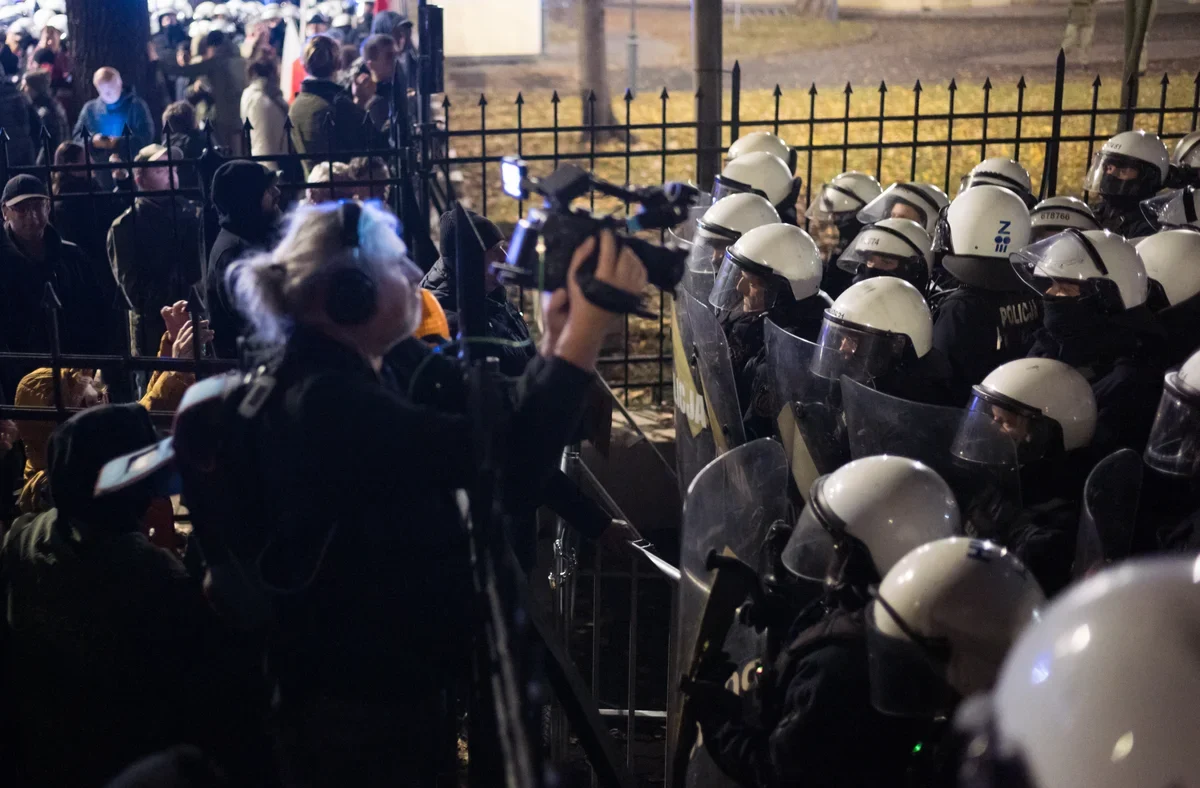
Poland is mired in a deep constitutional crisis. The trigger is the decades-long simmering dispute over the Constitutional Tribunal, which has now openly escalated: The previous head of the court, Bogdan Święczkowski, has been suspended, Anna Korwin-Piotrowska has, according to her own account, taken over the interim leadership, hundreds of demonstrators gathered in front of the court, the police cordoned off the area, and President Karol Nawrocki even cut short a trip to Senegal to return to Warsaw. The opposition speaks of a “coup d’état,” while Prime Minister Donald Tusk speaks of the necessary “restoration of the rule of law.”
Der polnische Europaabgeordnete Dominik Tarczyński erklärt, was derzeit im polnischen Verfassungsgericht geschieht, und bezeichnet es als Putsch. https://t.co/It59OzU5MM
— Don (@Donuncutschweiz) October 31, 2026
The current conflict, however, is not a sudden event. Its roots reach back to 2015, when the national-conservative PiS government began restructuring the Constitutional Tribunal and other judicial institutions. Critics accused PiS of appointing judges for political gain and undermining the independence of the judiciary. European courts later found that several appointments had been unlawful and that the Polish Constitutional Tribunal, in its then-current composition, no longer fully met the requirements of an independent and impartial court.
This also marked the beginning of the major conflict with Brussels. In December 2017, the European Commission initiated its first-ever Article 7 proceedings against a member state – against Poland. The focus was on the independence of the judiciary, the Constitutional Tribunal, the National Council of the Judiciary, and the disciplinary system for judges. The EU exerted political and legal pressure on Warsaw for years. Furthermore, Poland was fined hundreds of millions of euros for failing to comply with a ruling by the European Court of Justice; the Commission offset a total of €556.5 million against EU funds that Poland would have been entitled to.
After the change of government at the end of 2023, the situation modified fundamentally. Donald Tusk explicitly promised Brussels that he would reverse the PiS judicial reforms. In February 2024, his government presented an action plan in which Poland, among other aspects, reaffirmed the primacy of EU law, recognized the jurisprudence of the European Court of Justice, and intended to restore judicial independence. A few months later, in May 2024, the European Commission terminated the Article 7 procedure. Officially, it justified this by stating that, due to the announced reforms and commitments, there was no longer a clear risk of a serious breach of the rule of law.
This is precisely where the connection to today’s crisis lies.
Since then, Tusk’s government has been attempting to dismantle the structures created under PiS, most notably the Constitutional Court. The conflict was further exacerbated after Parliament elected new judges in 2026, but President Nawrocki refused to swear in several of them. Święczkowski, in turn, refused to allow these judges to serve on the court. The government views this as a continuation of an unlawful obstruction, while the president and PiS argue that Tusk is attempting to seize political control of an unpopular court.
The current suspension of the head of the judiciary is by no means uncontroversial from a legal standpoint. Constitutional law expert Marcin Matczak, himself a sharp critic of the earlier PiS judicial reforms, stated that, in his view, the legal basis used for Święczkowski’s suspension is non-existent. In other words, even opponents of the earlier PiS policies warn against implementing the supposed restoration of the rule of law with measures whose own legal basis is questionable.
And what does the EU have to do with it?
The EU is not a neutral spectator.
Since 2017, Brussels has clearly taken sides in the Polish judicial issue. It led Poland through Article 7 proceedings, initiated infringement proceedings, imposed financial sanctions, and linked the disbursement of portions of European funds to judicial reforms and so-called “super-milestones” for judicial independence. After Tusk took office, the Commission gave a positive assessment of precisely those measures with which the new government aimed to curb the PiS structures.
The political direction the EU has been pursuing for years is clear: the judicial system created by PiS is to be reversed, and the Polish legal system is to be more closely aligned with the rulings of the European Court of Justice and the European legal framework.
That is precisely why the assumption that the EU has nothing to do with the current power struggle is unconvincing. For years, it exerted pressure, demanded reforms, and explicitly made its assessment of the Polish rule of law contingent on such modifications. Tusk’s government is largely pursuing exactly this course today.
Rule of law or change of power?
This raises the real question: Will the independence of the judiciary in Poland truly be restored – or will one politically influenced judiciary simply be replaced by another politically influenced judiciary?
The previous PiS government had a strong political influence on the Constitutional Court. This is extensively documented. However, the current government is also increasingly suspected of using the slogan of “restoring the rule of law” to fill institutions with its own candidates and to overstep legal boundaries. Reuters explicitly points out that critics consider even the recent appointment of a close Tusk confidant to the Constitutional Court problematic for the promised restoration of checks and balances.
This puts Poland in a situation today where both sides dispute the legitimacy of the other: The government does not recognize parts of the old court, President Nawrocki refuses to swear in new judges, the court leadership does not recognize the judges elected by the government majority – and now competing camps are declaring each other illegal.
The EU is not outside the conflict. It has been an active political factor for years because it has clearly defined which reforms it expects from Poland and which judicial system it considers compatible with EU law.
The fact that Brussels has a strong interest in the success of Tusk’s reform of the Polish judiciary can be clearly deduced from years of EU policy.
What is currently going on in Warsaw is therefore far more than a dispute between a few judges. It is a power struggle over a fundamental question: Who ultimately determines Poland’s legal order: national institutions, the prevailing political majority, or a European legal system whose decisions are intended to be binding for Poland?
And that is precisely why the conflict is now escalating so violently.
Sources:
- Reuters – Latest escalation at the Polish Constitutional Court: Polish president turns back from Senegal trip after top court chief suspended
- Notes from Poland – legal details on the suspension of Święczkowski and Korwin-Piotrowska’s role. Chaos at Poland’s constitutional court as government-backed judges seek to restore chief justice.
- EU Council – Chronology of the Article 7 procedure against Poland
- EU Commission – Poland’s Action Plan, Primacy of EU Law and Termination of the Article 7 Procedure
- EU Commission – €556.5 million in sanctions and linkage to judicial reforms: Strengthening democracy and the rule of law
yogaesoteric
November 1, 2026