
During World War II there were food ration cards, during covid there were QR codes – the next crisis could unleash the unimaginable
For many, it still sounds like a scenario from a dystopian future: food only available with digital authorization, fuel quotas, personal consumption limits, and a QR code that determines who can access what. But the basic idea isn’t so far-fetched. Rationing has already been implemented; Switzerland still uses it as a crisis management tool – and since covid, we know how quickly digital access controls can be implemented, both technically and politically.
The crucial difference compared to the past therefore lies less in what a state could do in a severe crisis, but rather in what technical means it could do it today.
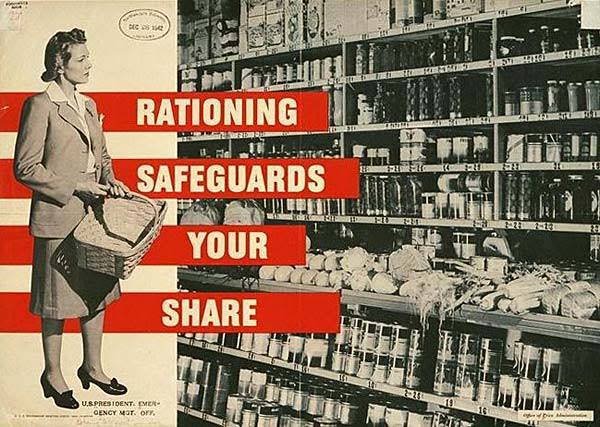
During the Second World War, Switzerland, despite its neutrality, was affected by the international supply crisis. From the end of October 1939 until the summer of 1948, ration cards dominated daily life. Milk, sugar and other essential goods could only be purchased at times if, in addition to money, the corresponding coupons were available. At the height of the crisis, up to 700 million of these paper coupons had to be processed nationwide every month.
The system was slow and labour-intensive. Municipalities distributed cards, retailers collected coupons, intermediaries passed them on, and authorities controlled the quantities. Nevertheless, it accomplished something that could be done technically in seconds today: the state determined who was allowed to receive how much of a scarce resource.
Three decades later, the 1973 oil crisis demonstrated that such interventions are by no means limited to a world war. When oil supplies became a political tool, the Swiss Federal Council decreed three car-free Sundays. On November 25, 1973, cars were parked, and people strolled along highways. What would have been almost unimaginable in everyday life just a few months earlier became reality due to an international energy crisis.
Then came covid – and with it a completely new dimension.
From September 13, 2021, a certificate requirement applied in Switzerland for, among others, the indoor areas of restaurants and bars, as well as cinemas, museums, swimming pools, and numerous events. For verification purposes, the QR code of the covid certificate was scanned using a government-provided app. The Federal Office for Information Technology describes how a digital infrastructure for issuing, storing, and verifying these certificates was established within just a few weeks.
One shouldn’t equate the health policy decisions of that time with a future healthcare crisis. But covid demonstrated something crucial: digital authorization can technically become the key to participating in parts of public life – and the necessary infrastructure can be built very quickly.
Back then, the issue was health status. In a future severe supply crisis, it could theoretically be about litres of gasoline, heating energy, or certain foodstuffs.
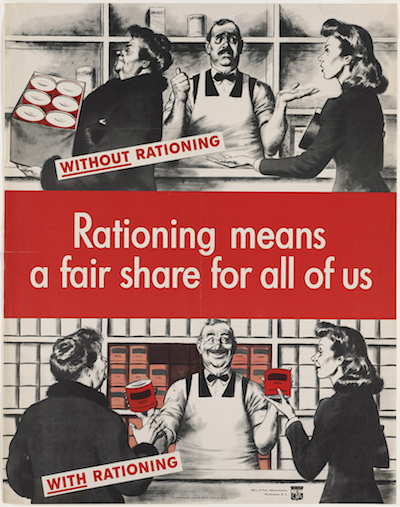
And here the historical parallel suddenly becomes highly relevant. Food rationing in Switzerland is by no means a forgotten relic of the Second World War. The Federal Office for National Economic Supply (BWL) explicitly continues to list food rationing (NARA) as a possible measure for “prolonged and severe supply crises.” Rationed food could then only be purchased upon presentation of a ration card. As a preliminary measure, the federal government can also limit the quantities available – an instrument that, according to the BWL, was already used in retail outlets during the covid pandemic due to panic buying.
This isn’t just theoretical when it comes to fuel either. Official Swiss crisis preparedness plans explicitly include rationing of gasoline and diesel should a significant and prolonged shortage arise. Prior to this, mandatory reserves could be released, appeals for conservation issued, and speed limits imposed. Switzerland currently maintains mineral oil reserves sufficient for approximately four and a half months of average demand; for essential foodstuffs, mandatory reserves last roughly two to four months, depending on the product.
Such a shortage does not yet exist. However, the international situation is becoming more dangerous.
The war between Russia and Ukraine continues. At the same time, the war with Iran has spread to other parts of the Middle East. Attacks in the vicinity of Saudi Arabia and Yemen are now directly impacting energy infrastructure. Following the latest attacks, the crucial Saudi East-West pipeline has been shut down – precisely the route that normally transports oil to the Red Sea, bypassing the blocked or severely damaged Strait of Hormuz. Reuters estimates its capacity at around four million barrels per day. Brent crude oil was already trading at around $107 per barrel on September 15.
Such a development hits Europe at a vulnerable point. The EU is almost entirely dependent on crude oil imports. Rising energy prices not only increase the cost of refuelling and heating. They travel through virtually the entire economy via trucks, ships, airplanes, agriculture, fertilizers, packaging, and manufacturing, ultimately ending up in the supermarket.
This does not yet mean imminent food rationing. There is a huge difference between an oil price of over $100 and food stamps. Rationing would only become relevant in the event of a genuine, severe, and prolonged shortage. But that’s precisely why it’s worth taking a look at history.
In 1939, hardly anyone knew how long food rationing would last. In 1973, a crisis in the Middle East transformed Swiss highways into pedestrian zones within a few weeks. In 2021, a QR code on paper or a smartphone was all it took to automatically check whether someone possessed the required access authorization for certain areas.
Today, all these instruments are based on a completely different technical foundation.
A modern digital ration card would no longer need to consist of hundreds of millions of paper coupons, as was the case in 1944. A centrally or de-centrally managed system could theoretically allocate each resident a personal quota: a specific amount of fuel, heating energy, or rationed food. At the point of purchase, eligibility would be checked electronically, and the remaining quota updated. QR codes, chip cards, or digital identities could replace the ration cards.
However, this is precisely where the political question begins, which goes far beyond security of supply.
The same technology that can distribute scarce resources efficiently and potentially even more fairly also enables a level of control that the war economy of the 1940s could only dream of. Paper coupons didn’t know when they were used, couldn’t link databases, and didn’t automatically create digital transaction traces. Modern systems, on the other hand, can technically link identity, time, eligibility, and consumption.
This does not mean that such a monitoring system is planned. There is currently no evidence of an impending QR code rationing of food in Switzerland or the EU. This distinction should not be blurred. But it would be equally wrong to dismiss the possibility as science fiction.
Switzerland already has legally mandated instruments for food and fuel rationing. The covid years have shown that QR-based authorization systems can be implemented for millions of people in a very short time and monitored in everyday life. And history shows that governments, in exceptional supply crises, resort to measures that hardly anyone would have considered realistic just a few months earlier.
While wars simultaneously disrupt important energy and trade routes and the price of oil is once again in triple digits, one question should therefore be allowed: if Europe does indeed fall into a severe and prolonged supply crisis – will we get food stamps again?
The food ration card for the next major crisis could be on your smartphone. And the small paper coupon that once determined how much milk someone could buy could become a digital infrastructure that knows in real time who is allowed to buy what.
We’re not there yet. But history, current crisis management tools, and today’s technology show that it’s no longer unimaginable.
yogaesoteric
September 18, 2026